

On a cold night in camp, the difference between shivering through dinner and staying warm enough to sleep comes down to one overlooked piece of gear: a pair of down pants. I have spent thousands of nights in a tent across the Triple Crown trails and winter bike tours, and for backpackers and thru-hikers chasing warmth with the least weight, these are the layer most people still don’t carry.
This is my list of the best down pants for backpacking in 2026, with a clear bias toward ultralight designs. My overall pick is the Feathered Friends Helios, and for ultralight down pants I reach for the Mountain Hardwear Ghost Whisperer Down Pants when every gram counts. The one trade-off to understand is warmth versus weight: more fill weight means warmer legs, but more bulk and less packability in your pack.
Jump to my Quick Picks below, or read on for the full reviews. For how I research and field-test gear, see the Gear Review Policy.
Quick Picks: Best Down Pants
- Best Overall: Feathered Friends Helios Down Pants – the warmest, most versatile set here: 900+ fill, full side zips, and real mountaineering pedigree.
- Best Warmth-to-Weight (Winter): Rab Electron Pants – 5.6 oz of 800 hydrophobic down for a genuinely warm pair at a fair price.
- Most Popular Ultralight Down Pants: Mountain Hardwear Ghost Whisperer Down Pants – easy to find and comfortable, if a touch underfilled for the price.
- Best Ultralight Premium: Western Mountaineering Flash Pants – 6.5 oz, 850 fill, with a reinforced seat.
- Best With Full Zips for Snow: Western Mountaineering Flight Pants – full-length zips plus WINDSTOPPER knees and seat for sitting in snow.
- Best Synthetic Alternative: Patagonia Das Light Pants – not down, but keeps working when wet and handles crampons and ski boots.
- Best Lightweight: Montbell Light Down Pants – under 7 oz with 3 oz of 800 fill; the go-to when every gram counts.
How We Tested
The down pants in this guide are researched and, where possible, field-tested by an experienced long-distance hiker and former outdoor store manager. Across thru-hikes, shoulder-season trips, and bikepacking trips, I judge down pants on warmth-to-weight ratio, packability, weather resistance, durability, comfort, and value for serious cold weather backpacking. Some of the items were supplied by the manufacturer and some were purchased by the author for this review. For more on how we research and review gear, see the BikeHikeSafari Gear Review Policy.
Down Pants Comparison Table
| Brand | Weight | Down Fill Power | Fill Weight | Shell Fabric | Side Zips |
|---|---|---|---|---|---|
| Feathered Friends Helios Down Pants | 13 oz | 900+ | 4.4 oz | 20D Pertex Quantum Pro | Yes, full |
| Rab Electron Pants | 13.5 oz | 800 | 5.4 oz | 20D Pertex Quantum Pro | No |
| Mountain Hardwear Ghost Whisperer Down Pants | 7.8 oz | 800 | 2.2 oz | 15D Nylon | Ankle only |
| Western Mountaineering Flash Pants | 6.5 oz | 850 | 2 oz | 12D Nylon | No |
| Western Mountaineering Flight Pants | 12.5 oz | 850 | 4 oz | 20D Gore Windstopper | Yes |
| Patagonia Das Light Pants | 11 oz | Synthetic | 2.2 oz | 10D Pertex Quantum Pro | Yes |
| Montbell Light Down Pants | 6.8 oz | 800 | 2.8 oz | 10D Nylon | No |
Best Down Pants for Winter Hiking & Backpacking 2026
Best Down Insulated Pants – Overall
Feathered Friends Helios Down Pants
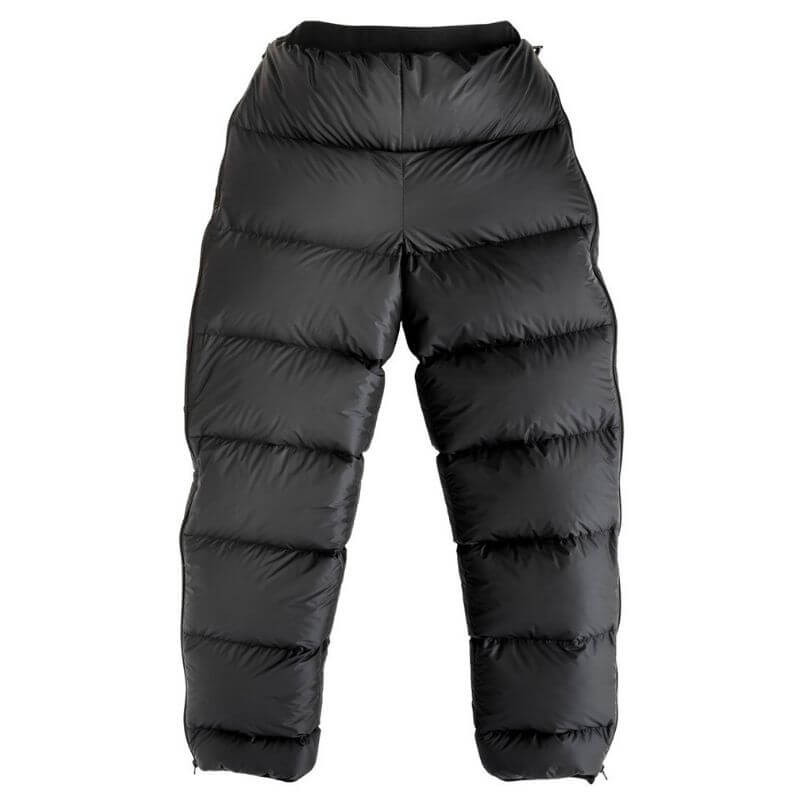
Weight: 13 oz / 368 grams
Fill Weight: 4.4 oz / 126 grams
Pros:
> 900+ loft down.
> Suitable for high mountain activities.
> Full-length zips
> Top Quality Everything
Cons:
> Some people report the length is a bit too short
When you are looking for cold weather gear, Feathered Friends make some the best ultralight down jackets, Down Booties, and Cold Weather Winter Sleeping Bags, so it is a simple pick to have the Helios is my pick for the best overall down pants in this guide.
Filled with 4.4 oz of 900+ fill power goose down, these are among the warmest insulated pants here while still weighing a reasonable 13 oz / 368 grams. You know you are getting real down quality with Feathered Friends, and the full-length side zippers are the killer feature. You can pull them on or off over crampons, ski boots, or heavy winter boots without de-shoeing.
These are built for cold: winter backpacking, ski touring, and high-altitude mountaineering are where they shine, not shoulder-season hiking. The 20D Pertex Quantum Pro shell adds wind resistance and a bit of weather protection that ultralight 10D pairs lack.
There are trade-offs. They are bulkier to pack than the ultralight picks, they have no pockets, and a few users report the inseam runs a little short. The side snaps on the waistband are also occasionally reported to pop open.
Trade-off: maximum warmth and full zips for a little extra bulk and cost.
Best for: winter backpackers, mountaineers, and ski tourers who want the warmest practical pair.
Compare Prices:
Best Warmth to Weight Puffy Pants
Rab Electron Pants
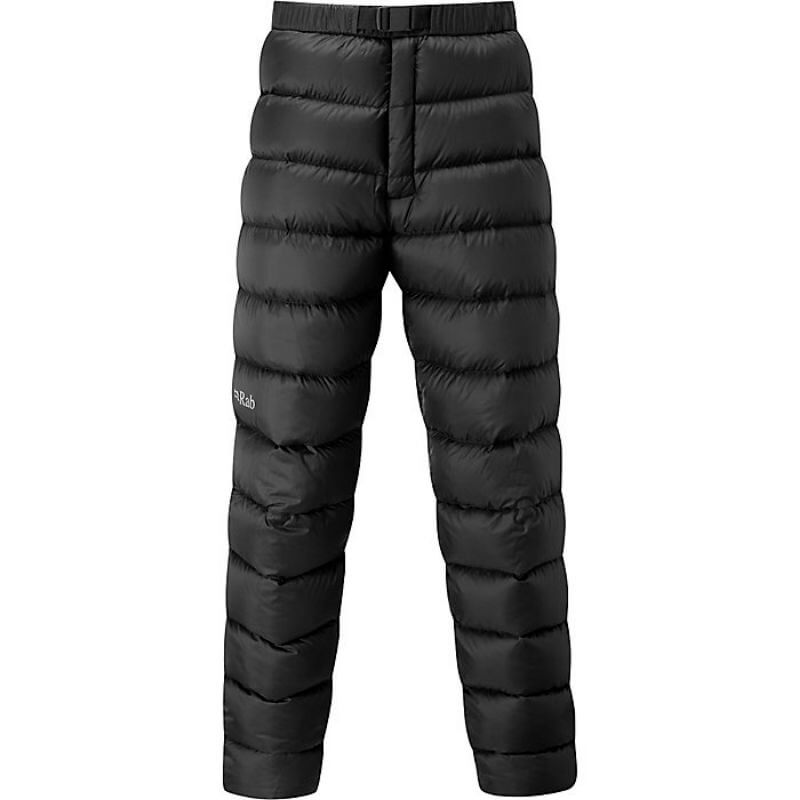
Weight: 13.5 oz / 382 grams
Fill Weight: 5.4 oz / 153 grams
Pros:
> Made of breathable 20D Pertex material.
> Hydrophobic 800 loft RDS Down
> Comfortable and warm
Cons:
> No pockets
> Heavy
The Rab Electron are a seriously warm pair of pants, and the best value winter-weight option in this guide. That 5.4 oz of 800 loft hydrophobic down is a huge fill weight comparable to many expedition-grade pants, yet they cost far less than the Helios or Flight. The Pertex outer is light, windproof, and water-resistant, and the hydrophobic treatment means the down holds loft better than standard down if it gets damp, just like many of their Down Sleeping Bags.
For cold, dry winter conditions these are hard to beat: snowshoeing, backcountry skiing, high-altitude mountaineering, or long evenings at a winter camp. The puffy pants compress well for a warm pair.
The downsides are the missing features. No pockets, and no full-length side zippers, which makes them fiddly to put on or take off outdoors with boots. They run a little snug, so consider sizing up if you layer underneath.
Trade-off: exceptional warmth per dollar, but no zips and no pockets.
Best for: cold, dry winter trips where you will wear them all day or around camp.
Compare Prices:
Best Ultralight Down Pants
Mountain Hardwear Ghost Whisperer Down Pants

Weight: 7.8 oz / 222 grams
Fill Weight: 2.2 oz / 62 grams
Pros:
> 800-fill RDS-certified down
> Two hand pockets.
> Zippered fly with snap button closure.
> Low-profile quilt pattern helps to trap heat
> Made of ultra-lightweight ripstop fabric
Cons:
> Expensive
> Ankle Zips only
The Mountain Hardwear Ghost Whisperer pants are the best-selling ultralight down pants around, and for good reason: they are comfortable, widely available (which usually means you can find them on sale), and easy to live with. If you like the Ghost Whisperer jacket, you will like these. Two hand pockets, a zippered snap fly, and ankle zips are rare conveniences that most ultralight pairs skip, and the low-profile quilt pattern traps heat without looking too puffy.
They suit three-season backpacking, around-camp use, and general winter layering. The fit is roomy without sagging at the waist.
The trade-off is warmth per gram — they are underfilled for the price compared with the Montbell or Flash. The ankle-only zips also mean you still have to de-shoe to get them on.
Trade-off: comfort, pockets, and availability over warmth-to-weight value.
Best for: buyers who want a comfortable, easy-to-find pair rather than a maximised spec.
Check Prices:
Best Premium Ultralight Down Pants
Western Mountaineering Flash Pants

Weight: 6.5 oz / 180 grams
Down Fill: 2 oz / 57 grams
Pros:
> 850+ fill power goose down.
> Reinforced seat material.
> Elastic ankle cuff closures.
> Adjustable waist belt.
> Water repellant.
Cons:
> Limited color options
> Often out of stock and not easy to get
The Western Mountaineering Flash are the classic ultralight down pants, and my go-to when every gram matters. At 6.5 oz they are one of the lightest real down pants you can buy, and they compress to about half the size of a water bottle. The 850 fill power goose down and lightweight ripstop shell are premium through and through, with a reinforced seat material and elastic ankle cuffs to keep drafts out.
They are best for three-season backpacking, fast-and-light alpine starts, and anyone under a strict weight budget. They are noticeably lighter and more compact than fleece or synthetic pants, but they are not built for deep winter, with only 2 oz of fill, they will leave you cold in a real midwinter freeze. They are not as durable as a dedicated pair of Winter Hiking Pants might be better for durability.
The trade-offs are the low total warmth, limited availability, and the price. They skip the full zip to save weight, so expect to de-shoe to get them on.
Trade-off: minimal weight and packability over total warmth.
Best for: ultralight backpackers and fast-and-light alpine trips in mild cold.
Check Prices:
Best Synthetic Insulated Puffy Pants
Patagonia Das Light Pants

Weight: 11 oz / 312 grams
Pros:
> Full-length Side Zippers
> 100% recycled nylon face fabric and insulation
> Will still keep you warm if it gets wet
> Can be used with crampons and ski boots
Cons:
> OK, they are not down pants, but still they are a good pair of insulated pants.
The Patagonia DAS Light are the odd one out here, and deliberately so — they are synthetic, not down. For some trips that is exactly the right call. Synthetic insulation keeps insulating when wet and dries faster, which matters for a pair of pants you might sit in snow with. The full-length side zippers let you use them with crampons and ski boots, and the recycled nylon face fabric is easy to live with.
They suit wet, coastal, or high-output winter use where down is a liability, as well as alpine climbing and mountaineering. They are also the most environmentally considered option here.
The trade-off is weight and compressibility versus down — they are heavier than a comparable down pant and don’t pack as small. They are not the warmest option, but they are the most forgiving in the wet.
Trade-off: wet-weather resilience and durability over warmth-to-weight and packability.
Best for: wet or high-output winter conditions and anyone who prefers synthetic.
Compare Prices:
Best Full Zip Winter Down Pants
Western Mountaineering Flight Pants
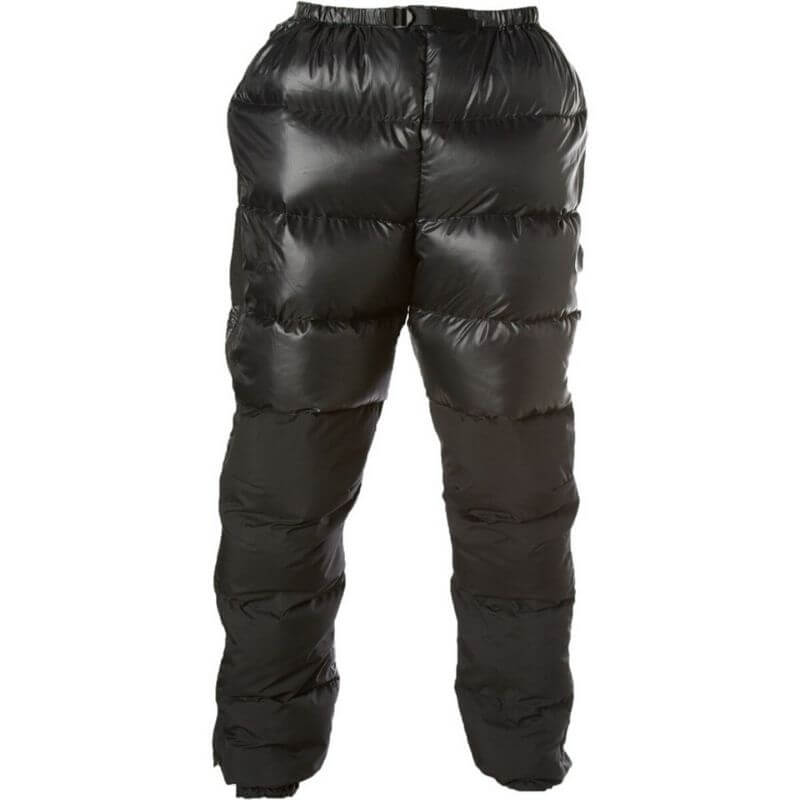
Weight: 12.5 oz / 360 grams
Fill Weight: 4 oz / 115 grams
Pros:
> Elastic ankle cuffs with Velcro closure.
> Full-length side zips.
> Adjustable waist belt
> Microfiber shell fabric with DWR finish.
> Gore Windstopper fabric protects you from the wind.
Cons:
> Expensive
> Limited color selection.
> Retailers are often out of stock
If you want cold weather down pants that can take a beating in the snow, the Western Mountaineering Flight are the pick. The standout here is the Gore WINDSTOPPER fabric over the seat and knees, the exact places that pick up moisture and abrasion when you sit or kneel in snow. The rest of the pant uses a DWR-treated microfibre shell. That makes them the best “on snow” pair in this guide.
They carry 4 oz of 850 fill plus full-length side zips and elastic ankle cuffs, so venting and layering are simple. They suit winter backpacking, snowshoeing, ski touring, and mountaineering.
The trade-offs are price and slightly less warmth per gram than the Rab Electron. There are no pockets, the colour range is limited, and they are aften out of stock and difficult to find.
Trade-off: snow-ready durability, full zips for a premium price and often out of stock.
Best for: winter backpackers and mountaineers who sit and kneel in snow.
Check Prices:
Best Lightweight Down Pants
Montbell Light Down Pants
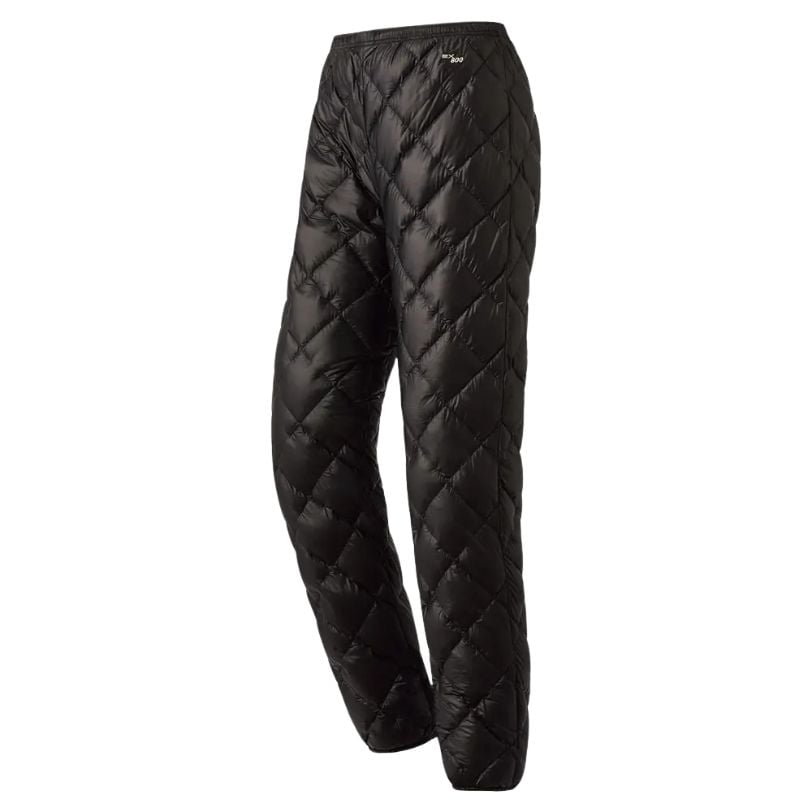
Weight: 6.8 oz / 192 grams
Down Fill: 3 oz / 85 grams
Pros:
> Ultralight
> Small pack size
> Good warmth to weight
Cons:
> Not the warmest down pants in this review
> Very often they are out of stock
For pure ultralight down pants, the Montbell Light are the benchmark, which is why both competitors feature them. At around 6.7 oz with roughly 3 oz of 800 fill, they deliver an excellent warmth-to-weight ratio and are also among the least expensive here. Diamond-shaped sewn-through baffles keep the down evenly distributed, and the whole thing stuffs down to about the size of a water bottle.
They suit three-season and mild winter backpacking, cold evenings at camp, and anyone counting grams for a thru-hike. They are not a deep-winter pair, but for fast-and-light trips they are exactly what I would pack.
The trade-off is durability and features. The 10D shell is thinner than most and needs a bit of care, and the feature set is minimal — no zippers, no pockets, no fly, just an elastic and drawstring waist. Fit runs less polished than pricier pairs.
Trade-off: minimum weight and great value in exchange for a thin shell and no features.
Best for: ultralight backpackers and thru-hikers in mild-to-moderate cold.
Compare Prices:
More Down Pants and Puffy Pants
The Down Pants listed below are ones that almost made the list or are still in the process of being evaluated or are not suitable due to price, availability, or long lead times:
- GooseFeet Gear Custom Down Pants: Custom down pants made to your specifications. Not cheap and long lead times.
Down Pants Buyers Guide
Down Pants Buyers Guide
Weight vs warmth
For down pants, warmth and weight pull in opposite directions, and understanding the balance is the single most useful thing you can take from this guide. Warmth comes from fill weight — the actual grams of down inside — while overall weight includes the shell, zips, and waistband. A pair with 5.6 oz of fill will always be warmer than a pair with 2 oz of fill (like the Western Mountaineering Flash), but it will also weigh and bulk more.
As a rule of thumb, keep a backpacking pair of down pants under about 14 oz. Below that you can find everything from a genuinely winter-warm pair down to a true ultralight summer-camp pair. Choose by the coldest temperature you expect, not the average.
Fill power vs fill weight
These two terms get confused constantly, so let’s be precise. Fill power (measured in cubic inches per ounce) tells you how fluffy and efficient the down is — 800, 850, and 900+ are premium levels. Fill weight tells you how much down is inside, in ounces or grams. Together they determine warmth: multiply fill power by fill weight and you get a meaningful measure of total insulating volume in cubic inches of total loft.
High fill power means better warmth per gram, which is why an 850-fill pair can weigh less than an 800-fill pair and still be just as warm. But fill weight still matters most of all — a 4 oz 800-fill pant is warmer than a 2 oz 900-fill pant.
Shell fabric durability and DWR
Nearly all down pants use ripstop nylon, and the denier tells you how tough it is. Ultralight pairs run 7D–10D; more durable winter pairs run 15D–20D or higher. Higher denier is tougher but heavier, so manufacturers lower it to cut weight. If you expect to wear them hard, go up in denier or look for reinforced seat and knees (the Western Mountaineering Flight adds WINDSTOPPER over those high-wear zones).
A DWR (durable water repellent) finish helps water bead off rather than soaking the down, which loses its loft when wet. Hydrophobic down treatments (like the Rab Electron’s) go further, keeping the down itself from clumping if it does get damp.
Full zip vs no zip
Full-length side zips are the feature that separates a winter pant from a camp pant. They let you pull the pants on and off without removing boots, crampons, or skis, and they give you instant venting. The downside is weight and cost, and a slight cold-seam risk along the zip.
No-zip designs are lighter and simpler, and they are warmer overall, but you will have to de-shoe to get them on, which is miserable in deep snow. If you only wear your pants at camp in the evening, skip the zips. If you wear them over ski boots or crampons, get full zips.
Fly and waist
A zippered or snap fly makes them behave more like real pants and eases on-and-off. An adjustable drawcord or belt waist is worth it. You want the pants to stay up over base layers without a cold gap. Elastic ankle cuffs (or drawcord hems) keep drafts and snow out, which matters more than most people expect.
Down vs synthetic for winter and thru-hiking
Down wins on warmth-to-weight and compressibility, and if cared for it lasts for decades. Synthetic (like the Patagonia DAS Light) wins on wet performance — it keeps insulating when soaked, dries faster, is easier to wash, and costs less.
For a dry alpine or interior winter, pick down. For a wet, coastal, or high-output trip where your legs will see moisture, synthetic is genuinely the better tool. This is also why I keep the DAS Light on this list despite it not being down.
Temperature and use-case guidance
- Summer / shoulder-season camp, above 40°F: 2–3 oz of fill is plenty. Look at the ultralight pairs (Montbell Light, Western Mountaineering Flash).
- Freezing evenings, 20–30°F: 3–4.5 oz fill. A balanced pair like the Ghost Whisperer or GooseFeet in a mid configuration.
- Deep winter, below 20°F: 4.5 oz of fill and up. The Helios, Rab Electron, or Flight are the right tools, ideally with full zips.
- Wet or high-output winter: synthetic (DAS Light) or hydrophobic down (Rab Electron).
- Ski touring and crampons: full-length side zips (Helios, Flight, DAS Light).
Price and value
Down pants are not cheap. Budget pairs start around the low $200s, and premium pairs climb past $300. The best value in this category is often not the cheapest, but the one that matches your temperature needs — the Rab Electron delivers near-expedition warmth for a mid-tier price, while the Montbell Light is exceptional warmth for the money at the ultralight end. Pay more only for a specific feature (full zips, WINDSTOPPER panels) or for custom fit.
Washing, drying, and storage
Wash down at least once a season with a dedicated down wash (Nikwax or Grangers), close all zips and snaps first, and spot-clean stains. Tumble dry on low with a couple of clean tennis balls to re-loft, checking every 20–30 minutes. Store down hanging or loose in a breathable bag, never compressed long-term, or the loft clumps and creates cold spots. Check out the guide on How to Wash A Down Jacket which is the same guide as washing down pants.
Repair Down Pants
If you wear down pants during extreme outdoor activities they will inevitably get torn, punctured, or even burned. As long as the damage is minimal you can fix it with Tenacious Tape. You could even use Duct Tape if needed.
Conclusion
All the down pants in this review are the best of the best. But which ones are best suited to what you are looking for. Below is the guide you will need:
- Best Overall: Feathered Friends Helios Down Pants
- Best Warmth-to-Weight (Winter): Rab Electron Pants
- Most Popular Ultralight Down Pants: Mountain Hardwear Ghost Whisperer Down Pants
- Best Ultralight Premium: Western Mountaineering Flash Pants
- Best With Full Zips for Snow: Western Mountaineering Flight Pants
- Best Synthetic Alternative: Patagonia Das Light Pants
- Best Lightweight: Montbell Light Down Pants
Frequently Asked Questions
What are the best down pants for backpacking?
For most backpackers, the Feathered Friends Helios is the best all-round down pant — warm, well-built, and easy to layer with full side zips. If weight is your priority, the Montbell Light Down Pants are the best ultralight choice, and the Western Mountaineering Flash is the premium ultralight option.
Are down pants worth it?
Down pants are worth it if you regularly camp or hike below freezing. They add a surprising amount of warmth for roughly 7–13 oz, and they are usually not much more expensive than a comparable winter mid-layer. If you only camp in mild conditions, a light pair of fleece or synthetic pants may serve you better.
What are the warmest down pants?
The Rab Electron packs the most fill for the weight here — 5.6 oz of 800 hydrophobic down — while the Feathered Friends Helios uses 900+ fill for outstanding warmth. In absolute terms, expedition pieces like the Feathered Friends Volant are warmer still, but they are overkill for most backpacking.
Are down pants better than synthetic insulated pants?
Down pants have a better warmth-to-weight ratio and compress smaller, and they last longer with care. Synthetic pants insulate better when wet, dry faster, cost less, and wash far more easily. Choose down for dry cold and synthetic for wet or high-sweat conditions.
Are down pants waterproof?
No. Down pants are water-resistant at best, through a DWR shell and sometimes hydrophobic down treatment, but they are never waterproof. If down gets soaked it loses loft and warmth. Keep down pants under a shell in rain, and consider synthetic if you expect wet conditions.
What fill power do I need for down pants?
Anything from 800 up is excellent for down pants; 850 and 900+ are premium. Fill power is about quality per ounce, but fill weight matters more for actual warmth — a 4 oz fill of 800-fill down is warmer than a 2 oz fill of 900-fill down.
How do I wash down pants?
Wash them at least once a season in a front-loading machine with a dedicated down wash, close all zippers and snaps first, then tumble dry on low with a couple of tennis balls to restore loft. Never store them compressed for long periods.

BikeHikeSafari Gear Review Process
The author, Brad McCartney from BikeHikeSafari is a small independent adventurer and outdoor gear tester who owns and runs BikeHikeSafari.com.
BikeHikeSafari is not part of a large blog network and is proudly independent. All reviews on this site are independent and honest gear reviews of outdoor products by the author.
The author, Brad McCartney is a very experienced triple crown thru-hiker, adventurer, and bike tourer having spent 1000s of nights sleeping in a tent and sleeping bag (Read more). He was a manager of an outdoor retail store and is very experienced in what is important when using and testing gear for reviews like this.
BikeHikeSafari will never receive any money for reviews and they do not accept sponsored reviews on this website. All the comments about the gear reviews are from the author based on his years of experience. Hope this independent review was helpful for you.

