

On the PCT thru-hike I carried a 10,000 mAh power brick because I was scared of running flat between resupplies but felt I needed more. On the Te Araroa I carried a 20,000 mAh and never once ran out. If you are also carrying a backpacking camera, Handheld Hiking GPS, or GPS Hiking Watch then it will be handy to charge all of them at the same time as you are charging your phone. That gap between what you think you need and what you actually use is the whole point of this guide. It is written for thru-hikers, backpackers and bikepackers who count grams, not for people charging a tablet at a campground. For some people, a Lightweight Portable Solar Charger is also a good option.
I have hiked the Triple Crown and the Te Araroa, toured on a loaded bike across several continents, and managed an outdoor retail store, so I have watched this category go from heavy plastic bricks to carbon fibre power banks that weigh less than a chocolate bar.
My current top pick is the Nitecore NB10000 Gen 4, with the Nitecore NB Air 5000 as the best ultralight option. The trade-off you need to understand before buying is simple: capacity, weight and charging speed, and you only get to prioritise two.
Jump to the Quick Picks below, or read on for the full testing notes. For how I research and field-test gear, see the Gear Review Policy.
Quick Picks: Best Backpacking Power Banks
- Best Overall: Nitecore NB10000 Gen 4 – 143 g for a genuine 10,000 mAh, dual USB-C and an IPX7 rating. It is the best weight-to-capacity ratio you can buy right now and the one I would hand to any thru-hiker without asking about their trip.
- Best Ultralight: Nitecore NB Air 5000 – 89 g and 9.7 mm thick. Enough to get a phone from flat to full once, which is all a fastpacker or weekend hiker on a two-nighter actually needs.
- Best For Thru-Hiking: Nitecore NB20000 Gen 3 – 291 g and 20,000 mAh. The right call for five-plus day carries, desert stretches with no town power, and anyone running a phone plus a satellite messenger plus a headlamp.
- Best Durability And Waterproofing: Nitecore Carbo 10000 Gen2 – 170 g, 30 W both ways and IPX8, which is full submersion rather than splash. The one I would take on a wet shoulder-season trip or packrafting.
- Best High Output For Cameras And Laptops: Anker 737 24,000 Power Bank (PowerCore 24K) – 607 g and 140 W. Too heavy for a thru-hike, right for bike touring, photography trips and anyone charging a laptop off-grid.
- Best Slim And Fast: Flextail Zero Power 10000 – 145 g and only 9.9 mm thick, which matters more than you think when you are sliding it into a hip belt pocket alongside a phone.
- Best Budget: INIU Carry Power Bank 10,000 – around 180 g, 10,000 mAh, more than half the price of the Nitecore. No IP rating, so it lives in a dry bag, but the value is hard to argue with.
- Best Wireless: INIU 10000 mAh Magsafe Wireless Portable Charger – magnetic charging while you keep using the phone, at a weight penalty over a comparable cabled bank. Handy for bike touring and navigation-heavy days.
How We Tested
The power banks in this guide are researched and, where possible, field-tested by an experienced long-distance hiker and former outdoor store manager. Across thru-hikes, shoulder-season trips, and bikepacking trips, I judge power banks on usable capacity per gram, charging speed in and out, packability, weather resistance, cold weather performance, durability, and value for serious backpacking. Some of the items were supplied by the manufacturer and some items were purchased by the author for this review. For more on how we research and review gear, see the BikeHikeSafari Gear Review Policy.
Follow along on Social Media
Power Bank Comparison Table
| Brand | Weight | Capacity mAh | Outlets |
|---|---|---|---|
| Nitecore NB10000 Gen 4 | 5 oz | 10,000 | 2 x USB-C |
| Nitecore NB Air 5000 | 3.1 oz | 5,000 | 1 x USB-C |
| Nitecore NB20000 Gen 3 | 10.2 oz | 20,000 | 2 × USB-C, 1 x USB-A |
| Nitecore Carbo 10000 Gen2 | 6 oz | 10,000 | 2 x USB-C |
| Anker 737 24,000 | 1 lb. 5.4 oz | 24,000 | 2 x USB, 1 x USB-A |
| Flextail Zero Power 10000 | 5.1 oz | 10,000 | 1 × USB-C, 1 x USB-A |
| INIU Carry Power Bank 10,000 | 6.3 oz | 10,000 | 1 × USB-C, 1 x USB-A |
| INIU 10000 mAh Magsafe Wireless Portable Charger | 6.9 oz | 10,000 | Wireless, 1 x USB-C |
Best Battery Packs For Backpacking 2026: Detailed Reviews
Best Backpacking Power Bank – Overall
Nitecore NB 10000 Gen 4
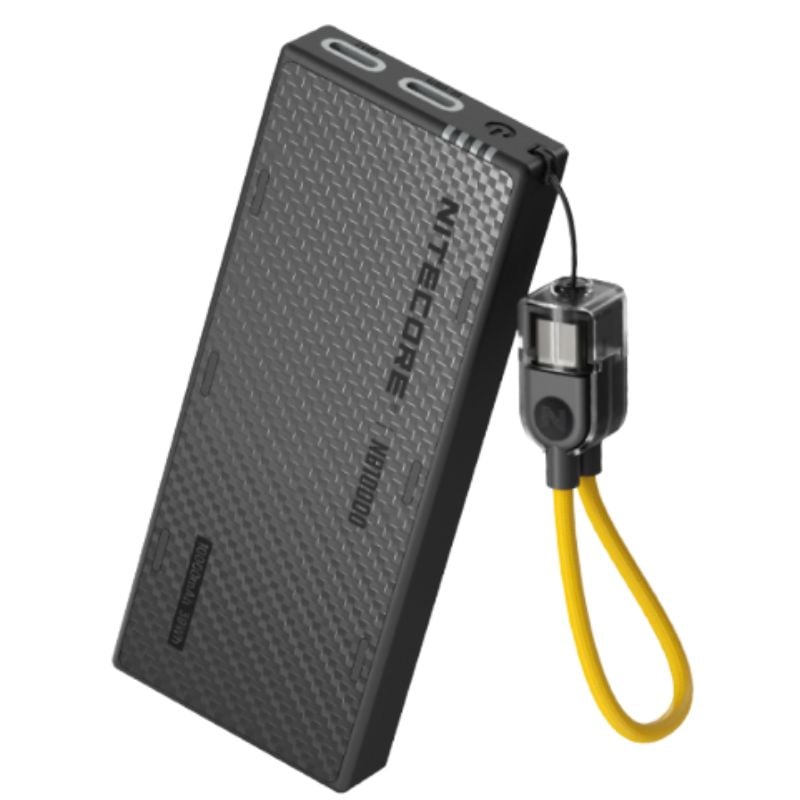
Weight: 5 oz / 143 grams
Pros:
> Ultralight
> 10000 mAh capacity
> Compact Size
Cons:
> Not much
This is the bank that finally makes the old weight-versus-capacity argument boring. At 5 oz / 143 g for a full 10,000 mAh, the NB10000 Gen 4 delivers roughly 2,000 mAh per ounce, which is the best ratio in the category and about 15 percent better than a comparable Anker. The carbon fibre composite shell is what buys you that, and it is stiff enough that I have no concerns about it living loose in a pack lid.
It suits almost every backpacking trip up to four or five days between charges. Two full phone recharges from a modern iPhone or Pixel is the realistic figure once you account for conversion loss, which covers a standard three-day weekend with navigation running, or four days if you are disciplined about airplane mode.
On trail the two things you notice are the dual USB-C ports and the IPX7 rating. Pass-through charging means one cable into the bank and one out to the phone in a resupply town, and you wake up with both full. IPX7 means an accidental river ford or a night in a wet tent vestibule is not a disaster, which is not true of most budget banks. The Gen 4 also bumped input to 22.5 W over the Gen 3’s 18 W, so a town stop is roughly three hours rather than four.
The honest trade-off is price. It costs around three times an INIU or Anker bank of the same capacity, and you are paying for grams and waterproofing rather than more power. If neither of those matters to you, buy cheaper.
Trade off: highest price per mAh in the guide, in exchange for the lowest weight per mAh.
Best for: any thru-hiker or backpacker doing three to five day carries who wants one bank and no compromises.
Compare Prices:
Best Ultralight Power Bank
Nitecore NB Air 5000
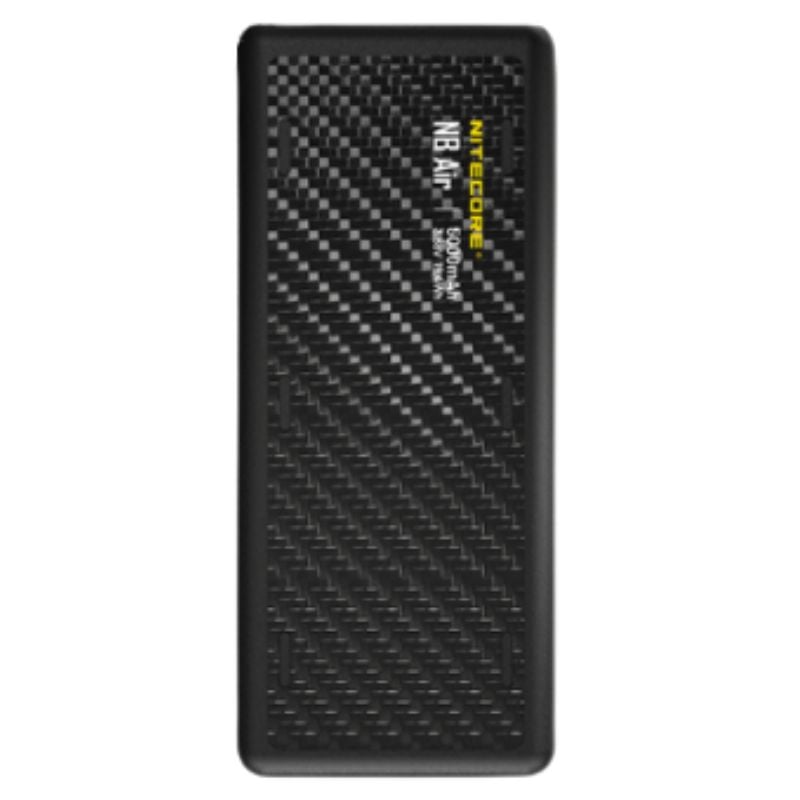
Weight: 3.1 oz / 89 grams
Pros:
> Ultralight
> 5000 mAh capacity
> Very Compact Size
Cons:
> Not much
Eighty-nine grams is less than a lot of people’s phone case, and that is the whole argument for the NB Air. It gives you one full phone recharge with a little left over, and it does it in a slab thin enough to disappear into a running vest or a shorts pocket.
This is a fastpacking, trail running and weekend hiking battery, not a thru-hiking one. On a two-night trip with the phone in airplane mode and GPS used sparingly, one recharge is plenty. On a five-day carry it is not, and no amount of careful power management will change that.
What it does well beyond the weight is the IPX7 rating and the low-current mode, which means it will actually charge a watch or a set of earbuds rather than shutting off because the draw is too low. That is a genuine annoyance with cheap banks and it is solved here. The single port is the obvious limitation: you cannot charge the bank and a device at once, so town stops need sequencing.
In many cases it is better to pair two of these before carrying a heavier single bank on some trips, since 178 g gets you 10,000 mAh split across two units with full redundancy if one fails.
Trade off: one port and one phone charge, in exchange for the lightest bank worth owning.
Best for: fastpackers, trail runners, weekend hikers, and as a backup bank alongside a solar panel.
Compare Prices:
Best Battery Pack for Thru Hiking
Nitecore NB 20000 Gen 3
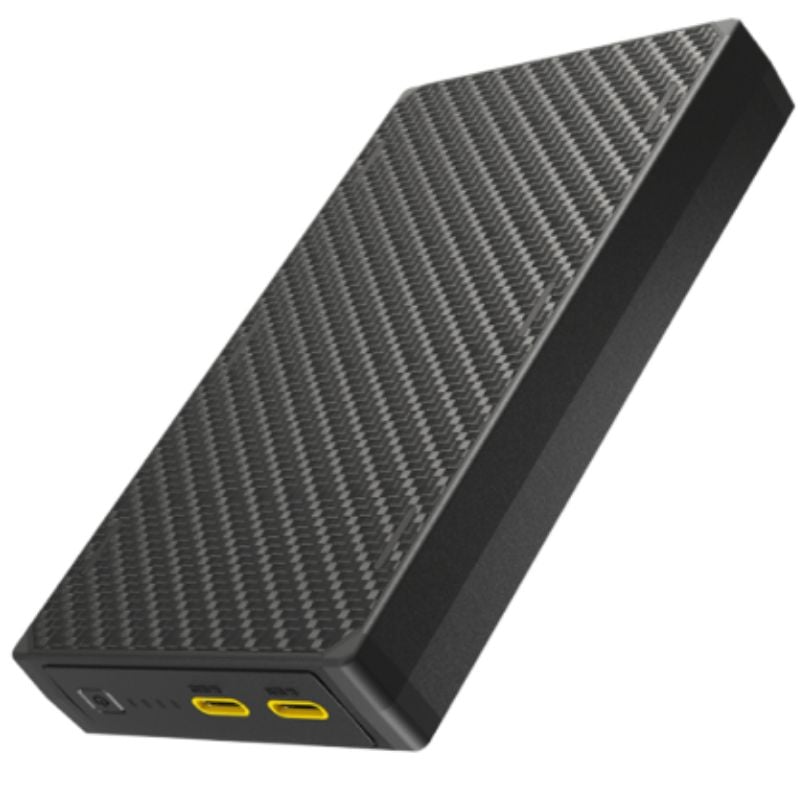
Weight: 10.2 oz / 291 grams
Pros:
> Weighs only 10.2 which makes it ultralight for 20,000 mAh
> Lightweight and strong carbon fiber
> Perfect for thru-hiking
Cons:
> More than 4 hours to recharge
This was the best overall pick on the previous version of this guide and it is still the right bank, just for a narrower job. At 291 g for 20,000 mAh it runs about 1,940 mAh per ounce, which is almost identical to the NB10000 Gen 4 in efficiency terms — you are not paying a weight penalty for the extra capacity, you are just carrying more of it.
Where it earns its place is long carries. Desert sections with no town power, the long stretches on the CDT, a week of bike touring through remote country, or any trip where you are running a phone, an inReach and a headlamp off one source. Four realistic phone charges is the number that matters.
The carbon fibre composite shell keeps it stiff and it supports pass-through charging, so a single wall charger in a resupply town tops up bank and phone together. Recharge time is around four and a half to five hours from flat at 18 W input, which is the one thing that annoys me — that is a long lunch in town, not a quick top-up.
The IPX5 rating is a step down from the NB10000 Gen 4’s IPX7. Splash resistant, not submersion proof. It goes in a dry bag on wet trips.
Trade off: nearly 300 g and a five-hour recharge, in exchange for genuine multi-day independence.
Best for: thru-hikers on long carries, desert sections, bike tourers, and anyone charging multiple devices.
Compare Prices:
Most Durable and Waterproof Battery Bank
Nitecore Carbo 10000 Gen 2
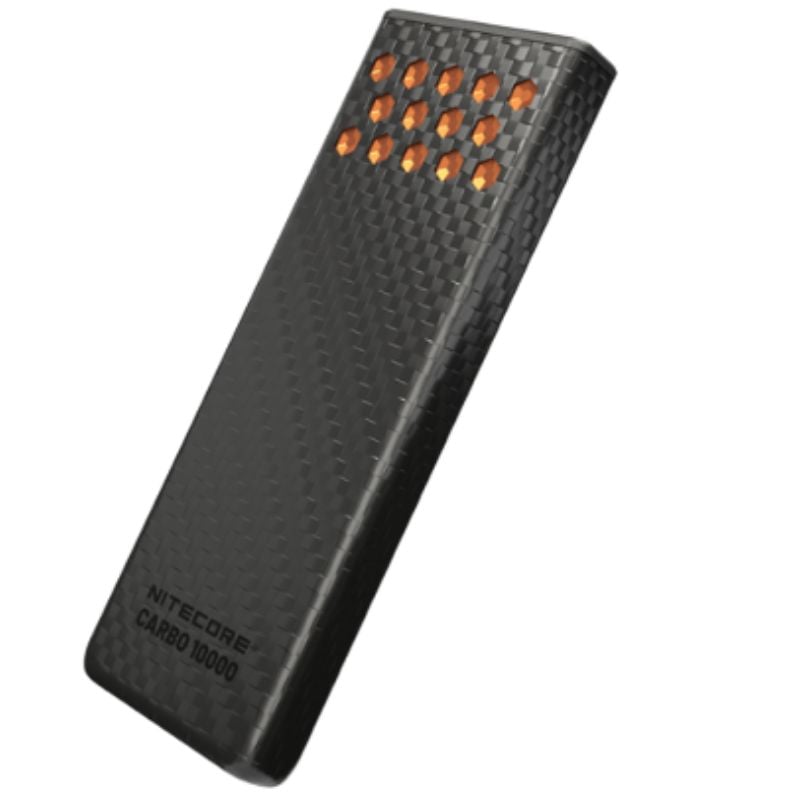
Weight: 6 oz / 170 grams
Pros:
> Ultralight 6 oz
> IPX 8 Waterproof
> 40 minute fast recharge
> Durable carbon fibre shell
> Perfect for packrafting or wet season trips
Cons:
> Heavier than other 10,000 batteries
The Carbo 10000 Gen2 is the bank I would choose for genuinely wet trips. IPX8 means rated for continuous submersion rather than splashes, and it is the only rating at that level in this guide. On the Te Araroa, where you are fording rivers with a pack on and rain is the default weather, that difference stops being theoretical.
It costs you 27 g over the NB10000 Gen 4 for the same 10,000 mAh, and in exchange you get the waterproofing plus 30 W two-way charging instead of 22.5 W. That faster input matters more than the output number suggests: a full recharge in 40 minutes, which is the difference between waiting and not waiting.
Build quality is a step up too. Carbon fibre shell with magnesium alloy heat sinks, which is over-engineered for what it is but does mean it runs cooler under a 30 W load. The rounded corners are a small thing that stops it catching on pack liners.
The Gen2 upgrade over the original Carbo added the second USB-C port, higher rated energy, faster input and the better waterproofing, so make sure you are buying the Gen2 and not older Gen1 stock.
Trade off: 27 g heavier than the NB10000 Gen 4 for waterproofing and faster charging.
Best for: wet-climate trekking, packrafting, shoulder-season trips, New Zealand and Tasmania.
Compare Prices:
Best High Capacity for Laptops
Anker 737 24,000 Power Bank
Weight: 1 lb. 5.4 oz / 607 grams
Pros:
> High Capacity Battery
> Incredibly fast charging
> Can even charge a laptop such as an Apple Mac!
> TSA safe for flying
Cons:
> Heavy
> A little expensive
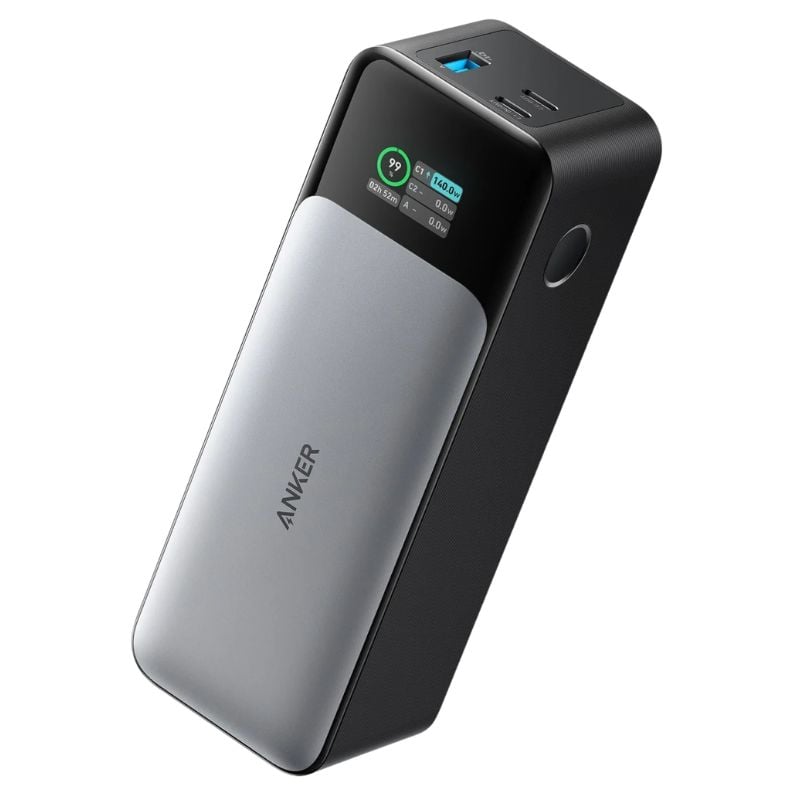
This replaces the Anker 737 PowerCore III Elite 25600 that used to sit on this page. The current model is the PowerCore 24K, and the important change is 140 W USB-C PD 3.1 output, which is enough to charge a MacBook Pro at close to full speed off-grid.
Let me be clear about who this is not for. At 607 g it is more than twice the weight of the Nitecore NB20000 Gen 3 for only 20 percent more capacity. No thru-hiker should carry this unless you need to charge drone batteries on the trail. The mAh per ounce maths is poor and the volume is worse.
Who it is for is bike tourers, photographers and anyone working from the road. If you are carrying a mirrorless camera with three batteries, a drone and a laptop, this charges all of them properly rather than trickling. The smart display showing real-time input and output wattage and remaining time is genuinely useful when you are budgeting power in a campground with 40 minutes of outlet access.
At 87.36 Wh, it is under the 100 Wh carry-on limit, so it is TSA flight safe, but it is close enough that airline staff occasionally ask. Keep the printed Wh figure visible and keep up to date with any changes to flight regulations.
Trade off: far too heavy for hiking, but nothing else here charges a laptop at speed.
Best for: bike touring, van life, photography trips, base camps, off-grid work.
Compare Prices:
Thinnest Backpacking Power Bank
Flextail Zero Power 10000C
Weight: 5.1 oz / 145 grams
Pros:
> Very Lightweight
> Thin profile
> Made with strong and light carbon fibre
Cons:
> Not much
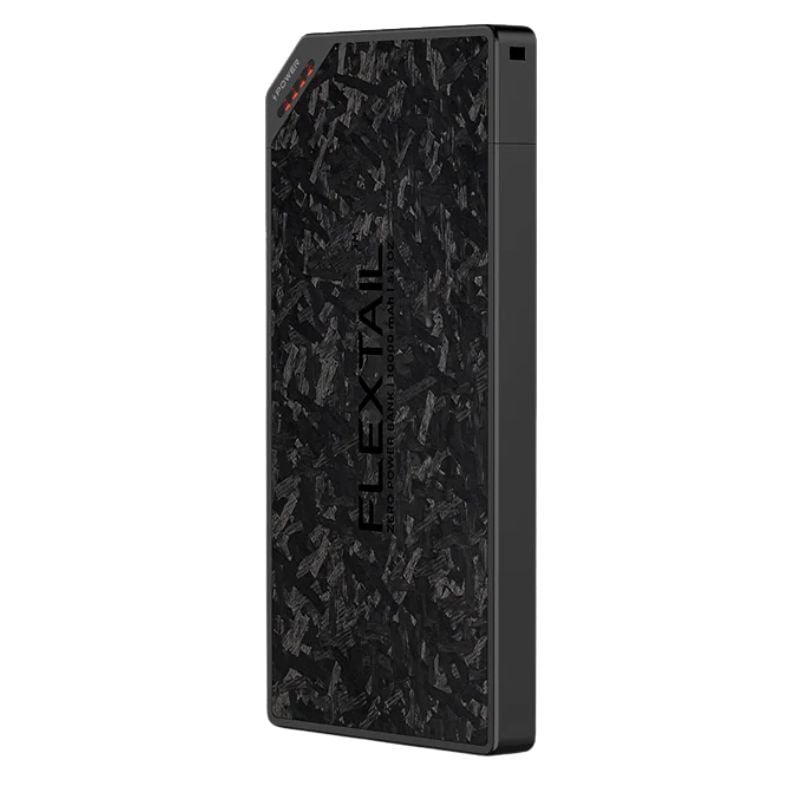
Flextail’s pitch is thinness rather than raw weight, and at 9.9 mm it delivers. That matters more than the spec sheet suggests: a 10 mm slab sits flat against your back panel or slides into a hip belt pocket next to a phone, where a 16 mm brick does not.
At 145 g it is within 2 g of the Nitecore NB10000 Gen 4, so on weight alone it is a coin toss. The differentiators are the shape, the efficiency mode that trades charging speed for roughly 30 percent more usable energy, and an emergency reserve that holds back the last 10 percent so you always have something for a map check or an emergency call.
That reserve feature is smarter than it sounds. The most common power bank failure on trail is not the bank dying, it is you draining it on day two watching downloaded video and having nothing on day four.
The weakness is the IPX4 rating. That is splash resistance only, well below the NB10000 Gen 4’s IPX7 and the Carbo Gen2’s IPX8. In sustained rain it needs a dry bag. For desert and dry-climate trips that is irrelevant, and this becomes a strong pick.
Trade off: IPX4 only, so it needs protection in the wet, but nothing else this thin exists.
Best for: dry-climate thru-hikes, ultramarathons and fastpacking, anyone packing into tight hip belt pockets.
Compare Prices:
Best Budget Power Bank For Hiking 2026
INIU Carry Power Bank 10,000
Weight: 6.3 oz / 180 grams
Pros:
> Great price
> Fast charge
>
Cons:
> Not as light as some other battery banks in this review
This is the budget pick and it replaces the Anker 313 that used to sit here. At more than half the price of the Nitecore NB10000 Gen 4 and only about 37 g heavier, the value is genuinely hard to argue with.
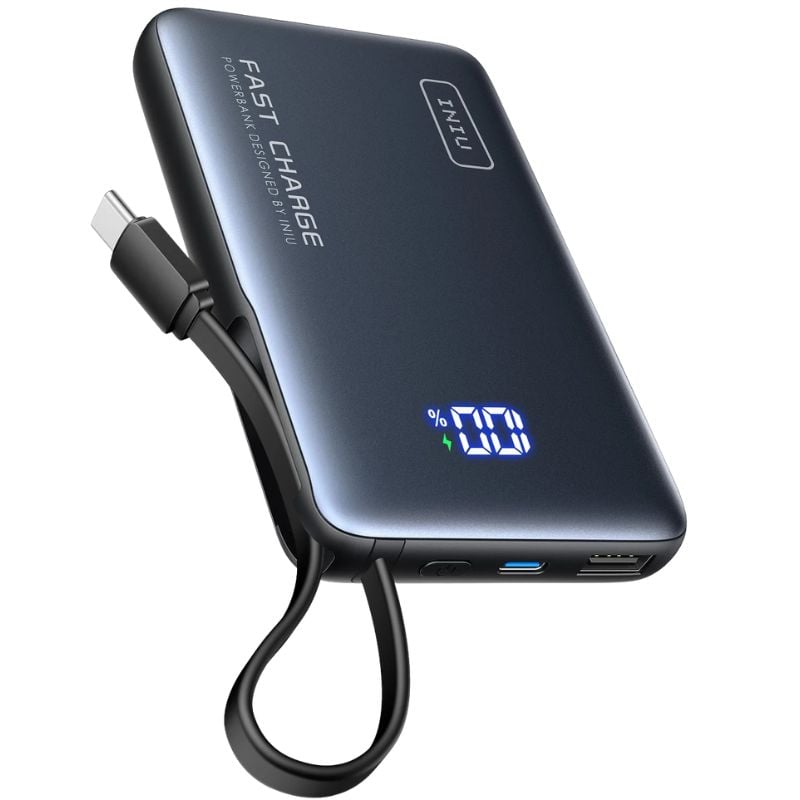
The integrated USB-C cable doubles as a carry lanyard, which is one less cable to lose. There is a digital percentage display rather than the four LED dots you get on most cheap banks, which sounds trivial until you are trying to decide whether to ration power on day four.
The compromises are real. There is no IP rating at all, so it lives in a dry bag or a zip lock, no exceptions. It is chunky rather than slim, about 18 mm thick, which is awkward in a hip belt pocket. And you are trusting a value brand with a lithium cell, so buy from a reputable retailer and register the warranty.
Trade off: no weather rating and a bulky shape, in exchange for the best price and the fastest output here.
Best for: budget-conscious backpackers, shared use, dry climates, and anyone who wants fast charging without the Nitecore price.
Compare Prices:
Best Wireless Power Bank For Backpacking 2026
INIU 10000 mAh Magsafe Wireless Portable Charger
Weight: 6.9 oz / 195 grams
Pros:
> This power bank has wireless charging and USB-C charging
> Lightweight
> Very compact size
Cons:
> Not cheap
Wireless charging on trail is a convenience feature, not an efficiency one, and it is worth being honest about that up front. Magnetic wireless transfer loses meaningfully more energy than a cable, so you get fewer real charges out of the same 10,000 mAh.
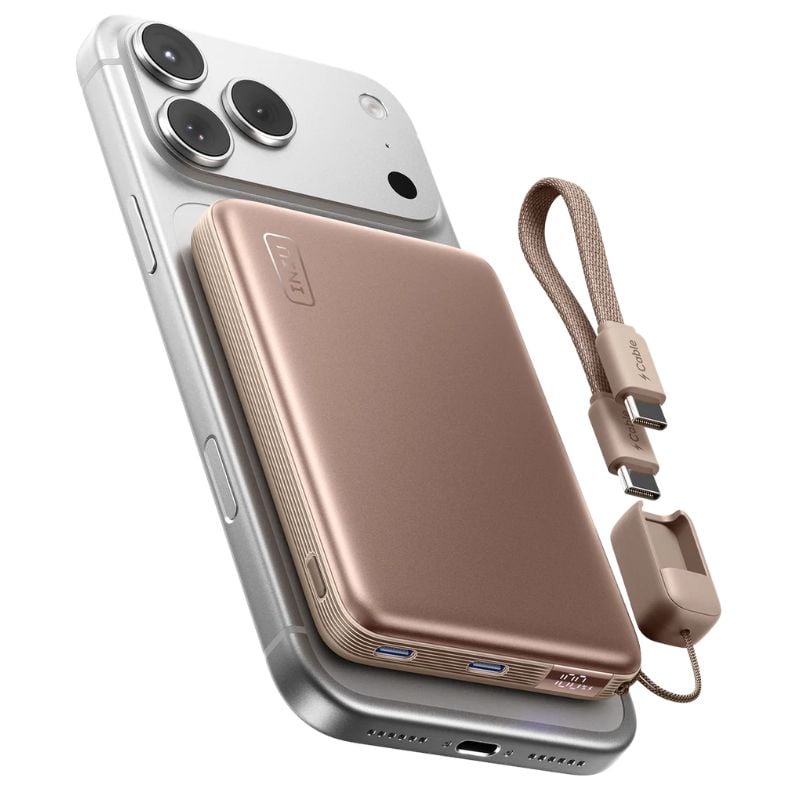
What you get in return is the ability to keep using the phone while it charges, with the bank stuck to the back of it. On a bike touring day where the phone is running navigation on the bars, or on a long road walk where you are taking photos, that is genuinely useful. Cables snag, magnets do not.
At around 195 g it is roughly 50 g heavier than the NB10000 Gen 4 for the same rated capacity and less usable output, so on a gram-counting thru-hike this is the wrong choice. The USB-C port is there when you want the efficiency back.
The other caveat is that magnetic hold strength varies a lot with phone case thickness. With a thick case it will slide off in a pocket. Test the combination at home before a trip.
Trade off: heaviest real-world cost per usable mAh here, in exchange for cable-free charging while you use the phone.
Best for: bike touring, navigation-heavy days, anyone already committed to a MagSafe phone setup.
Compare Prices:

Power Banks Buyers Guide
Portable Backpacking Power Banks Buyers Guide
Rated Capacity vs Usable Capacity
The single most misunderstood number in this category is the one printed on the box. A 10,000 mAh power bank does not deliver 10,000 mAh to your phone. Cells are rated at around 3.6 to 3.9 volts internally, your phone charges at 5 volts, and the conversion between them loses energy as heat. Add standby drain and cable losses and you land at roughly 60 to 70 percent of the printed figure reaching your device.
Manufacturers who are honest about this publish a “rated energy” or “rated output” number alongside the headline capacity. The Nitecore NB10000 Gen 4 lists 6,800 mAh rated output at 5 V from a 10,000 mAh cell. The NB20000 Gen 3 lists about 11,220 mAh from 20,000 mAh. Those are the numbers to plan around.
In practice, assume a 10,000 mAh bank gives you two full charges of a modern smartphone, a 20,000 mAh bank gives you four, and a 5,000 mAh bank gives you one. If your trip planning depends on getting three charges out of a 10K, you have already made a mistake.
Watt-Hours, mAh And Why Airlines Only Care About One
Milliamp hours are meaningless without a voltage. Watt-hours are the real unit of stored energy, and it is the only one airlines use. Multiply mAh by nominal voltage and divide by 1,000 to get Wh: a 10,000 mAh bank at 3.9 V is 39 Wh, and a 20,000 mAh bank is around 72 to 74 Wh.
The rule most carriers follow is 100 Wh in carry-on, never in checked baggage, with 100 to 160 Wh requiring airline approval and usually limited to two units. That works out to roughly 27,000 mAh as the practical ceiling. Every bank in this guide is under it, including the Anker 737 at 87.36 Wh, though at that size expect to be asked about it at the gate.
Two changes worth knowing about. Several airlines now restrict using a power bank in flight or require it to be visible rather than stowed in an overhead bin, and rules vary by carrier rather than by country. Check your specific airline before a long-haul with a big bank. And when comparing banks, use Wh rather than mAh, because a bank quoting 10,000 mAh at 3.6 V holds less energy than one quoting 10,000 mAh at 3.9 V.
Weight vs Capacity: The mAh Per Ounce Test
The honest way to compare backpacking power banks is capacity divided by weight. Anything above about 1,900 mAh per ounce is excellent, 1,500 to 1,900 is acceptable, and below 1,300 means you are carrying dead weight.
Carbon fibre banks sit at the top of that range. The Nitecore NB10000 Gen 4 at 143 g for 10,000 mAh runs around 2,000 mAh per ounce, the NB20000 Gen 3 around 1,940, and the Flextail Zero Power close behind. A conventional plastic-shelled Anker 10,000 at 244 g runs around 1,160, which means over a 10,000 mAh capacity you are carrying roughly 100 g of nothing useful.
Where this argument gets interesting is that the ratio barely changes between 10K and 20K in the premium banks. That means the capacity decision is purely about trip length rather than about a weight penalty for going bigger. Work out how many days between charges, multiply by your daily phone drain, add a margin, and pick the smallest bank that covers it.
Charging Speed, Input And Output Wattage
Output wattage determines how fast your phone charges. Input wattage determines how fast the bank refills. For backpacking, input is the number that actually shapes your day.
A resupply stop is often two hours in a café with one power outlet and a coffee you have already finished. A bank that takes five hours to refill at 18 W input means you either wait, or you leave town with a partial charge. The NB10000 Gen 4 at 22.5 W input refills in around three hours. The Carbo 10000 Gen2 at 30 W does it in under three. A 20,000 mAh bank at 18 to 20 W input needs four and a half to five hours, which realistically means an overnight in a hostel.
You also need a wall charger capable of supplying that wattage. Pairing a 30 W-capable bank with a 12 W phone plug wastes the feature entirely. Carry a small GaN charger rated at or above your bank’s input.
Output matters less than people think for hiking. A phone charging at 18 W versus 22.5 W is a difference of a few minutes on a full charge. It only becomes important if you are charging a laptop or multiple devices simultaneously.
Ports, Cables And Pass-Through Charging
Two USB-C ports is the configuration to look for, and USB-A is now legacy. Two ports means you can charge two devices, but more importantly it means pass-through charging: the bank recharges from the wall while simultaneously charging your phone from its other port. One wall outlet, one overnight, everything full. Single-port banks like the NB Air force you to sequence, which is fine on a weekend and painful on a thru-hike.
Bidirectional ports matter too. On some banks only one port accepts input. Check which one, because plugging the wall charger into the wrong port at 11 pm and waking up to an empty bank is a mistake most people only make once.
Integrated lanyard cables are increasingly common and genuinely useful. They double as a carry loop, they weigh a few grams, and they remove a failure point from your kit. The counter-argument is that a fixed cable is a wear point you cannot replace, so I still carry one short spare USB-C cable regardless.
Finally, check low-current mode. Watches, earbuds and some headlamps draw so little that a bank will decide nothing is connected and switch itself off. Nitecore banks handle this properly. Many cheap banks do not.

Waterproofing And IP Ratings On Trail
IP ratings are not marketing noise in this category, they are the difference between a working bank and a dead one on day three. The scale that matters here runs IPX4 splash resistant, IPX5 low-pressure jets, IPX7 immersion to one metre for 30 minutes, IPX8 continuous immersion.
For dry climates, IPX4 is genuinely enough. For anywhere with sustained rain, river fords, or a tent that might flood, IPX7 or better changes the calculation. The Nitecore NB10000 Gen 4 is IPX7 and the Carbo 10000 Gen2 is IPX8, which is the only full submersion rating here.
None of this replaces a dry bag. Any bank with no rating at all — the INIU Pocket Rocket, the Anker Zolo — goes in a waterproof stuff sack or a zip lock, every time, no exceptions. A rated bank in a dry bag is belt and braces, and after watching a friend’s unrated bank die in a Fiordland downpour I have never regretted it.
Cold Weather Performance
Lithium cells lose capacity as they get cold. Below freezing you can expect meaningful losses, and at -20°C a standard bank may refuse to output at all. This catches people out on alpine starts, winter traverses and high-altitude treks where the bank spent the night in a pack outside the sleeping bag.
The simple fix costs nothing: sleep with the bank and the phone inside your sleeping bag, and keep them in an inside jacket pocket during the day. Body heat keeps the cells in their working range and you will get most of your capacity back.
The equipment fix is the Nitecore Summit 10000, which has a heating element that warms cells before delivering power and is rated for operation to -40°C. For genuine winter use that is worth the 175 g. For three-season hiking it is not.
Also note that fast charging usually disables itself in the cold. Charging a bank at 2°C in an unheated hut will be slow regardless of the wattage rating.
Durability, Case Materials And Battery Ageing
Carbon fibre composite shells are the reason the premium banks weigh what they do, and the stiffness is real. A carbon shell resists the torsion that cracks cheap plastic banks when they get compressed under a full pack. The Carbo 10000 Gen2 adds magnesium alloy heat sinks, which keeps it cooler under load and extends cell life.
Batteries also age. Expect meaningful capacity loss after three to four years of regular cycling, and faster if you routinely store the bank fully charged or fully flat. Store long-term at around 50 to 60 percent charge in a cool place, and top it up every few months rather than leaving it flat for a season.
Old banks are also the ones that fail dangerously. Swelling, heat during charging, or a case that no longer sits flat all mean retire it. And check recall databases before trusting an older unit — the Anker PowerCore 10000 (model A1263) was recalled in 2025 across more than a million units for fire risk, and a lot of those are still sitting in gear drawers.

Solar Panel Or Power Bank?
For most backpacking, a power bank alone wins. Solar panels add weight, they only work in direct sun at a decent angle, and hiking with a panel strapped to your pack lid under tree cover generates far less than the marketing suggests.
Solar earns its place in two situations: very long stretches without resupply, and consistently sunny open terrain such as desert sections or high-altitude plateaus. In those cases a folding panel plus a 10,000 mAh bank is lighter and more reliable than a 20,000 mAh bank alone, because the bank buffers the panel’s inconsistent output.
Never charge a device directly from a panel. Charge the bank from the panel, charge the device from the bank. See my best solar chargers for backpacking guide for the panels worth carrying.
Price And Value
There are three price tiers. Budget banks at roughly 25 to 40 US dollars give you the capacity with a weight penalty and no weather rating. Mid-tier at 55 to 70 dollars gets you either the low weight or the waterproofing but rarely both. Premium at 80 to 100 dollars, essentially the Nitecore carbon fibre line, gets you the best mAh per ounce, IPX7 or IPX8, dual bidirectional USB-C and low-current mode.
The way to think about it is cost per gram saved. Going from an Anker 10,000 to a Nitecore NB10000 Gen 4 saves about 100 g for roughly 55 dollars more, which is around 55 cents per gram. Compared with what people spend to shave weight off a tent or a sleeping bag, that is one of the cheapest weight savings in a backpacking kit.
If you hike a few weekends a year, buy the budget bank and put it in a dry bag. If you are thru-hiking, buy the carbon fibre one. The weight is with you every step for five months.
Conclusion
The Best Battery Packs For Backpacking in 2026 are:
- Best Overall: Nitecore NB10000 Gen 4
- Best Ultralight: Nitecore NB Air 5000
- Best For Thru-Hiking: Nitecore NB20000 Gen 3
- Best Durability And Waterproofing: Nitecore Carbo 10000 Gen2
- Best High Output For Cameras And Laptops: Anker 737 24,000 Power Bank (PowerCore 24K)
- Best Slim And Fast: Flextail Zero Power 10000
- Best Budget: INIU Carry Power Bank 10,000
- Best Wireless: INIU 10000 mAh Magsafe Wireless Portable Charger
Frequently Asked Questions
How many mAh do I need for backpacking?
Plan on 10,000 mAh for trips up to three days, 20,000 mAh for four to seven days, and 5,000 mAh only for overnights or fastpacking. Remember that a 10,000 mAh bank realistically delivers around 6,800 mAh to your phone after conversion losses, which is roughly two full smartphone charges. If you are also running a satellite messenger, a headlamp and a watch, add a day’s worth of margin.
What is the best power bank for thru-hiking?
For most thru-hikes the Nitecore NB10000 Gen 4 is the answer: 143 g, two realistic phone charges, dual USB-C and IPX7. For long desert carries or sections with five-plus days between town power, step up to the Nitecore NB20000 Gen 3 at 291 g. A lot of experienced thru-hikers carry two NB10000s instead of one NB20000 for redundancy and flexible charging.
Is it better to carry two small power banks or one big one?
Two 10,000 mAh banks weigh about 286 g against 291 g for a single 20,000 mAh, so the weight is effectively identical. Two banks give you redundancy if one fails, let you charge from two outlets simultaneously in town, and let you leave one behind on short sections. One bank is simpler, costs less and has fewer things to lose. I lean towards two on long trails and one on shorter trips.
Do power banks work in cold weather?
Not well. Lithium cells lose significant capacity below freezing and may refuse to output at all around -20°C. The free fix is keeping the bank in your sleeping bag overnight and in an inside jacket pocket by day. The equipment fix is the Nitecore Summit 10000, which has a built-in heating system and is rated to -40°C, though it costs you 32 g over a standard 10,000 mAh bank.
Can I take a power bank on a plane?
Yes, in carry-on only, never in checked baggage. The standard limit is 100 watt-hours, which is roughly 27,000 mAh, with 100 to 160 Wh needing airline approval. Every bank in this guide is under 100 Wh. Some airlines now also restrict using or stowing power banks during flight, so check your specific carrier before a long-haul.
Are ultralight carbon fibre power banks worth the money?
If you are counting grams, yes. A Nitecore NB10000 Gen 4 saves around 100 g over a conventional 10,000 mAh Anker for roughly 55 dollars more, which is one of the cheapest weight savings available in a backpacking kit. If you hike a handful of weekends a year, that money is better spent elsewhere and a budget bank in a dry bag will serve you fine.
Should I get a solar charger instead of a power bank?
For most trips, no. Solar panels only produce useful power in direct sun at a good angle, and a panel flapping on a pack lid under tree cover generates very little. Solar makes sense on very long remote stretches and in consistently sunny open terrain, and even then you use it to charge the bank rather than the device. See my solar charger guide for the panels worth the weight.
Do power banks expire or wear out?
Yes. Expect noticeable capacity loss after three to four years of regular use, faster if stored fully charged or fully flat. Store long-term at around 50 to 60 percent in a cool place. Retire any bank that swells, gets unusually hot while charging, or no longer sits flat, and check recall databases for older units.
Follow along on Social Media

BikeHikeSafari Gear Review Process
The author, Brad McCartney from BikeHikeSafari is a small independent adventurer and outdoor gear tester who owns and runs BikeHikeSafari.com.
BikeHikeSafari is not part of a large blog network and is proudly independent. All reviews on this site are independent and honest gear reviews of outdoor products by the author.
The author, Brad McCartney is a very experienced triple crown thru-hiker, adventurer, and bike tourer having spent 1000s of nights sleeping in a tent and sleeping bag (Read more). He was a manager of an outdoor retail store and is very experienced in what is important when using and testing gear for reviews like this.
BikeHikeSafari will never receive any money for reviews and they do not accept sponsored reviews on this website. All the comments about the gear reviews are from the author based on his years of experience. Hope this independent review was helpful for you.

