

I have carried a small bottle of biodegradable soap across the PCT, the AT, the CDT and months of bike touring, and after all that the choice comes down to two things: what is in the bottle, and how you get rid of the dirty water.
This is a guide to the best biodegradable soap for camping and backpacking in 2026, written for thru-hikers and backpackers who want one product that washes hands, body, hair, clothes and cooking pots without leaving a mess behind. Hiking, camping and backpacking are dirty activities, and a good camp soap is versatile enough to clean your backpacking cooking pots, sporks and everything else.
My top pick is Dr. Bronner’s Pure Castile Liquid Soap, with Summit Suds Powdered Soap as the best backpacking option. The trade-off you need to understand is cleaning power against biodegradability, because the soaps that lather best in cold water are the ones with the harshest surfactants. See the Quick Picks below, and always follow the Leave No Trace Principles. For how I research and field-test gear, see the Gear Review Policy.
Quick Picks: Best Backpacking Soap
- Best Overall: Dr. Bronner’s Pure Castile Liquid Soap – the only widely available all-purpose liquid soap made purely from saponified plant oils, so it breaks down in soil far better than the SLS based competition. Ten years of my backpacking and bike touring trips have run on it.
- Best for backpacking: Summit Suds All-Purpose Powdered Soap – 28 g of powder in a 1 oz bottle that cannot leak in your pack, and the only powdered camp soap without SLS or SLES.
- Best for body, hair and clothes: Sea to Summit Wilderness Wash– ultra concentrated, gentle on skin over multiple days, and the most leak resistant cap of any liquid soap I have carried.
- Best for cold and fragile environments: Dr. Bronner’s Pure-Castile Bar Soap – when you are hiking somewhere cold, dry or alpine, soil microbes are slow, so the shortest ingredient list wins.
- Best soap sheets: Sea to Summit Pocket Hand Wash – 50 sheets in a pocket sized case for handwashing at road crossings and town stops.
- Best unseated soap sheets: Coleman Camp Soap Sheets – the same idea with no fragrance, which makes them the better pick in bear country
- Best for greasy dishes: Sierra Dawn Campsuds – the strongest degreaser here. It cuts through burnt-on dinner that plant oil soaps struggle with, at the cost of harsher ingredients.
- Best waterless wipes: Sea to Summit Wilderness Wipes – for desert sections and dry camps where you have no water to spare, with no soap entering the environment at all.
How We Tested
The biodegradable camp soaps in this guide are researched and, where possible, field-tested by an experienced long-distance hiker and former outdoor store manager. Across thru-hikes, shoulder-season trips, and bikepacking trips, I judge biodegradable camp soap on cleaning performance per gram carried, ingredient list and how readily it breaks down in soil, leak resistance, versatility across body, hair, clothes and dishes, skin comfort over multiple days, and value. All washing and grey water disposal was done following Leave No Trace principles at least 200 feet from any water source. Some of the items were supplied by the manufacturer and some items were purchased by the author for this review. For more on how we research and review gear, see the BikeHikeSafari Gear Review Policy.
Follow along on Social Media
Biodegradable Soap Comparison Table
| Brand | Type | Sizes |
|---|---|---|
| Dr. Bronner’s Pure Castile Liquid Soap | Liquid | 2 oz, 4 oz, 8 oz, 16 oz, 32 oz, 1/2 gallon, 1 gallon |
| Summit Suds All-Purpose Powdered Soap | Powder | 1 oz, 3 oz |
| Sea to Summit Wilderness Wash | Liquid | 1.3 oz, 3 oz, 8.5 oz |
| Dr. Bronner’s Pure-Castile Bar Soap | Bar | 5 oz |
| Sea to Summit Pocket Hand Wash | Sheets | 0.5 oz |
| Coleman Camp Soap Sheets | Sheets | 0.3 oz |
| Sierra Dawn Campsuds | Liquid | 2 oz, 4 oz, 8 oz, 16 oz, 1 Gallon |
| Sea to Summit Wilderness Wipes | Wipes | 8 oz (15 wipes) – 17 oz (32 wipes) |
Best Biodegradable Soaps For Backpacking 2026: Detailed Reviews
Best Biodegradable Soap – Overall
Dr. Bronner’s Pure Castile Liquid Soap

Pros:
> Can wash your body, hair, clothes, and dishes.
> Affordable
> Vegan and Cruelty-Free
Cons:
> Can irritate some people who have super sensitive skin
This has been my soap of choice for most of my backpacking and bike touring trips for more than ten years. I have used it to wash my hands, face, body, clothes, dishes and hair, and as shaving cream when I can be bothered to shave.
What separates it from everything else here is the ingredient list. It is the only widely available all-purpose liquid soap made from nothing but plant oils, which means soil microbes break it down far more readily than the sulfate based camp soaps. If you care about what happens to your grey water, this is the one.
It is concentrated enough that a 2 oz bottle covers a long trail section. A quarter to half a teaspoon is enough to make a couple of litres of cool water properly soapy, so the temptation to squeeze out more than you need is the main thing to fight.
The honest trade-offs are cold weather and cold water. Without harsh surfactants it never lathers dramatically, and in genuinely cold conditions it thickens toward a sludge. Warming even a small amount of water changes it completely. In hard water areas it can leave a faint film on pots that needs an extra rinse. The cap has leaked on me, so it lives in a zip bag. People with very sensitive skin occasionally react to the scented versions, and the Baby Unscented fixes that.
Trade off: less lather and cold weather thickening in return for the cleanest ingredient list in the category.
Best for: any thru-hike or bike tour where one bottle has to do everything.
Compare Prices:
Best Backpacking Soap
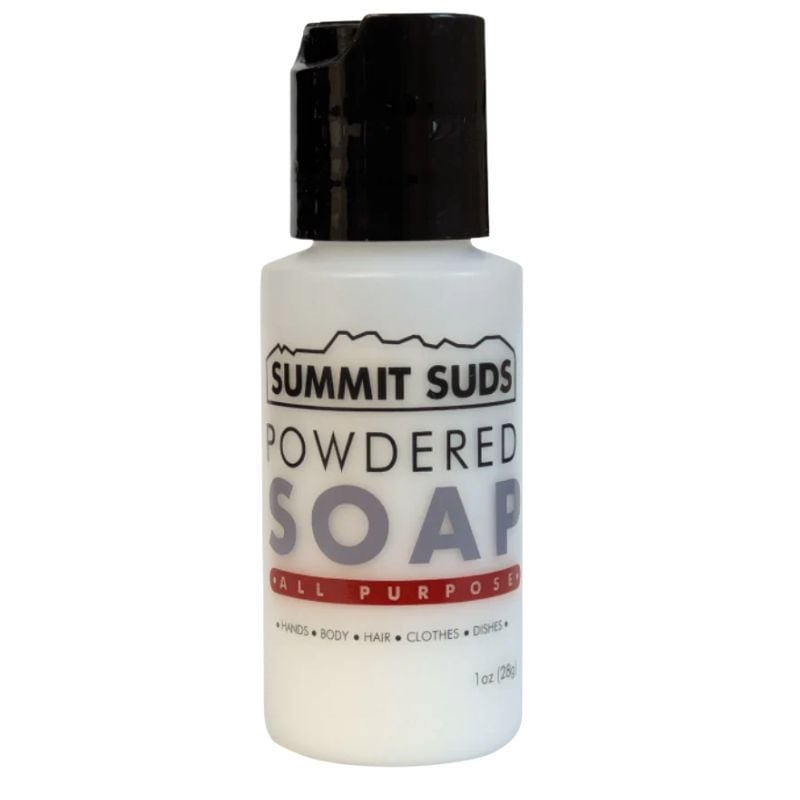
Summit Suds All-Purpose Powdered Soap
Pros:
> Can wash your body, hair, clothes, and dishes.
> Affordable
> Powder doesn’t leak like liquid
Cons:
> More expensive per ounce than liquid
Powder solves the one problem every liquid camp soap has. It cannot leak into your food bag, and 28 g of soap in a 41 g package is about as light as a genuinely useful cleaning system gets.
The formula is five ingredients: baking soda, a coconut derived foaming agent, corn starch, MSM and citric acid. That matters because it is the only powdered camp soap on the market without SLS or SLES, which puts it in the same environmental bracket as castile soap while weighing less.treelinereview+1
It suits fast and light trips, thru-hike resupply boxes and bikepacking where every gram of toiletries gets scrutinised. It also travels well because there is nothing liquid to declare at an airport.
The trade-offs are real. You need more powder than liquid, roughly a teaspoon per two litres of cool water, so the weight advantage narrows on very long sections. It dissolves better than soap flakes or sheets, but you should dissolve it into water first rather than tipping it onto a dirty pot. The squeeze bottle dispenses awkwardly, and the refill packet in your own dropper bottle is the better system. It is also the most expensive option here per ounce and is mostly an online purchase.
Trade off: higher cost and slightly more product used, in return for zero leak risk and the lightest carry weight.
Best for: ultralight thru-hikers and anyone who has had soap leak through a food bag once already.
Compare Prices:
Best Biodegradable Camping Soap
Sea to Summit Wilderness Wash

Pros:
> Can be used to wash your body, and it is often used as an alternative to shampoo.
> Secure Lid
> Affordable
Cons:
> Small size
When I tested this thru-hiking I found it extremely concentrated. The soap is thick and lasted a lot longer than I expected, and it was gentle on my skin across hands, hair and body over consecutive days. It is the complete body wash of the group.
It comes in a durable bottle with a small, secure lid, and unlike Dr. Bronner’s it has never leaked on me. That alone earns it a place in a lot of packs.
Where it beats castile soap is cold water. The SLES in the formula lathers when the water is too cold for plant oil soap to do much, and it stays liquid in the cold. Where it loses is what that ingredient means once the water hits the ground. SLES only breaks down reasonably fast in soil that is warm, moist and full of microbes, so in cold, dry, alpine or desert conditions it can persist for far longer than the biodegradable label suggests.
Compared with Campsuds it is the gentler of the two on skin, hair and fabrics, and the weaker degreaser. For a multi-week hike where you are washing yourself and your clothes daily, that is the right way round. The sizes are all small, so even concentrated you may run out sooner than you plan.
Trade off: better cold water performance and a leakproof cap, in exchange for a sulfate surfactant you should not be disposing of in fragile country.
Best for: washing body, hair and trail clothes on trips in warm, damp conditions.
Compare Prices:
Best Biodegradable Soap for Cold Weather
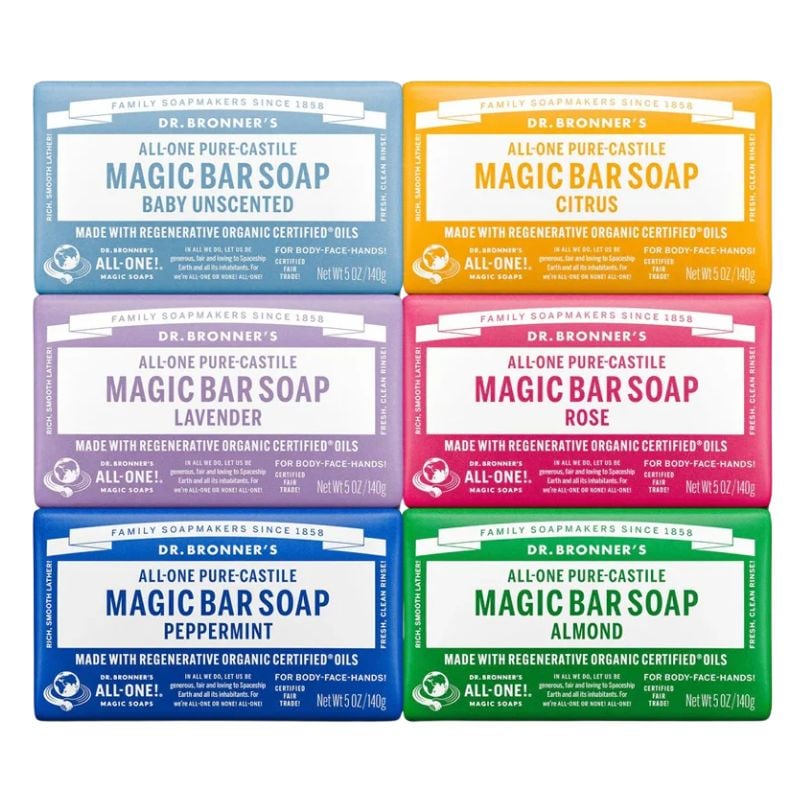
Dr. Bronner’s Pure-Castile Bar Soap
Pros:
> Can wash your body, hair, clothes, and dishes.
> Affordable
> Available in unscented and several scented varieties
Cons:
> Need some form of container to carry the soap
I was slow to come around to bar soap for backpacking, but on ingredients alone it is hard to argue with. Saponified plant oils, a little sea salt, citric acid and vitamin E, wrapped in paper with no plastic bottle to carry out. Microbes break that down about as fast as anything you could put on the ground.
It is also the cheapest way to wash on this list per use, and being triple milled it does not go mushy the way cheap bars do. Unlike liquid castile it lathers respectably even in cool water, which makes it the pick for shoulder season and alpine trips where liquid soap turns to sludge.
For a thru-hike you do not carry the whole bar. Slice off a chunk to match your section and keep it in a case or zip lock bag. That keeps the weight sensible and stops the usual bar soap problem of having nowhere clean to put it.
The trade-offs are convenience. A wet bar is heavier than the soap it contains, and using a bar on dishes is clumsy. The fix is to rub it onto a dish brush or grate a little into warm water rather than attacking the pot directly. In hard or cold water it can leave a slight film that needs an extra rinse.
Trade off: the least convenient format here, in exchange for the cleanest ingredients, no plastic and the lowest cost.
Best for: cold or fragile environments, plastic free trips, and budget conscious hikers.
Compare Prices:
Best Biodegradable Soap Sheets
Sea to Summit Pocket Hand Wash

Pros:
> Easy to Use
> Compact size
> 50 Sheets per pack
> Lightweight
Cons:
> The container is not waterproof so if it comes in contact with water all the sheets will clump together
Fifty sheets in a 14 g case live in a hip belt pocket for handwashing before eating, after a cathole, and at trailhead toilets that never have soap.
Using them is simple. Open the case, pull one out with dry hands, wet it and work up a lather. That dry hands requirement is the whole limitation, because it means they are a hand wash rather than a shower solution.
The container is not waterproof. If water gets in, the sheets clump into a single useless block. Keep the case somewhere that stays dry rather than the pocket you reach into with wet hands.
They also dissolve reluctantly in genuinely cold water, and they contain SLS, so they are a hygiene item rather than an environmentally optimal choice. Given how little soap is in a sheet, the volume you are putting into the ground is tiny, which for me is the argument that keeps them in the pack. They are not a substitute for a proper camp soap for dishes or clothes.
Trade off: almost no weight and total convenience, in exchange for a sulfate formula, a hands only use case and a container that must stay dry.
Best for: trail hygiene, town stops and travel days on a thru-hike.
Compare Prices:
Best Unscented Soap Sheets
Coleman Camp Soap Sheets

Pros:
> Convenient small flip top container is small enough to fit your pocket
> Easy to Use
> TSA Approved so can be stored in your backpack or luggage when going on flights.
Cons:
> Can take a while to dissolve properly
The Coleman sheets do the same job as the Sea to Summit Pocket Hand Wash with one significant difference: they are completely unscented. That is what makes them the better choice for bear country, where you are already carrying a bear canister and doing everything you can to keep smells out of your kit.
They come in a flip top case that fits a pocket, they are approved for carry-on luggage, and they work with hot or cold water. Fifty sheets is plenty for a long section.
Compared with a liquid soap they are more limited but more foolproof. You can use them on hands, dishes and in a pinch on clothes, and there is nothing to spill.
The main complaint is that they can take a while to dissolve properly, particularly in cold water, and you sometimes end up working a half dissolved sheet around your hands longer than you would like. Warm water fixes it. Like all soap sheets, the sheet count is generous but the actual soap volume is small, so treat them as a hygiene and light cleaning item rather than a substitute for a concentrated liquid on a trip where you are washing pots every night.
Trade off: slower to dissolve than a liquid soap, in exchange for no scent, no leaks and near zero weight.
Best for: bear country trips and hikers who want an unscented pocket soap.
Compare Prices:
Best Biodegradable Soap for Greasy Dishes
Sierra Dawn Campsuds

Pros:
> Can be used to wash your face, hair, clothes, or dishes
> Compact travel size
> This soap uses oils that may deter insects
> Long-Lasting – A little goes a long way
Cons:
> Not everyone has been keen on the scent this soap gives off
If something is greasy, burnt on or ground into fabric, Campsuds is the soap on the list that shifts it. A very small amount, well under a quarter teaspoon in a couple of litres of water, is enough.
It comes in a travel size bottle that packs easily with the rest of your kit, and it stays workable in cold water where plant oil soaps go dull.
The lavender, peppermint and citronella oils are marketed as insect deterrent. In my experience that does not work for most people. If it works for you, take the win, but do not choose your soap for it. The scent itself divides people, and it is the reason I would not use this on dishes if fragrance in your morning coffee bothers you.
The two honest problems are skin and soil. It is more drying on skin and hair than Wilderness Wash, so it earns its place as a dish and gear soap rather than a body wash. And it contains SLS, which means the same caveat as Wilderness Wash applies but harder: do not use it where you have to dispose of the water in cold, dry or fragile ground. Keep the bottle in a zip bag, because the cap can leak.
Trade off: the strongest cleaning power here, at the cost of harsher ingredients and a scent on your dishes.
Best for: greasy pots, filthy gear and heavily soiled clothes on warm weather trips.
Best Waterless Wipes
Sea to Summit Wilderness Wipes

Pros:
> Convenient resealable packet
> Gentle on the Skin with the right pH balance for human skin.
> Contains vitamin E and aloe vera to create a pleasant smell
> Compostable
Cons:
> For use on the body only
Sometimes there is no water to spare, and that is when these earn their weight. On desert sections and dry camps I have used them to get salt and grime off skin at the end of the day without touching my water supply.
They are thick fibre wipes, soft on skin, and they leave neither a sticky nor a slippery residue. The vitamin E and aloe vera mean they do not dry your skin out even in genuinely arid conditions, and they are pH balanced for skin, which shows if you use them on your face.
The real advantage over any soap on this list is that no soap enters the environment at all. On a fragile alpine or desert trip, a wipe is the lowest impact wash you can do short of plain water.
The trade-offs are cost, weight per use and rubbish. You carry every used wipe out. Compostable on the packet means commercially compostable, so they do not go in a cathole with your other business, whatever anyone tells you. They are also a body product rather than a cleaning system. You can wipe a plate in an emergency, but they contain ingredients you do not want to eat, so rinse afterward.
Trade off: you pack out every used wipe and pay more per wash, in return for no soap in the environment and no water needed.
Best for: desert sections, dry camps, fragile terrain and staying civil on cold nights.
Compare Prices:
Biodegradable Camp Soap Buyers Guide
Buyers Guide: Biodegradable Backpacking Soap
Liquid vs Bar vs Powder vs Sheets vs Wipes
Format decides how your soap behaves in a pack more than which brand you buy.
Concentrated liquid is the most versatile and the most efficient per gram of actual cleaning, which is why it dominates thru-hiker kit lists, but every liquid bottle is a leak waiting to happen and the cheap flip caps on most camp soaps are the culprit.
Powder is the format for people who have already had that happen. It cannot spill, a useful supply weighs under 30 g, and you use slightly more of it than liquid to get the same result.
Bar soap has the cleanest ingredients and the lowest cost per wash, and it lathers in cool water better than liquid castile does, but a wet bar is heavy and awkward and you need a draining case.
Sheets carry almost no weight and are ideal for handwashing on the move, though they dissolve slowly in cold water and the amount of soap in a sheet is small.
Wipes are not soap at all, and that is their advantage: nothing enters the environment, but you carry every used wipe out.
For most trips I carry one concentrated liquid or powder for camp duties and a case of sheets in a hip belt pocket for hands.
What Biodegradable Actually Means on a Soap Label
The word is close to unregulated. In practice, biodegradable on a soap bottle means the surfactant breaks down by roughly 60 to 70 percent within about a month under standard wastewater treatment conditions, which is the framework set out by the OECD. Read that again, because it describes a treatment plant, not a hillside. There is no standard at all for how fast a soap breaks down in backcountry soil. There is also no guarantee about the rest of the bottle, because the label only speaks to the surfactant while the preservatives, fragrance compounds and thickeners get a free pass. So treat the claim as a starting point and read the ingredient list instead.
Four rules of thumb serve you well: a short ingredient list, no fragrance, nothing advertising antibacterial or degreasing superpowers, since chemicals that kill microbes also kill the microbes that eat your soap, and no long unpronounceable chemical names. Roughly speaking, the first few ingredients do the cleaning, the middle handles texture and preservation, and the tail end is smell, colour and marketing.
SLS and SLES: The Ingredient That Matters Most Outdoors
This is the detail most camp soap articles skip. Sodium lauryl sulfate and its milder cousin sodium laureth sulfate are the surfactants in the majority of soaps sold for outdoor use, including two of the most popular picks on this page.
They are technically biodegradable, and under ideal conditions, meaning warm, damp soil packed with microbes, they break down reasonably quickly. The problem is that a lot of backpacking does not happen in those conditions.
In cold, dry, alpine, desert or nutrient poor ground, a sulfate based soap can sit there for months. Sulfates are also the reason those soaps lather in cold water, cut grease better and do not turn to sludge in the cold, which is a genuine performance advantage you are trading away.
My rule is simple. Warm, damp trips where you need cleaning power: sulfate based soap is a defensible choice, used sparingly. Cold, dry, alpine or high traffic areas: use castile liquid, a plain bar, or no soap at all. Concentration matters as much as chemistry. Ten hikers each using a capful in the same drainage does more damage than the label ever accounts for.
Scented or Unscented, and Bear Country
If you are backpacking in bear country you will already be carrying a bear canister and bear spray, and your soap should be unscented too. Bears have an extraordinary sense of smell and a neutral soap gives them less to investigate, even though they will still find you interesting regardless.
Unscented also matters environmentally, because fragrance compounds can become more toxic as they break down in soil, and phthalates used to make scents last hide behind the single word fragrance on a label. Unscented is generally kinder to sensitive skin as well, and it keeps perfume out of your backpacking cookware, which anyone who has drunk lavender flavoured coffee will appreciate. Scented soap still has a place.
Essential oil scents in a plant oil base break down fine, and a scented wipe is a small pleasure in a desert camp. Just do not choose a soap for its insect repelling claims. Lavender, peppermint and citronella oils sound promising but in my experience they do very little.
How Much Soap to Carry on a Thru-Hike
Almost everyone carries too much. A concentrated liquid needs somewhere between an eighth and a half teaspoon to make two litres of cool water properly soapy, and a powder needs about a teaspoon for the same job.
At that rate a 40 ml bottle of Wilderness Wash or a 2 oz bottle of Dr. Bronner’s covers a long resupply section comfortably if you are disciplined, and a 28 g bottle of powder does the same. If you are unsure, test at home before you leave.
Use your chosen soap for a week of dishes and one load of hand washed shirts and you will know your own rate.
Bar soap you cut to size, a chunk rather than a whole 5 oz bar. Sheets you count, since fifty sheets is generally more handwashing than a week of hiking demands. Refilling into a small dropper bottle rather than carrying the manufacturer’s bottle saves both weight and the leak risk, and it forces small doses, which is the single best thing you can do for the environment and for your pack weight at the same time.
Washing Dishes, Clothes and Yourself Without Trashing the Place
Move away from water first. Collect what you need in a pot or bottle and carry it at least 200 feet, roughly 70 adult paces, from any lake, river or stream, then wash there. For dishes, scrape every scrap of food out before soap touches anything, and pack the scraps out.
A two pot system, one soapy and one to rinse, uses far less soap than washing under a trickle. Warm water does more work than extra soap does, so if you have fuel to spare, heat a little.
For clothes, a wash bag or a dry bag with a couple of litres of water and the smallest amount of soap you can manage will shift trail funk better than scrubbing in a stream ever will, and a purpose made wash bag like the Scrubba is worth the weight on a long trip.
For yourself, rinse with plain water first and use soap only where it is genuinely needed, which for most of us is hands, feet and armpits. On a dry or fragile trip, skip soap on your body entirely and use a wipe.
Grey Water Disposal Done Properly
Grey water is your dish water, wash water and toothpaste water, and it is not human waste, so it does not belong in a cathole. That advice is out of date and it slows decomposition, attracts wildlife and concentrates chemicals in one spot.
The current best practice is to strain the food particles out with a bandana or a small sieve, pack those out with your rubbish, then broadcast the water by flinging it in a wide arc over a large area at least 200 feet from any water source and not directly onto plants. Spreading it thin is the whole point, because a diluted, dispersed dose breaks down far faster than a concentrated puddle.
In a developed campground, use the designated grey water sink or basin if there is one, and do not tip dish water into a pit toilet or a bathroom sink unless the site says that is fine, because most camp plumbing is not built for it. Never wash in a water source, whatever the label on the bottle promises.
Soap and Technical Gear
Camp soap is a general purpose tool and some of your gear needs better. Do not put an all-purpose camp soap through a down jacket or a down sleeping bag, because it strips the natural oils from the down and flattens the loft. Use a dedicated down wash instead.
Merino base layers last longer washed in plain water or a wool specific soap, since general soaps and their higher pH leave wool stiff and shorten its life.
Waterproof shells with a DWR finish should be washed with a technical cleaner rather than soap, because soap residue attracts water and kills the finish faster than dirt does. Water filters get plain water only.
On the trail this mostly means accepting that a rinse in clean water is the right treatment for your expensive layers, and saving the soap for skin, socks, shirts and cookware. Save the proper washes for when you get home.
Price and Value
Cost per wash tells a different story than the price on the shelf. A 5 oz bar of pure castile bar soap is the cheapest way to get clean on this page by a wide margin, followed by a large bottle of liquid castile decanted into a small travel bottle.
Concentrated camp specific liquids sit in the middle, generally two to three dollars per fluid ounce, but because you use so little the actual cost per trip is trivial.
Powder is the most expensive soap here per ounce and is mostly an online purchase, which you are paying for in leak proofing and weight rather than cleaning.
Wipes are the most expensive way to get clean per use, and you are paying for water independence and zero soap in the environment, which is sometimes exactly what you need. The pragmatic answer for most thru-hikers is a big bottle of Dr. Bronner’s at home, refilled into a small bottle each resupply, with a case of sheets for hands. That combination costs very little across an entire trail.
Conclusion
Ideally, you want to use as little soap as possible. However, if you must use any kind of soap, then you should use biodegradable soap. In this article, I have given you the best biodegradable soaps that you can use right now.
If you care about the planet, then I would recommend switching to one of the biodegradable soaps mentioned in this gear review for your next hiking or backpacking trip.
Overall, here are the Best Biodegradable Soaps for Hiking:
- Best Overall: Dr. Bronner’s Pure Castile Liquid Soap
- Best for backpacking: Summit Suds All-Purpose Powdered Soap
- Best for body, hair and clothes: Sea to Summit Wilderness Wash
- Best for cold and fragile environments: Dr. Bronner’s Pure-Castile Bar Soap
- Best soap sheets: Sea to Summit Pocket Hand Wash
- Best unseated soap sheets: Coleman Camp Soap Sheets
- Best for greasy dishes: Sierra Dawn Campsuds
- Best waterless wipes: Sea to Summit Wilderness Wipes
Follow along on Social Media
Frequently Asked Questions
What is the best biodegradable soap for camping and backpacking?
Dr. Bronner’s Pure-Castile Liquid Soap is my overall pick because it is the one widely available all-purpose liquid soap made from nothing but saponified plant oils, so it breaks down in soil far better than the sulfate based alternatives. For backpacking specifically, Summit Suds powdered soap is lighter and cannot leak in your pack.
Is soap labelled biodegradable actually safe to use outdoors?
Not automatically. The label refers to how the surfactant breaks down under wastewater treatment conditions, not on a cold hillside, and it says nothing about the fragrance, preservatives or thickeners in the bottle. Read the ingredient list, choose the shortest one you can find, use as little as possible, and never wash in or near a water source.
Do most camping soaps contain SLS?
Yes, most of them do. Sodium lauryl sulfate and sodium laureth sulfate appear in the majority of soaps sold for outdoor use, including Sea to Summit Wilderness Wash and Campsuds. They lather better in cold water and cut grease more effectively, but they only break down quickly in warm, damp, microbe rich soil, so avoid them in cold, dry or alpine country.
Can I use biodegradable soap in a lake or river?
No. Soap works by lowering water’s surface tension, which damages fish gills and cell membranes and reduces oxygen availability, so no soap belongs in a water source regardless of the label. Carry water at least 200 feet away, wash there, and fling the dirty water over a wide area.
Should I dig a hole for my dish water?
No, that advice is out of date. Grey water is not human waste and burying it concentrates chemicals, slows decomposition and attracts animals. Strain out the food scraps, pack them out, then broadcast the water in a wide arc at least 200 feet from any water source and away from plants.
How much biodegradable soap do I need for a thru-hike?
Far less than you think. An eighth to a half teaspoon of concentrated liquid makes two litres of water properly soapy, so a 40 ml bottle or a 2 oz bottle covers a long resupply section. Test your own rate at home for a week before you commit to a bottle size.
Can I use biodegradable camp soap on my down sleeping bag or rain jacket?
No. All-purpose camp soap strips the oils from down and flattens loft, and soap residue on a DWR finish makes a shell absorb water instead of shedding it. Use a dedicated down wash and a technical shell cleaner at home, and keep the camp soap for skin, socks, shirts and cookware.
Scented or unscented biodegradable soap, which is better?
Unscented for anything in bear country, for anyone with sensitive skin, and for dishes, since fragrance lingers in cookware and some fragrance compounds get more toxic as they break down in soil. Scented plant oil soaps are fine elsewhere, but ignore the insect repelling claims because they rarely work.

BikeHikeSafari Gear Review Process
The author, Brad McCartney from BikeHikeSafari is a small independent adventurer and outdoor gear tester who owns and runs BikeHikeSafari.com.
BikeHikeSafari is not part of a large blog network and is proudly independent. All reviews on this site are independent and honest gear reviews of outdoor products by the author.
The author, Brad McCartney is a very experienced triple crown thru-hiker, adventurer, and bike tourer having spent 1000s of nights sleeping in a tent and sleeping bag (Read more). He was a manager of an outdoor retail store and is very experienced in what is important when using and testing gear for reviews like this.
BikeHikeSafari will never receive any money for reviews and they do not accept sponsored reviews on this website. All the comments about the gear reviews are from the author based on his years of experience. Hope this independent review was helpful for you.

