

After thousands of nights in the backcountry across the Triple Crown (PCT, AT, CDT), the Te Araroa, and a stack of bikepacking trips, I’ve slept in tents far more than in hammocks, but on the right trail such as the Appalachian Trail or backpacking in the jungle on stretches with no flat ground, a backpacking hammock is the smarter shelter. This guide is for thru-hikers, ultralight backpackers and trail bikepackers who want a hammock that handles real weather, packs small, and won’t quit after 100 nights of use.
My current overall pick is the Hennessy Hammock Ultralite Backpacker Classic for serious backcountry use, and the Hammock Gear Wanderluxe Ultralight Kit is the one I’d put on a thru-hike when I want everything such as a hammock rain tarp, bug net, suspension in a single backpacking hammock kit. The trade-off you actually need to understand: the lightest hammock is rarely the most comfortable, and a “complete” kit is almost never the lightest.
Quick Picks – Best Backpacking Hammocks
- Best Overall: Hennessy Hammock Ultralite Backpacker Classic – A backcountry standard for decades. Asymmetrical, bottom-entry, includes tarp and bug net at 1 lb 15 oz.
- Best Ultralight Thru-Hiking Hammock: Hammock Gear Wanderluxe Ultralight Kit – The one I’d put on a thru-hike. Dyneema tarp, integrated bug net, suspension, stakes, everything in one kit under about 2 lb.
- Best All-in-One Hammock Tent: Kammok Mantis Ultralight All-In-One Hammock Tent – Knotless setup, integrated everything. The best pick if you don’t want to think about kit-building.
- Best Lightweight Backpacking Hammock: Warbonnet Blackbird – 16 oz body, integrated asym bug net, a real gear shelf, and a 350-lb limit you can actually trust.
- Best Car Camping Hammock: ENO OneLink Hammock System – At around 4 lb this is not the hammock to carry in your backpack, best used for car camping.
- Best Double Hammock for Camp & Car Camping: ENO Double Nest Hammock – Not a thru-hike hammock, but the one I’d grab for camp lounging or car camping.
How We Tested
The hammocks in this guide are researched and, where possible, field-tested by an experienced long-distance hiker and former outdoor retail store manager. Across Triple Crown thru-hikes (PCT, AT, CDT), the Te Araroa, shoulder-season trips and bikepacking expeditions, I judge backpacking hammocks on weight-to-comfort, packability, weather resistance, durability, suspension quality and value for serious backpacking. Some of the items were supplied by the manufacturer and some were purchased by the author for this review. For more on how we research and review gear, see the Review Policy for further details.
Backpacking Hammock Comparison Table
| Brand | Weight | Included Gear |
|---|---|---|
| Hennessy Hammock Ultralite Backpacker Classic | 1 lb. 15 oz | Hammock, rain tarp, bug net, ridgeline, tree straps, stuff sack. |
| Hammock Gear Wanderluxe Ultralight Kit | 2lb. 1oz | Hammock, rain tarp, bug net, ridgeline, carabiners, daisy chain tree straps, tent stakes, stuff sack. |
| Kammok Mantis Ultralight All-In-One Hammock Tent | 2lb. 4oz | Hammock, rain tarp, bug net, ridgeline, tree straps, tent stakes, stuff sack. |
| Warbonnet Blackbird | 1 lb. | Hammock, bug net, ridgeline, |
| ENO OneLink Hammock System | 2lb. 7oz | Hammock, rain tarp, bug net, ridgeline, tree straps, stuff sack. |
| ENO Double Nest | 1lb. 3oz | Hammock, ridgeline, carabiners, tree straps, stuff sack. |
Follow along on Social Media
Best Backpacking Hammocks – Detailed Reviews 2026
Best Backpacking Hammock – Overall
Hennessy Hammock Ultralite Backpacker Classic

Weight: 1 lb. 15 oz / 868 grams
Pros:
> Environmentally Friendly- Tree hugger webbing straps included.
> Durable- Built to last.
> Easy Access- Bottom entry with velcro strap.
Cons:
> Lashing can be fiddly and hard to hold the tension on the rope that’s quite thin.
The Hennessy Ultralite Backpacker Classic has been on the trail for decades and the reason it keeps showing up on long-distance thru-hikes is that it’s a complete, reliable shelter at under 2 lb. Asymmetrical shape, structural ridgeline, integrated bug net, and a detachable rain fly, everything is in the box, just add an ultralight backpacking quilt.
The bottom-entry Velcro closure is divisive. Some hikers love it because you drop in and seal up without zips; others find the Velcro fiddly when it gets gritty. The included tree-hugger webbing straps are a nice touch and stop bark damage.
Trade-off: the suspension lashing can be fiddly and the rope is on the thin side, which makes tension management harder than on a daisy-chain or whoopie-sling system. At 200 lb max, it’s also not for heavier hikers.
Best for: classic-style hammock backpackers, AT thru-hikers who want a proven complete system under 2 lb.
Compare Prices:
Best Ultralight Backpacking Hammock
Hammock Gear – The Wanderluxe – Ultralight Kit

Weight: 2 lb. 1 oz / 935 grams
Pros:
> Dyneema Hammock Tarp included
> Kit includes everything including Stakes, cord, bug net, and more
> Good price
Cons:
> Not much
What I like about the Hammock Gear Wanderluxe is that it includes everything you need, and I mean everything. For a thru-hiker who doesn’t want to research seven separate purchases — tarp, bug net, ridgeline, suspension, stakes, stuff sack, carabiners, you buy one box and your Appalachian Trail Gear is fully kitted out.
The top-of-the-range Dyneema hex tarp is the part that makes this kit worth the money. Dyneema doesn’t sag when wet, doesn’t stretch out at 2 am in a storm, and packs smaller than silnylon at the same waterproofing.
Trade-off: at 2 lb 1 oz this is heavier than a stripped Warbonnet Blackbird body alone, but cheaper and lighter than buying the Blackbird plus a comparable Dyneema tarp separately. The complete-kit convenience is real.
Best for: thru-hikers and ultralight backpackers who want a single-purchase, do-everything hammock shelter system.
Compare Prices:
Best Hiking Hammock 2026
Kammok Mantis Ultralight All-In-One Hammock Tent

Weight: 2 lb 4 oz / 1021 g (inc rainfly and bug net)
Pros:
> High Strength to Weight Ratio- Stong, yet light materials such as SpiraLine.
> Insect Repellent- Dragonet mesh.
> Easy Step Up and Take Down- Knotless suspension and a quick tear down.
Cons:
> Material- The material can rip easily if you exceed the weight limit.
The Kammok Mantis UL is one of the cleanest all-in-one hammock tents on the market. The knotless suspension is the headline feature, you can be hung and ready to sleep in under 60 seconds without messing with knots, which matters more than you think after a 25-mile day.
The Dragonet mesh keeps bugs out, the structural ridgeline gives a repeatable shape, and the Stargazer panel lets you roll back the fly on clear nights. The Levitas 20D ripstop is light but the weight limit is real, exceed it and the fabric will let you know.
Trade-off: at 1 lb 15 oz it’s heavier than a Hammock Gear Wanderluxe kit and less customisable than some others. You’re paying for setup simplicity.
Best for: hammock campers who want a fast, idiot-proof complete shelter system and don’t want to assemble their own kit.
Compare Prices:
Best Lightweight Backpacking Hammock
Warbonnet Blackbird
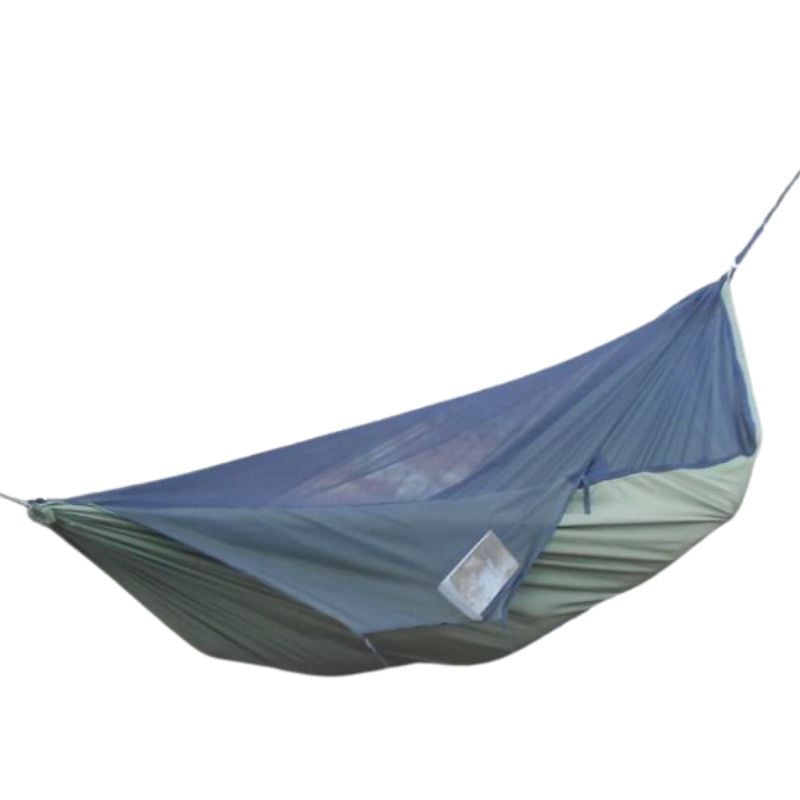
Weight: 1 lb (not including suspension system slings or rain fly)
Pros:
> Lightweight
> Easy setup
> Durable
Cons:
> Need to purchase extras to make the system work best
The Warbonnet Blackbird is the hammock that does everything a backcountry hammock needs to do and very little it doesn’t.
The asymmetrical cut gives you a near-flat diagonal lay, the integrated bug net stays tensioned and out of your face thanks to the structural ridgeline, and the built-in gear shelf solves the single biggest problem with hammock camping – where to put your stuff at night. The 350-lb limit gives a real safety margin, which matters more than it sounds on the third week of a long trail when you’re tired and sloppy with your setup.
Trade-off: suspension is usually sold separately, so the kit cost climbs once you add straps, rain tarp and underquilt. It’s not the lightest hammock body in this guide, but it’s one of the most refined.
Best for: thru-hikers and long-distance backpackers who want one hammock that just works.
Compare Prices:
Best Hammock for Car Camping
ENO OneLink Hammock System

Weight: 2lbs 7oz / 1.45 kg (inc rainfly and bug net)
Pros:
> Strong yet Breathable- Made of 30D Ripstop Nylon.
> Insect Repellent- Includes a Guardian SL Bug Net.
> Easy Step Up- No-knots-needed setup.
Cons:
> Bug Net Fitting- The bug net can be tight.
The all-inclusive and OneLink Hammock shelter system from Eagle Nest Outfitters (ENO) promises to keep you dry all night and completely insect bite-free. The ENO OneLink Hammock shelter system is very strong and breathable 70D Ripstop Nylon and rated to carry 400 lb.
The rain tarp included is streamlined and also uses lightweight and the Guardian Bug Net, which features an integrated ridgeline and it has a quick no-knots-need setup and so you’ll be protected in no time.
Trade-off: at just under 4 lb it’s too heavy to carry on trail compared to the other backpacking hammocks mentioned above. It is simple but use it for car camping.
Best for: hammock campers who want everything in one package for their car camping or short overnight trips.
Compare Prices:
Best Double Hammock 2026
ENO Double Nest
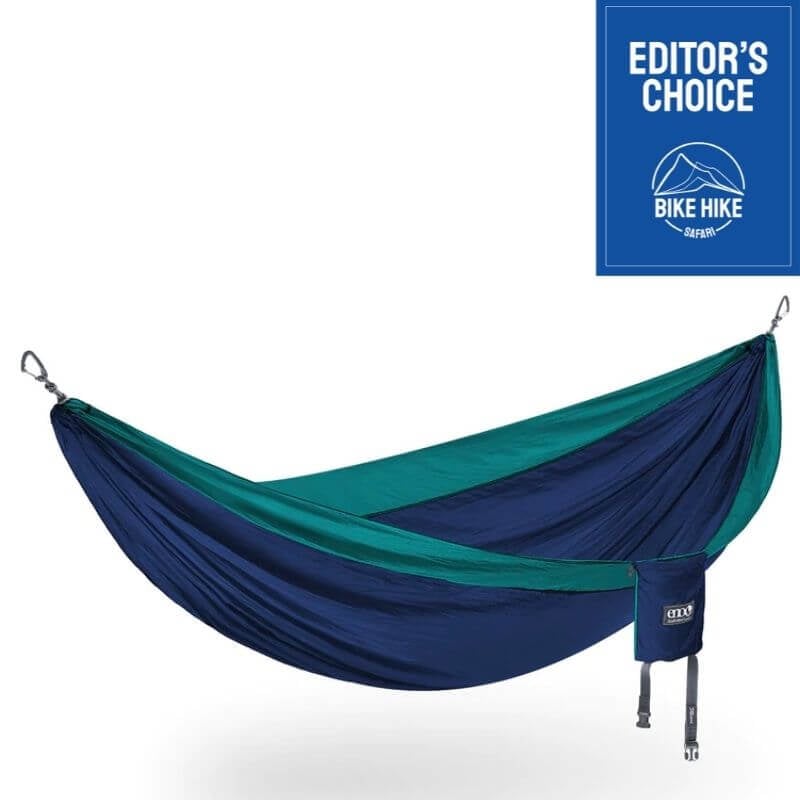
Weight: 1 lb. 3 oz. / 539 grams (no rain fly or bug net)
Pros:
> Quite Lightweight for a double hammock
> 400lb / 181kg weight limit
> Durable
> Choice of several colors
Cons:
> Too heavy for most people to take hiking
> Need to buy Tarp and bug net as extra add ons
The ENO DoubleNest is not a thru-hike hammock and I wouldn’t put it on a long trail, but it’s the right pick for camp lounging, car camping, and stringing up between trees on rest days. The 400-lb limit is generous, the fabric is durable, and the colour options are unmatched.
It doesn’t include a tarp, bug net or suspension, so the real cost climbs once you add the necessary extras for any night under it.
Trade-off: heavy by backpacking standards and lacks integrated weather and bug protection. Pair it with ENO accessories for backyard or car camping.
Best for: camp lounging, car camping, two people sharing a hammock at base camp.
Compare Prices:
Backpacking Hammock Buyers Guide
Backpacking Hammock Buyers Guide
Weight And Packability
For backpacking, the hammock body should be under about 20 oz for fast-and-light trips and under about 30 oz for a complete kit with tarp and bug net. Dyneema tarps add cost but cut significant weight and don’t sag when wet, the difference matters on a long trail.
Length, Width, and Weight Limit
Match length to your height plus margin: most hikers up to 6 ft are fine in a 10-ft hammock; over 6 ft, go 11 ft. 12-ft hammocks are overkill for almost everyone. Width drives the diagonal lay, wider hammocks give a flatter sleep but pack and weigh more. Always check weight limit against your fully loaded body weight plus margin; never run a hammock at its stated maximum. Most allow for at least 250 lb with some allowing up to 400 lb weight limit.
Suspension System for Hammocks
Whoopie slings are the lightest and most adjustable system and the right pick for ultralight thru-hikes, pair them with wide tree huggers for Leave No Trace.
Daisy-chain straps are heavier but the easiest system for beginners and car camping. Avoid bare rope or thin straps that bite into bark.
Knots for Hammocks
There are a couple of different knots you need to know when hammock camping such as the Bow Line, Taut Line Hitch, and a couple more.
Where to Hang
Make sure you take enough rope and slings to tie between trees that are quite spread out. It is best to try and find trees about 12 inches in diameter to ensure you have a strong tree and are not stressing the tree too much. Also, ensure you are using common sense and not stringing the hammock across trails or access areas for both humans and wildlife. If in bear country ensure you are well away from your bear canister or bear bag.
Hammock Camping Accessories
Most hammocks come equipped with an integrated bug net, tree straps, tent stakes, sleeping pad, Under Quilt, and a rain fly, some are not included and you need to buy these hammock accessories.
Just a note that most people use an under quilt when hammock camping as most sleeping pads are too bulky to use on hammocks.
Rain Flys, Hammock Tarps, and Shelter Systems
You will need to have one of the best rain flies for hammocks when hammock camping. The hammock shelter can come in many shapes and sizes. There are a couple of things to consider when looking for a good quality hammock shelter system.
- It must cover the entire hammock to keep you dry.
- It should be lightweight
- It should be waterproof
- It should pack up to a small size if you are backpacking. Not so important for car camping.
I wrote a guide dedicated to rain fly and tarps for camping hammocks. Take a look at the complete guide to the best rain flies for hammocks.
Some of the best hammocks are even waterproof themselves so keep an eye out for this as when that sudden downpour appears, the last thing you want is to end up being drenched right through.
Tent Stakes
Most hammocks that use a Rain Fly will also need good tent stakes to peg out the edges of the fly. When shopping around try and find the Best Ultralight Titanium Tent Stakes, even if they cost a little more. They will help keep the weight down to make backpacking a little easier.
Bug Nets
Whether you use integrated bug nets or something that you tie up to the main line is up to you. Unless you are hiking in the lifeless deserts (unlikely as you may not have any trees) or in cold weather and winter camping, you will need a good bug net.
Under Quilts and Sleeping Pads
Hammocks are colder than the ground. Wind pulls heat through the underside of the hammock and compresses any insulation under your body. Down underquilts solve this cleanly and are the standard for serious hammock camping, but they’re expensive and not as packable as sleeping pads. Pads work in a double-layer hammock or with a wide rectangular pad, but they’re slippery and the shoulders often still touch the cold sides. For most backpackers, an underquilt is the better long-term buy.
Types of Hammock Camping
The final thing you may want to consider is the purpose of your hammock. The purpose will affect how much you want to spend on your hammock, how heavy you’re willing to carry, or how many extra accessories you are going to need.
Ultralight Hammocks for Hiking
Since this is an article about which is the best ultralight hammock for backpacking, you’re going to want one that is suitable for backpacking trips. Hammock weight is one of the main things to consider when looking for the best lightweight hammocks for hiking.
There is a difference between a day trip and a thousand-mile-long adventurous thru-hike. Ultralight hammocks are usually made from a strong ultra-lightweight fabric that is durable and strong enough even for heavy hikers.
Camping Hammock
When it comes to camping hammocks they need to be comfortable and for some people, a hammock tent is a good option with everything included.
If you plan to use your hammock for sleeping in instead of a simple shelter when it’s warm out or to relax around camp, you’re going to need one that’s a lot more durable, weather-resistant, and insect-proof, so consider this before spending your money on something that isn’t suited for your individual situation.
Car Camping Hammock
For car camping a camping hammock can be simple or even a good cheaper camp hammock will be enough for a camping trip. Weight is not the biggest issue so look for comfort.
Backyard Hammock
A backyard hammock is not really within the scope of this gear review but any of the camping hammocks in this review could be used as a hammock in the backyard for lazing around, reading, or chilling out. Most are heavier in weight and use a large spreader bar to make a flat hammock. Others are well-rounded like a banana shape. Either will be good for chilling out.
Budget Hammock
There are many good budget hammocks on the market. And many in this gear review are reasonably priced. If you want top-of-the-line ultralight fabrics with all the accessories then the price goes up compared to a hammock to laze around on at home.
Leave No Trace when Hammock Camping
When hammock camping make sure you use wide tree straps that do the minimum of damage to trees. When using your hammock setup, ensure your suspension system does not do any damage and when you leave your campsite there should be no evidence that you have been there, other than your photos.
Leave no trace of your trip so others can enjoy their own experience in nature.
Price and Value
Hammocks are certainly not cheap but they are kind of like tents when it comes to price. You can get cheap ones and expensive ones, and the price is often a good guide to the quality and features of the hammock. In many cases, you will need to ensure you have all the hardware, rain tarps, and mosquito nets to find out the real cost. Specialist ultralight backpacking hammocks will be more expensive than camping or backyard hammocks.
Conclusion
The Best Backpacking Hammocks for 2026 are:
- Best Overall: Hennessy Hammock Ultralite Backpacker Classic
- Best Ultralight Thru-Hiking Hammock: Hammock Gear Wanderluxe Ultralight Kit
- Best All-in-One Hammock Tent: Kammok Mantis Ultralight All-In-One Hammock Tent
- Best Lightweight Backpacking Hammock: Warbonnet Blackbird
- Best Car Camping Hammock: ENO OneLink Hammock System
- Best Double Hammock for Camp & Car Camping: ENO Double Nest Hammock
Follow along on Social Media
Frequently Asked Questions
What is the best ultralight hammock for backpacking and thru-hiking?
For a complete ultralight kit, my pick is the Hammock Gear Wanderluxe Ultralight Kit because the Dyneema tarp and integrated bug net give you a full shelter system at around 2 lb. The Hennessy Hammock Ultralite Backpacker Classic is also lightweight but more refined and is what I’d recommend overall.
Down vs synthetic underquilt for thru-hiking – which is better?
Down underquilts are the standard because they have the best warmth-to-weight and pack the smallest, which matters when you’re carrying everything for months. Synthetic underquilts are cheaper and keep insulating when wet, which is useful in persistently damp climates, but they’re heavier and bulkier. For most thru-hikes, down is the right call as long as you keep it dry.
Is a hammock better than a tent for thru-hiking?
On trails with consistent tree cover such as the Appalachian Trail, a hammock can be a smarter shelter because you don’t need flat ground and you stay off wet, sloping or root-covered sites. On treeless trails such as the Sierra above tree line, the CDT in Wyoming, the Te Araroa’s South Island high country, a tent is the only option.
What is the minimum hammock length for taller hikers?
If you’re up to 6 ft tall, a 10-ft hammock is the minimum and 11 ft is more comfortable. Over 6 ft, go 11 ft minimum and consider 12 ft if you side-sleep with a knee bend. Width matters too – the diagonal lay only works if the hammock is wide enough to actually go diagonal.
How cold is too cold for hammock camping?
Most hammock campers switch to a tent around 32°F unless they have a real cold-weather setup: a quality down underquilt rated to the expected low, a winter sock or top cover, and a proper four-season tarp. With the right kit, hammock camping works well into the teens and below. Without it, you’ll be cold by 40°F.
Should I buy a complete kit or build my own hammock system?
Start with a kit if you’re new, the Hammock Gear Wanderluxe or Kammok Mantis UL get you sleeping outside without decision fatigue. Build your own once you know your preferences. A custom Warbonnet body plus a Dyneema tarp plus a tuned underquilt will beat any kit on weight and comfort, but it costs more and takes research time.
Do I need a tarp and bug net for backpacking with a hammock?
Yes, unless you’re confident in dry, bug-free conditions for the entire trip. A tarp is essential because rain on a hammock without one is a disaster, and a bug net is essential anywhere with mosquitoes, no-see-ums, or biting flies. Buy them as part of a kit or piece them together yourself, but don’t skip them.
BikeHikeSafari Gear Review Process
The author, Brad McCartney from BikeHikeSafari is a small independent adventurer and outdoor gear tester who owns and runs BikeHikeSafari.com.
BikeHikeSafari is not part of a large blog network and is proudly independent. All reviews on this site are independent and honest gear reviews of outdoor products by the author.
The author, Brad McCartney is a very experienced triple crown thru-hiker, adventurer, and bike tourer having spent 1000s of nights sleeping in a tent and sleeping bag (Read more). He was a manager of an outdoor retail store and is very experienced in what is important when using and testing gear for reviews like this.
BikeHikeSafari will never receive any money for reviews and they do not accept sponsored reviews on this website. All the comments about the gear reviews are from the author based on his years of experience. Hope this independent review was helpful for you.

