

After 30 years of thru-hiking, backpacking, and hiking, and several years managing an outdoor retail store, I have learned that a good pair of hiking sunglasses is about eye protection and durability first, with everything else second. This guide is for thru-hikers and backpackers who need lenses that stay put, cut glare on snow and water, and survive being shoved in and out of a pack for months on end.
My current top pick is the Oakley Flak 2.0, with the Smith Parallel 2 as the best ultralight option and the Goodr OG as the budget pick, see the Quick Picks below for the full rundown. The trade-off you need to understand is lens quality and coverage versus weight and price, and I have picked each pair below to hit that balance for serious trail use. For how I research and field-test gear, see the Gear Review Policy.
Follow along on Social Media
Quick Picks: Best Hiking Sunglasses
- Best Overall: Oakley Flak 2.0 – the most durable all-rounder with true-to-life optics and replaceable lenses, my default pick for long days on trail.
- Best for Mountaineering: Julbo Explorer 2.0 – side shields and photochromic lenses that handle snow glare and high-altitude sun better than anything else here.
- Best for Backpacking: Smith Lowdown 2 – ChromaPop polarized lenses and a light, comfortable frame that disappears on multi-day trips.
- Best Ultralight: Smith Parallel 2 – featherweight and packable, ideal for thru-hikers counting grams.
- Best for Women: Maui Jim Starfish – a women’s specific fit with scratch-resistant glass lenses and excellent UV protection.
- Best Budget: Goodr OG – under $30, polarized, and grippy enough for trail running, the best cheap sunglasses on the market.
- Best Value Polarized: Sunski Treeline – polarized, light, and backed by a lifetime warranty at a mid-range price.
- Best Polarized: Tifosi Swank Polarized – a no-fuss polarized pair that stays put on sweaty climbs.
- Best Cheap: Knockaround Fast Lanes – durable, unisex, and genuinely good for the price.
- Best Eco Friendly Hiking Sunglasses: Costa Fantail Polarized Sunglasses – made with used fishing nets, lifetime warranty but not the cheapest pair of hiking sunglasses.
- Also Worth Considering: Julbo Shield
How We Tested
The hiking sunglasses in this guide are researched and, where possible, field-tested by an experienced long-distance hiker and former outdoor store manager. Across thru-hikes, shoulder-season trips, and bikepacking trips, I judge hiking sunglasses on lens quality, UV protection, glare reduction, weight, fit and security, durability, and value for serious backpacking. Some of the items were supplied by the manufacturer and some items were purchased by the author for this review. For more on how we research and review gear, see the BikeHikeSafari Gear Review Policy.
Hiking Sunglasses Comparison Table
| Brand | Lens Material | Lens Width |
|---|---|---|
| Oakley Flak 2.0 | Polycarbonate | 59mm |
| Julbo Explorer 2.0 | Polycarbonate | 130mm |
| Smith Lowdown 2 | Polycarbonate | 55mm |
| Smith Parallel 2 | Polycarbonate | 55mm |
| Maui Jim Starfish | Glass | 56mm |
| Goodr OG | Polylaminate | 53mm |
| Sunski Treeline | Polycarbonate | 50mm |
| Tifosi Swank Polarized | Polycarbonate | Not Specified |
| Knockaround Fast Lanes Polarized Sunglasses | Polycarbonate | 53mm |
| Costa Fantail Polarized Sunglasses | Polycarbonate | 59mm |
| Julbo Shield | Polycarbonate | 130mm |
In-Depth Reviews: Best Sunglasses for Hiking 2026
Best Hiking Sunglasses 2026 – Overall
Oakley Flak 2.0

Lens Width: 59 Millimeters
Lens Material: Polycarbonate
Pros:
> Durable
> Full UV protection
> Unobtainium Grips
Cons:
> Price
The Oakley Flak 2.0 is my overall pick because it does the fundamentals better than anything else here. The frame is made from a stress-resistant, lightweight thermoplastic, and the Unobtainium nose pads and ear socks grip harder the more you sweat, so these stay put on a long climb. The lenses offer full UVA, UVB, and UVC protection and also filter blue light, which matters on bright snow and water.
A good thing about these sunglasses is the optics. The refraction is very close to real life, so near and far objects stay where they actually are. A lot of cheaper sunglasses subtly shift depth perception, and that is the last thing you want on a rocky descent. The trade-off is that the low-light transition level is only 11%, so these run dark in shadow and forest, you will be taking them off under tree cover.
They are not cheap, but the replaceable lenses soften that blow. Scratch a lens and you buy a new lens, not a new pair. If you have a big head, get the Flak 2.0 XL; there is also a standard size.
Trade off: dark in low light and shadow, and pricey.
Best for: thru-hikers and backpackers who want one durable, do-everything pair.
Compare Prices:
Best Trekking Sunglasses for Mountaineering
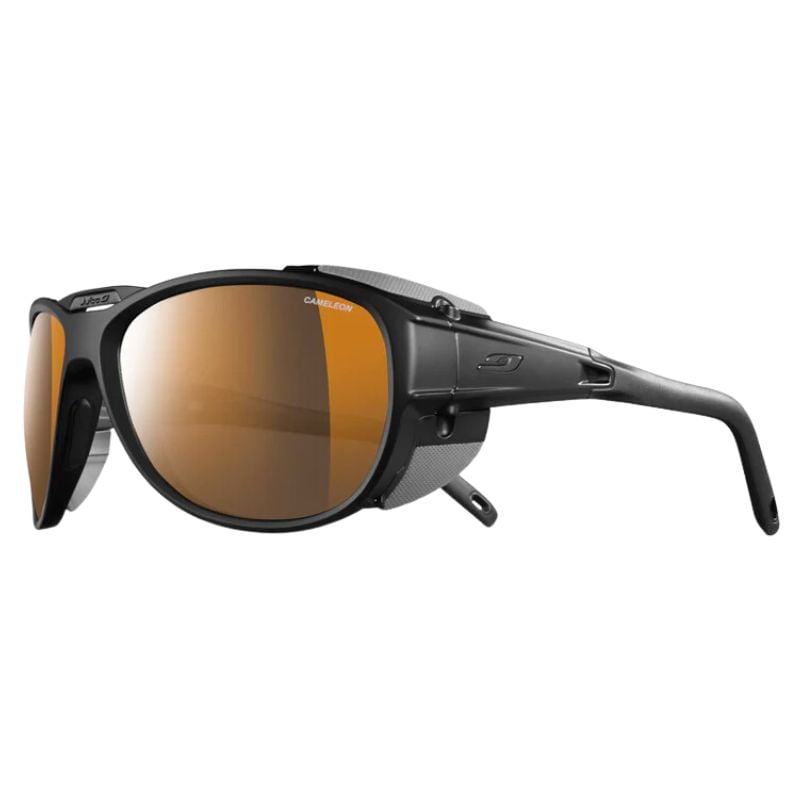
Julbo Explorer 2.0
Lens Width: 130 Millimeters
Lens Material: Polycarbonate
Pros:
> Full UV protection
> Eye shields to reduce internal reflection
> Comfortable
> Anti-fog lens
Cons:
> They don’t fit everyone
The Julbo Explorer 2.0 is built for high altitude and snow. The nylon frame and side shields do their best to stop any light coming in from the sides, which is exactly what you want above the tree line where glare bounces off snow in every direction. The photochromic lenses darken and lighten with conditions, so one pair covers a bright alpine start and a shaded descent.
Fit is where these win. The soft nose grip and adjustable temples move in every direction, which gives a secure fit that will not slide off your nose, even when you are sweating. The anti-fog and reflective coating keeps your vision clear when you are working hard.
The honest downside is fit. The wraparound shape does not suit every face. But if they fit, they are one of the best backpacking sunglasses for mountaineering and glacier travel.
Trade off: the wraparound fit does not work for everyone.
Best for: mountaineering, glacier travel, and snow-heavy thru-hikes.
Compare Prices:
Best Sunglasses for Backpacking
Smith Lowdown 2

Lens Width: 55 Millimeters
Lens Material: Polycarbonate
Pros:
> Good Quality Lens
> Comfortable
> Polarized lenses
> Full UV Protection
Cons:
> The nose bridge can annoy some people when hot and sweaty
The Smith Lowdown 2 is my pick for backpacking because it balances weight, comfort, and lens quality without costing the earth. The ChromaPop polarized lenses protect against all UV rays and do a genuinely good job of boosting contrast on trail, so roots and rocks pop instead of blurring together.
They come in a few frame colours and lens styles, and there are three sizes. The standard Lowdown 2, the Lowdown XL for bigger heads, and the Lowdown Slim for smaller ones. That sizing range is more than most competitors offer and makes these easy to fit.
The one thing to watch is the nose bridge, which can irritate some people when it gets hot and sweaty. It is a minor gripe rather than a deal breaker, but worth knowing if you run hot. Overall these are right up there with the best backpacking sunglasses in 2026.
Trade off: the nose bridge can annoy some people in the heat.
Best for: multi-day backpacking trips where comfort and weight matter most.
Compare Prices:
Best Hiking Sunglasses
Smith Parallel 2

Lens Width: 55 Millimeters
Lens Material: Polycarbonate
Pros:
> Stylish
> Reasonably Priced
> Protection against all UV
> Lightweight
Cons:
> Not as durable as some ohter sunglasses in this review
The Smith Parallel 2 is the pair I would grab for a thru-hike. They are light enough that you forget they are on, and they pack down to almost nothing, which matters when every gram in your pack is being argued over. The ChromaPop polarized lenses deliver the same contrast boost as the Lowdown 2 in a more minimal frame.
They hit the sweet spot between coverage and weight. The slim arms slide easily under a hat or a buff, and they stay put on descents.
They are not the most rugged pair here, so treat them with a little more care rather than tossing them loose into the bottom of your pack. But for fast-and-light hiking and thru-hiking, they are hard to beat.
Trade off: lighter build means a little less ruggedness.
Best for: ultralight backpackers and thru-hikers counting grams.
Compare Prices:
Best Hiking Sunglasses for Women
Maui Jim Starfish

Lens Width: 56 Millimeters
Lens Material: Glass
Pros:
> Stylish
> Scratch resistant Lenses
> Protection against all UV
> Durable and Lightweight
Cons:
> Lens doesn’t go dark enough
The Maui Jim Starfish is the women’s specific pick here, and it earns the spot on lens quality alone. The polarized glass lenses are scratch resistant and shield your eyes from glare and all harmful UV and blue light, which is exactly what you want on bright, exposed trails.
The nylon frame is lightweight and easy to wear all day, and the lenses come in a range of colours such as the HCL Bronze and Maui Rose for sunny and overcast conditions, and Natural Grey for direct bright sun. The one recurring comment is that the grey lens does not go dark enough for some people in full sun, so pick your tint with that in mind.
These are durable, good-looking, and genuinely protective. If you want a women’s fit with glass optics, this is the pair.
Trade off: the grey lens can run a little light in direct sun.
Best for: women hikers who want glass lens clarity and scratch resistance.
Compare Prices:
Best Eco Friendly & Sustainable Sunglasses
Goodr OG

Lens Width: 53 Millimeters
Lens Material: Polylaminate
Pros:
> Leightweight
> 100% UV protection
> Comfortable
> Great Price
Cons:
> Not as durable as some other hiking sunglasses
The Goodr OG is the budget pick, and honestly it is the pair that surprised me most. For under $30 you get polarized lenses, full UV400 protection, and a frame with a grippy coating that actually stays put when you sweat which is more than I can say for plenty of pairs costing four times as much.
They are light, they do not slip, and they come in a good choice of colours, so they double as a running and everyday pair.
The trade-off is durability and optics. The lenses are fine but not in the same league as Maui Jim or Oakley, and the frame will not survive being sat on. But at this price you can buy three pairs and not care.
Trade off: basic optics and lighter build for a very low price.
Best for: budget-conscious hikers and trail runners who want polarized protection cheap.
Compare Prices:
Best Eco Friendly & Sustainable Sunglasses
Sunski Treeline

Lens Width: 50 Millimeters
Lens Material: Polycarbonate
Pros:
> Lifetime warranty
> Lightweight recycled frames
> Polarized Lens & 100% UV protection
> Comfortable
> Reasonably Priced
Cons:
> The style is not for everyone
The Sunski Treeline has been sitting in my “to review” pile for too long, and it deserves a full spot here. These are genuinely popular backpacking sunglasses due to the quality polarized lenses, a light frame, and a lifetime warranty at a mid-range price.
The fit is comfortable and they stay put on the move, and the styling is clean enough to wear anywhere. The lifetime warranty is the real differentiator; if you break them, Sunski replaces them, which takes the sting out of owning a pair you will actually use hard.
They are not the most premium optics on this list, but for the money they are one of the best value polarized options you can buy.
Trade off: mid-tier optics, but backed by a lifetime warranty.
Best for: hikers who want polarized value with a warranty safety net.
Compare Prices:
Best Polarized Hiking Sunglasses
Tifosi Swank Polarized

Lens Width: Unknown
Lens Material: Polycarbonate
Pros:
> Polarized Lens
> Lightweight
> Non Slip nose bridge
Cons:
> Tifosi logo on the lens
The Tifosi Swank is a good balance of cost, comfort, style, and quality. There are plenty of polarized hiking sunglasses out there, but the Swank does everything well without costing much. The polarized lens cuts glare, and the nose pad prevents slipping, which is helpful on sweaty days or if you want to use these for running.
My one gripe is the Tifosi logo printed on the lens itself, and its quite big. The brand name is already on the arms, that should be enough, and the lens logo is a small annoyance you notice in bright light.
They also come in an XL size for bigger heads, and a non-polarized version that is about half the price if you are on a tight budget. Overall a solid polarized pair for hiking, backpacking, and more.
Trade off: the logo on the lens is mildly annoying.
Best for: hikers who want a dependable polarized pair at a fair price.
Compare Prices:
Best Budget Hiking Sunglasses
Knockaround Fast Lanes Polarized Sunglasses

Lens Width: 53 millimeters
Lens Material: Polycarbonate
Pros:
> Unisex
> Lightweight
> Polarized Smoke Lenses
> Protection against all UV
> Budget Price Hiking Sunglasses
Cons:
> Inside reflection on the lens
The Knock Around Fast Lanes Polarized Sunglasses do as they say. These sunglasses come with a matte black polycarbonate frame, which makes these sunglasses incredibly lightweight while wearing them.
These sunglasses have rectangular lenses that suit most face shapes. This pair of sunglasses come with polarized smoke lenses, which decrease the glare from any sunlight, but you still maintain the true color perception of what you are looking at.
These are the perfect sunglasses for a hiker on a budget. They may be on the lower/more affordable side of the market, but they are still durable and perfect for men or women.
With a UV coating on the lenses, these sunglasses will offer protection from harmful UV rays.
Overall, these are the best hiking sunglasses for those on a budget.
Compare Prices:
Best Eco Friendly Hiking Sunglasses
Costa Fantail Polarized Sunglasses

Lens Width: 59 Millimeters
Lens Material: Polycarbonate
Pros:
> Scratch and impact-resistant Lens
> Made from recycled materials.
> Comfortable
> Lifetime warranty
Cons:
> These sunglasses are only available in a medium-frame fit. This can cause issues with people with larger or smaller heads.
The Costa Fantail is the other eco-friendly option here, and it comes with a serious bonus, a lifetime warranty. Costa partnered with Bureo so the fishing nets recycled into pellets are used to make the frames, and those frames come in a wide range of styles.
You get a choice of glass lenses or 580 polycarbonate lenses. The 580 polycarbonate are the clearest lenses Costa makes, lightweight and impact resistant, and they give sharper, deeper colours. The glass lenses are also very clear and extremely scratch resistant. All lenses are polarized, which reduces eye strain on long days.
The catch is fit. These only come in a medium frame, which can be a problem for people with larger or smaller heads. If they fit you, they are a high-quality, environmentally friendly pair with a lifetime warranty behind them.
Trade off: only available in a medium fit.
Best for: eco-conscious hikers who want a premium polarized pair with a lifetime warranty.
Compare Prices:
Sunglasses Also Worth Considering
Julbo Shield

Lens Width: 130 Millimeters
Lens Material: Polycarbonate
Pros:
> Choice of lenses
> Removable side shields
> Comfortable
> Protects against all the UV
Cons:
> All made in a similar design
The Julbo Shield gives you a comfortable, secure fit thanks to its soft nose pad and the soft material on the end of the temples, plus removable side shields that stop sunlight reflecting back onto the lens. That side coverage is the same reason I rate the Explorer 2.0 so highly for snow.
There is a good range of lens options. The Spectron polycarbonate lenses are light, shock and scratch resistant, while the REACTIV photochromic lenses darken and lighten with conditions. A cord attachment adds extra security if you want it.
The one limitation is that they all come in a similar wraparound design, so if that shape does not suit your face you are out of luck. But if it does, these are a really good pair of hiking sunglasses.
Trade off: all models share a similar wraparound design.
Best for: hikers who want side-shield protection and photochromic flexibility.
Compare Prices:
Hiking Sunglasses Buyers Guide
Hiking Sunglasses Buyers Guide
Lens Materials
Lenses come in three main materials, and each has a clear role on trail.
Polycarbonate is the workhorse. It is a high-quality plastic that is strong and impact resistant, which is exactly what you want when a branch whips back or your pack gets dropped. Polycarbonate can scratch if it lacks an anti-scratch coating, but it is light and durable, and it is the right default for hiking.
Plastic lenses are cheaper and noticeably less durable. They scratch easily and distort over time, and in most cases they are not the lens material you want on a hike. They are fine for a spare pair in the car, not for months on trail.
Glass lenses offer the best optical clarity and scratch resistance of the three, which is why Maui Jim and Costa build their premium pairs around them. The trade-off is weight and fragility — glass is heavier and can shatter on impact. For most backpackers, polycarbonate is the better balance; for hikers who prioritise optics above all else, glass is worth the weight.
Whatever material you choose, make sure the lens carries an anti-scratch or anti-glare coating.
UV Protection and VLT
UV protection is the single most important thing on a pair of hiking sunglasses, because UV light damages your eyes over time and the damage is cumulative. You want lenses that block 100% of UVA and UVB, and ideally UVC as well. UVB in particular is associated with skin cancer, and at altitude the exposure is much higher than at sea level, so do not skimp on this.
The second number to understand is VLT, or Visible Light Transmission, which tells you how much light the lens lets through. A low VLT means a darker lens for bright sun and snow; a higher VLT means a lighter lens for forest and overcast conditions. A lens around 8–12% VLT is ideal for bright alpine and glacier conditions, while something in the 15–25% range works better under tree cover. If you hike a mix of both, this is where photochromic lenses earn their keep.

Polarized vs Non Polarized
Polarized lenses filter out reflected light, which cuts glare dramatically. This matters most when you are hiking on snow, near water, or on bright rock, where glare can be genuinely painful and can hide the detail of the trail. Most of the pairs in this guide are polarized for that reason.
The trade-off is subtle: polarization can slightly alter how you read certain surfaces, and some hikers find it flattens depth perception on ice. For general hiking, polarized is the better choice. If you spend most of your time in dense forest where glare is not an issue, a non-polarized pair will save you money and work just fine.

Photochromic Lenses
Photochromic lenses darken in bright light and lighten in shade, so one pair adapts as you move from an exposed ridge into tree cover. This is genuinely useful for hiking, where conditions change constantly, and it is why the Julbo pairs in this guide use them.
The trade-off is that photochromic lenses do not transition instantly — there is a short lag when you step from sun into shade — and they tend to cost more. For thru-hikers who cross snow, forest, and open ground in a single day, the convenience is usually worth it. For hikers who mostly stay in one kind of terrain, a fixed lens is fine.
Frames and Fit
For frames, nylon or nylon blends are the most durable and are built for tough conditions, so look for nylon over cheap plastic. Some pairs, like the Ecoer in this guide, are even made from recycled nylon and fishing nets.
Fit matters more than almost anything else, because you will wear these for hours while sweating. Look for a pair that stays put without digging in — nose pads and grippy temple tips help, and adjustable temples are a bonus. The goal is a pair that moulds to your face so you forget you are wearing them. If you have a larger or smaller head, check for XL or Slim sizing, which several of the pairs here offer.

Prescription Options
If you wear prescription glasses, you have a few routes. Some of the pairs in this guide can be fitted with prescription lenses, and wraparound frames generally work better than flat fashion frames for holding a prescription in place. Alternatively, look at fit-over sunglasses that sit over your existing glasses, or contact lenses plus a non-prescription pair. Whatever you choose, do not hike in your only pair of prescription glasses — a spare matters more on trail than in town.
Price and Value
A quality pair of hiking sunglasses is rarely cheap, especially from a well-known brand, and price does generally reflect lens quality and build. But you do not have to spend a fortune. There are genuinely good polarized pairs in this guide under $50, like the Goodr OG and the Knockaround Fast Lanes, and they will protect your eyes every bit as well as a $200 pair — they just will not have the same optics or longevity.
The honest way to think about it is cost per year. A $200 pair with replaceable lenses and a lifetime warranty can outlast five $40 pairs, so the expensive option is sometimes cheaper in the long run. Decide how hard you are on your gear, and buy accordingly.
Conclusion
The Best Hiking Sunglasses in 2026 are:
- Best Overall: Oakley Flak 2.0
- Best for Mountaineering: Julbo Explorer 2.0
- Best for Backpacking: Smith Lowdown 2
- Best Ultralight: Smith Parallel 2
- Best for Women: Maui Jim Starfish
- Best Budget: Goodr OG
- Best Value Polarized: Sunski Treeline
- Best Polarized: Tifosi Swank Polarized
- Best Cheap: Knockaround Fast Lanes
- Best Eco Friendly Hiking Sunglasses: Costa Fantail Polarized Sunglasses
- Also Worth Considering: Julbo Shield
Follow along on Social Media
Frequently Asked Questions
What should I look for in hiking sunglasses?
Your first priority is 100% UV protection, ideally UVA, UVB, and UVC. After that, look for polarized lenses if you hike on snow or near water, a light and durable polycarbonate or nylon frame, and a fit that stays put when you sweat. Style comes last.
Are polarized sunglasses better for hiking?
For most hikers, yes. Polarized lenses cut glare from snow, water, and bright rock, which reduces eye strain and helps you read the trail. The main exception is icy terrain, where polarization can hide the sheen of ice that your eyes would otherwise catch.
Should I wear sunglasses while hiking?
Yes. Sunglasses protect your eyes from UV damage, which is cumulative and much stronger at altitude, and they also shield against wind, dust, and branches. They help you see trail detail more accurately in bright conditions too.
What lens colour is best for hiking?
Grey is the most neutral and works across most conditions. Brown or copper lenses boost contrast and are good for mixed terrain, while rose tints help in overcast and forest light. Match the tint to where you hike most, rather than chasing one “best” colour.
Are photochromic lenses worth it for hiking?
If you hike in dark forests and open ground in a single day, yes — photochromic lenses adapt to changing light so you do not have to swap pairs. If you mostly hike in one kind of terrain, a fixed lens is cheaper and works just as well.
Do I need expensive sunglasses for hiking?
No. There are solid polarized pairs under $50 that protect your eyes just as well as premium pairs. What you pay extra for is better optics, durability, and a warranty — which can make the expensive pair cheaper per year if you are hard on your gear.


BikeHikeSafari Gear Review Process
The author, Brad McCartney from BikeHikeSafari is a small independent adventurer and outdoor gear tester who owns and runs BikeHikeSafari.com.
BikeHikeSafari is not part of a large blog network and is proudly independent. All reviews on this site are independent and honest gear reviews of outdoor products by the author.
The author, Brad McCartney is a very experienced triple crown thru-hiker, adventurer, and bike tourer having spent 1000s of nights sleeping in a tent and sleeping bag (Read more). He was a manager of an outdoor retail store and is very experienced in what is important when using and testing gear for reviews like this.
BikeHikeSafari will never receive any money for reviews and they do not accept sponsored reviews on this website. All the comments about the gear reviews are from the author based on his years of experience. Hope this independent review was helpful for you.

