

I have carried a coffee maker on thru-hikes, multiway backpacking trips, and on long bike touring trips, so this guide is built for ultralight backpackers and thru-hikers who refuse to start a cold morning without a decent brew.
My current top ultralight pick for 2026 is the GSI Outdoors Ultralight Java Drip, which I have been using since I first hiked in Canada and Alaska more than 30 years ago, with the Bialetti Moka as the best quality option for seriously awesome coffee.
I have spent more than 30 years thru-hiking, backpacking and bike touring. I also managed a hiking retail store, and every maker here has been researched and where possible used in the field. The trade-off with backpacking coffee is you are really choosing brew quality and taste against weight and clean-up. You could choose Backpacking Instant Coffee but if you demand better quality coffee I will walk you through the best coffee making options. See my Quick Picks below, or read on for the full reviews. For how I research and field-test gear, see the Gear Review Policy.
Quick Picks: Backpacking Coffee Makers
- Best Overall: GSI Outdoors Ultralight Java Drip – my long-term workhorse, almost no weight penalty and dead simple to use on any stove, for ultralight hikers.
- Best Quality Camp Espresso: Bialetti Moka – my pick for car camping and bike touring where weight matters less and flavour matters more.
- Best Ultralight Pour-Over: Sea to Summit Frontier UL Collapsible Pour Over – packs flat to nothing and weighs next to nothing, ideal for grams-counting thru-hikes.
- Best Backpacking Coffee Press: Jetboil Coffee Press – turns a Jetboil into a French press, no extra cookware to carry.
- Best for MSR Windburner: MSR Windburner Coffee Press – same idea for Windburner users, brews straight in the pot.
- Best for Gourmet Taste: Aeropress Coffee Maker – the best-tasting cup here if you are willing to carry the extra parts and filters.
- Best Backpacking Espresso: Wacaco Nanopresso – real pressure-brewed espresso in a hand-held unit for when you want a proper short black on trail.
- Best Instant Coffee: Starbucks VIA – OK, some people just want a simple instant coffee, with Starbucks VIA being the best option
How We Tested
The backpacking coffee makers in this guide are researched and, where possible, field-tested by an experienced long-distance hiker and former outdoor store manager. Across thru-hikes, shoulder-season trips, and bike touring trips, I judge coffee makers on brew quality, weight and packability, ease of use on a backpacking stove, clean-up, durability, and value for serious backpacking. Some of the items were supplied by the manufacturer and some were purchased by the author for this review. For more on how we research and review gear, see the BikeHikeSafari Gear Review Policy.
Camping Coffee Maker Comparison Table
| Brand | Type | Weight |
|---|---|---|
| GSI Outdoors Ultralight Java Drip | Drip Filter | 0.4 oz |
| Bialetti Moka | Espresso Maker | 11.2 oz |
| Sea to Summit Frontier UL Collapsible Pour Over | Drip Filter | 2 oz |
| Jetboil Coffee Press | French Press | 1.3 oz |
| MSR Windburner Coffee Press | French Press | 1.3 oz |
| Wacaco Nanopresso Portable Espresso Maker | Press Espresso Maker | 11.8 oz |
| Aeropress Coffee Maker | Press Espresso Maker | 11.5 oz |
| Starbucks VIA | Instant | N/A |
Follow along on Social Media
Best Camping Coffee Makers: Detailed Reviews
Best Ultralight Coffee Maker
GSI Outdoors Ultralight Java Drip

Weight: 0.3 oz / 8 grams
Type: Reusable drip cone (no paper filters)
Material: Nylon mesh with plastic frame
Servings: 1–2 per brew
Packability: Folds flat, near-zero pack space
Pros:
> Ultralight
> Compact
> Affordable
> Makes good coffee
Cons:
> Can be messy to clean up.
This is the maker I keep coming back to. It is the lightest coffee filter, most compact and makes good coffee. Almost nothing beats a reusable drip cone that weighs next to nothing and needs no paper filters.
It suits everything from fast-and-light thru-hikes to bike touring. I have been using this coffee maker for more than 30 years, and I’ve used it all around the world, which tells you all you need to know about durability.
In real use it brews a clean cup, packs flat, and rinses easily. The honest trade-off is that it makes one cup at a time and the mesh is damp after use, so you carry it slightly wet or let it dry at the next break.
Trade-off: single-serve and damp after brewing.
Best for: ultralight thru-hikers who want a no-fuss, no-filter daily brew.
Compare Prices:
Best Quality Coffee Maker
Bialetti Moka

Weight: 11.2 oz / 318 grams (1 cup, but varies by cup size)
Type: Stove-top moka pot (percolator-style espresso)
Material: Aluminium (some stainless models)
Servings: 1–12 depending on size
Packability: Bulky, rigid
Pros:
> No extra filters are needed, as a filter is built within and doesn’t need to be replaced.
> Made from durable aluminum.
> Easy to use.
Cons:
> You will need to keep an eye on the brewing time
> Too Heavy to use Backpacking
This makes the richest stove-top coffee here and it is the one I reach for when weight matters less. I not only use this when camping but I have used this on several bike touring trips and when I am at home.
The camping espresso maker suits car camping and bike touring far better than fast-and-light thru-hiking.
In use it brews a strong, espresso-style cup. The trade-offs are bulk, weight, and that it takes time to cool before clean-up.
Trade-off: heavy and bulky, not a thru-hike piece.
Best for: bike tourers and car campers who want cafe-strength coffee.
Compare Prices:
Best Ultralight Pour Over Coffee
Sea to Summit Frontier UL Collapsible Pour Over

Weight: 2 oz / 55 grams
Type: Collapsible silicone pour-over (uses paper filters)
Material: Food-grade silicone
Servings: 1 at a time
Packability: Collapses flat
Pros:
> The Sea to Summit Frontier Pour Over can collapse down to less than an inch in thickness.
> Made with food-grade silicone and durable stainless steel. It is strong and reliable to last.
> Easy To Use: Just add your ground coffee to the brewer and your hot water.
Cons:
> Not much
For grams-counters this is the most packable dedicated pour-over I carry and a close second to the GSI UL filter. It collapses to almost nothing and disappears in the food bag or ultralight pot.
It is built for ultralight thru-hiking and minimalist setups where every gram is questioned.
In use it sits neatly on a mug and brews a clean cup. The trade-off is that it needs paper filters, so you carry a small stack and pack out the used ones under Leave No Trace.
Trade-off: requires paper filters you must pack in and out.
Best for: minimalist UL backpackers who want pour-over flavour at the lowest weight.
Compare Prices:
Best Backpacking Coffee Press
Jetboil Coffee Press

Weight: 1.3 oz / 37 grams
Type: French press plunger that fits Jetboil cups
Material: Plastic/silicone plunger
Servings: Fills your Jetboil cup
Packability: Nests inside the Jetboil
Pros:
> This is one of the lightest coffee makers on our list.
> Turns your Jetboil camping stove into your French-style press.
> Reasonably Priced.
Cons:
> Only for use with Jetboil, if you have one they are awesome
If you already run a Jetboil as your backpacking stove, this is the easiest way to get a real French press cup with no extra cookware. It nests inside the system, so it costs you almost no extra space.
It suits thru-hikers and bikepackers who already cook on a Jetboil and want richer coffee than a drip cone gives.
In use it is quick and the cup is full-bodied. The trade-off is that it only works with the Jetboil system and you must disassemble it to pack.
Trade-off: Jetboil-only, must take apart to stow.
Best for: existing Jetboil users who want press coffee with zero added gear.
Compare Prices:
Best Backpacking Coffee Press for MSR Windburner
MSR Windburner Coffee Press Review
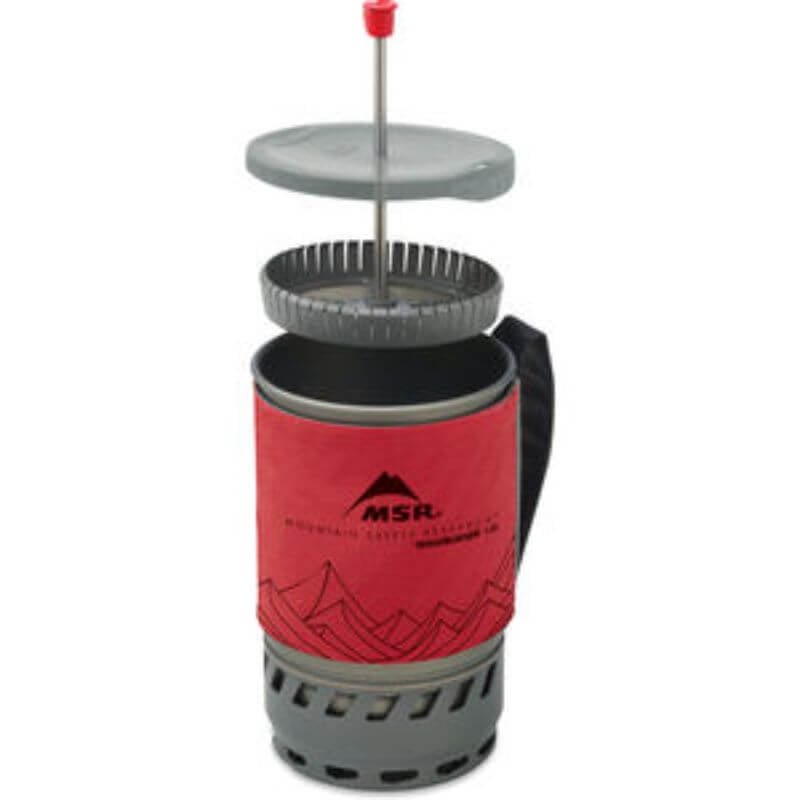
Weight: 1.3 oz / 40 grams
Type: French press plunger for MSR Windburner
Material: Plastic/silicone plunger
Servings: Fills the Windburner pot
Packability: Nests inside the Windburner
Pros:
> Lightweight
> Compact
> Makes good quality coffee
> Reasonably Priced
Cons:
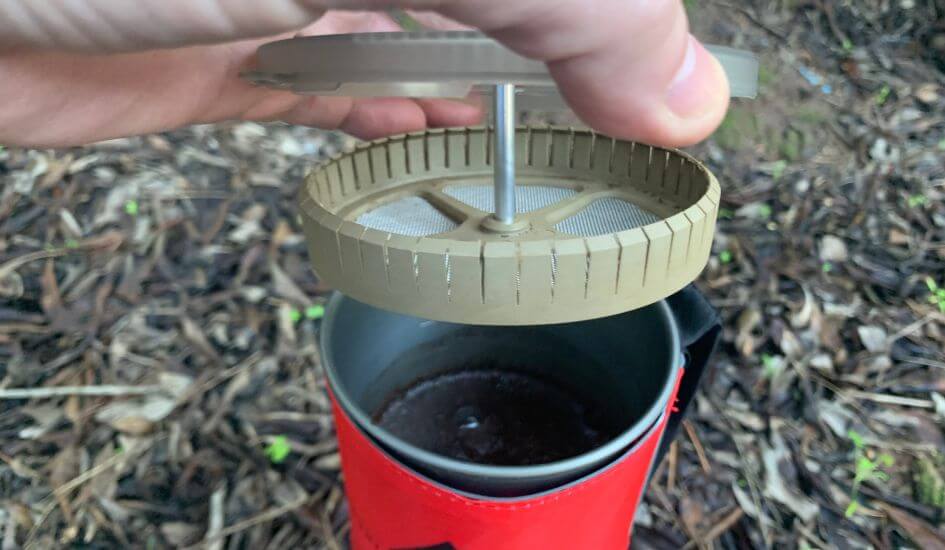
> Might be easy to lose the screw-on handles for the press
> Some coffee grounds can squeeze through the side of the press
This is the Windburner equivalent of the Jetboil press. If you already own an MSR Windburner then adding the french press is a no brainer. It turns the pot you already carry into a French press, which is the smart move for system-stove users.
It is aimed at backpackers running an MSR Windburner who want press coffee without extra kit.
In use it brews straight in the pot and is simple to operate. The trade-off is that it is tied to the Windburner system and needs disassembly to pack.
Trade-off: Windburner-only.
Best for: MSR Windburner users who want full-bodied press coffee with no added cookware.
Compare Prices:
Read the full in-depth review of the MSR Windburner Coffee Press
Best Taste Espresso Maker
Wacaco Nanopresso Portable Espresso Maker Review
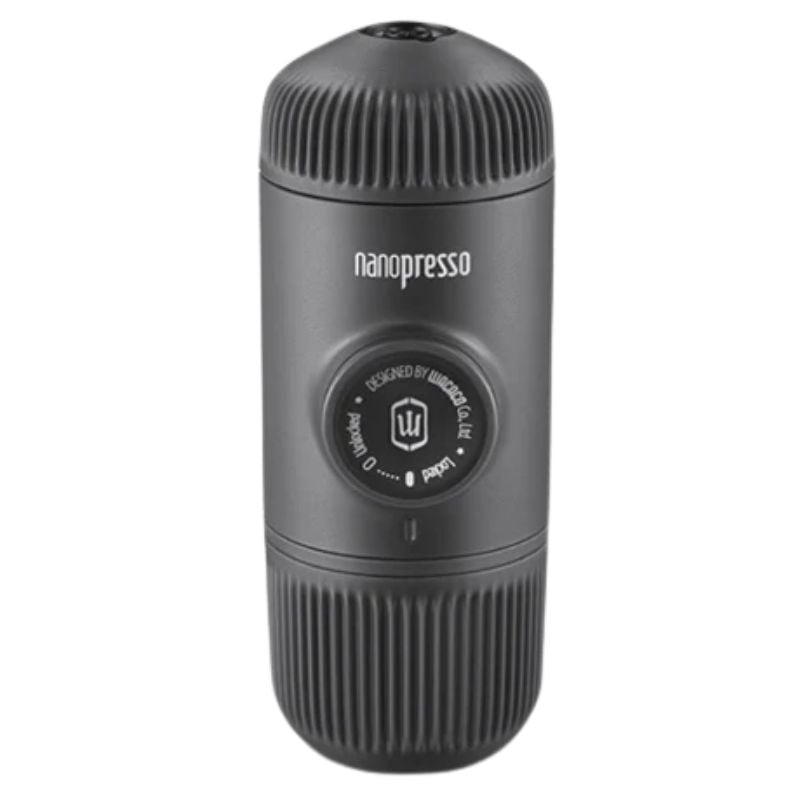
Weight: 11.8 oz / 336 grams
Type: Hand-pumped espresso maker
Material: BPA-free plastic
Servings: 1 espresso shot per cycle
Packability: Compact, comes with stuff sack
Pros:
> Coffee lovers will appreciate the quality espresso coffee that this product produces.
> The Wacaco Espresso maker doesn’t use any electricity or batteries for its power.
> It is quite small and compact.
Cons:
> Not Cheap
This makes genuine pressure-brewed espresso by hand, which no drip or press here can match. If you want a proper short black on trail, this is it.
It suits coffee snobs on car camping and bike touring trips more than ultra-strict gram-counters. I used this quite while I was working at an outdoor store as it was our go-to coffee maker in store.
In use it pulls a surprisingly good shot. The honest trade-offs are weight, lots of little parts, and slower clean-up than a simple drip cone.
Trade-off: heavier, fiddly, one shot at a time.
Best for: espresso lovers who will carry the extra grams for a real shot.
Compare Prices:
Best Backpacking Espresso Coffee Maker
Aeropress Go Coffee Maker Review
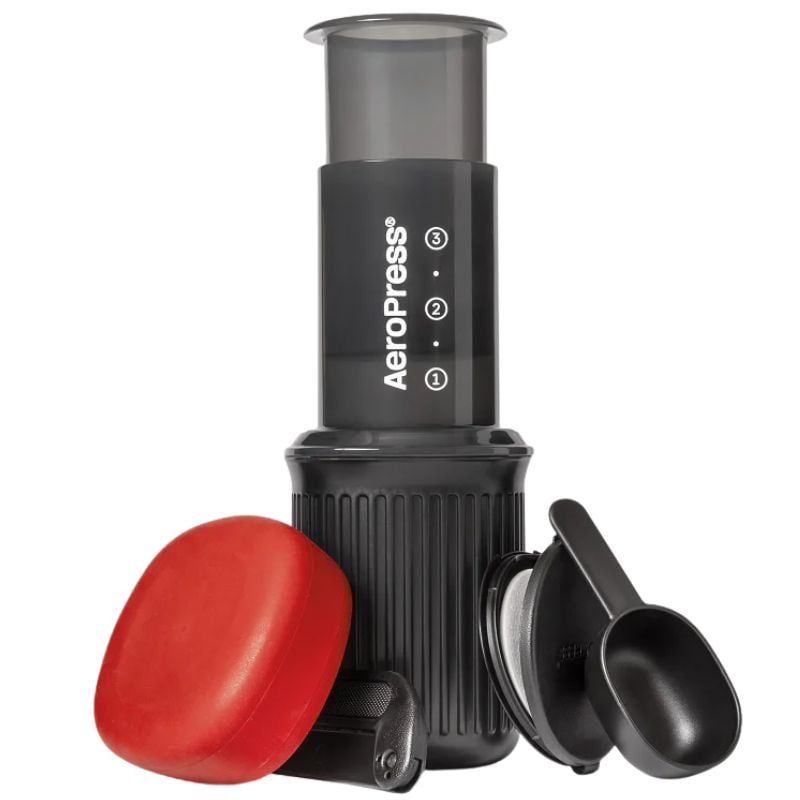
Weight: 11.5 oz / 325 grams
Type: Pour-over/press hybrid
Material: BPA-free polypropylene
Servings: 1–2 small cups
Packability: Compact, packs into itself
Pros:
> The Aeropress Coffee Makers are lightweight.
> Brew a quality full-body cup of coffee within minutes.
> This coffee maker is made from durable and reliable plastic
Cons:
> You need to use disposable paper filters every time you want to make a coffee.
This is the best-tasting brewer on the list if you put the effort in. I’ve had many coffees made from this coffee maker and I can confirm the quality is good.
It suits anyone who values flavour over absolute weight savings, on both backpacking and bike touring trips.
In use it makes a clean, rich cup fast once you know the routine. The trade-offs are the number of parts, the special filters, and that it brews one serving at a time.
Trade-off: several parts and proprietary filters to carry, and bulky size.
Best for: taste-first backpackers willing to manage a few extra pieces.
Compare Prices:
Best Instant Coffee
Starbucks VIA Instant Coffee

Pros:
> Coffee is 100% ethically sourced
> Available in handy individual packets
> Available in boxes of up to 84 count
> Tastes great considering it is instant coffee
Cons:
> Can be a little expensive
> I cannot comment on the taste of all the flavors, because I didn’t bother with the decaf one!
OK, so this review is about coffee makers but some of you might just want some backpacking instant coffee and Starbucks VIA is my overall pick and the instant coffee. I have used more than any other instant coffee. It does the one thing a backpacking coffee has to do: it is tastes good and you can find it almost anywhere. The microground packets dissolve well in hot water and it tastes good for an instant coffee, which is not something I say lightly as a coffee lover.
It suits just about every trip, from a single overnight to a long thru-hike, and the wide roast range means you can dial in the strength you like. I have tried most of the flavors and like Columbia and Pike Place, but I also really enjoyed the French dark roast, really smoky and powerful.
The trade-off is price, it costs more per serving than the supermarket brands, and the decaf I never bothered with, so I cannot comment on it.
Trade-off: costs more per packet than budget brands.
Best for: hikers who want a dependable, easy-to-find cup that tastes good.
Compare Prices:
Coffee Maker Buyers Guide
Backpacking Coffee Maker Buyers Guide
After more than 30 years of brewing coffee on trail, from the early mornings in Canada and Alaska to long bike touring days, I have learned that the best backpacking coffee maker is the one that matches your trip, not the one with the most features. Here is how I think it through before every trip.
Coffee Maker: Quick Decision Guide
- Lightest possible setup for a solo thru-hike: reusable drip cone or collapsible pour-over.
- Best-tasting cup, willing to carry parts: Aeropress.
- Already run a Jetboil or Windburner: the matching coffee press.
- Car camping or bike touring, flavour first: Bialetti moka pot.
- Real espresso on trail: Wacaco Nanopresso.
- Zero clean-up, big-mile days: quality instant.
Brew Method: Match the Coffee to the Trip
- Drip / pour-over (GSI Java Drip, Sea to Summit Frontier UL): the lightest and simplest way to get real brewed coffee. Best for solo and duo thru-hikers who want a clean cup with minimal fuss. Mesh cones skip paper filters entirely.
- French press (Jetboil and MSR Windburner presses): full-bodied coffee with no extra cookware if you already run a system stove. A little more clean-up, slightly more sludge in the cup.
- Stove-top espresso / moka (Bialetti Moka): the richest coffee here, but heavy and bulky. My pick for car camping and bike touring, not thru-hiking.
- Hand-pumped espresso (Wacaco Nanopresso): genuine pressure-brewed espresso, for coffee snobs willing to carry the grams and manage the parts.
- Instant (Alpine Start, Starbucks VIA): no brewer, no clean-up, near-zero weight. The honest choice for big-mile days and alpine starts.

Weight and Packability
For backpacking, this is usually the deciding factor. A reusable drip cone weighs well under an ounce; a moka pot or steel travel press can run over a pound. Beyond raw weight, look at packed shape: a flat-folding pour-over or a collapsible silicone cone disappears in a food bag, while a rigid cone or moka pot fights you for space. As a rule, the lighter and flatter the maker, the more likely it stays in your pack trip after trip.
Ease of Use
Nothing beats Instant Coffee for Backpacking, but if you want real coffee, count the steps. The fewer parts and pieces, the faster your morning. Ask whether you have to boil water separately or whether the device is self-contained, and whether the maker actually fits your stove or pot. An Aeropress needs a cup wide enough to press into; a moka pot needs a stable burner. Drip cones and presses are the most forgiving on a wobbly backcountry stove.
Clean-Up & Leave No Trace
Almost everything here leaves grounds to deal with and needs a rinse. Following Leave No Trace Principles, pack out all used grounds and paper filters rather than burying or scattering them. Reusable mesh and silicone makers cut filter waste, which is one reason I lean on the GSI Java Drip. Also consider cool-down time: a moka pot or metal espresso unit gets too hot to disassemble straight away, which slows down clean-up on a cold morning when you want to pack and move.
Additional Kitchen Supplies
Be honest about the full system, not just the brewer. Will you need a separate kettle or pot to boil water, or is the device self-contained? Do you already carry a mug it can sit on or press into? Paper-filter methods mean carrying a stack of filters and packing out the used ones. Factoring in these extras stops you from buying a “light” maker that quietly adds weight and bulk once everything is accounted for.
Number of Servings
Most good backpacking makers brew 1 to 3 servings. Match this to who you actually hike with. Solo and duo hikers are best served by a single-cup drip cone or press; you rarely need a unit that brews 20 ounces at once. Larger groups should consider whether there is clean-up time between servings (a real issue with single-cup pour-overs) or step up to a group press. Remember that more servings usually means a bigger, heavier unit, so do not over-buy capacity you will not use.
Material & Durability
Trail life is hard on gear. Stainless steel, aluminium, silicone, and tough BPA-free plastics survive being crushed in a pack; glass and anything rust-prone do not belong in the backcountry. Material also drives weight and how the coffee tastes, so the lightest reliable option usually wins for backpacking. For a maker you will use for decades, like my GSI Java Drip, durability is part of the value.
Coffee-to-Water Ratio
For a consistent cup, brew by weight. A roughly 16:1 water-to-coffee ratio (about 300 g water to 16 g coffee per cup) is a reliable starting point; adjust to taste. Stronger methods like espresso let you stretch a small, strong extraction into a longer Americano by adding hot water, getting more cups from less coffee, which can matter on a long trip. A tiny digital scale makes this easy at home; on trail, most of us measure by a known scoop and dial it in.
Choosing the Right Grind
Grind size is the most overlooked variable, and getting it wrong ruins good beans. Match the grind to the method:
- Fine: espresso makers (Wacaco, moka pot).
- Medium: pour-overs and drip cones.
- Coarse: French presses, to keep grounds out of the cup.
Decide whether you will buy pre-ground for one method or carry a small manual grinder so you can grind fresh and keep flexibility. For most thru-hikes, pre-ground to the right size saves weight and hassle.
Value
Most makers here are affordable, and for coffee lovers they are easily worth it. The pricier options are usually the espresso units. The best value is not the cheapest maker, it is the one that suits your trips and lasts: a $15 drip cone you use for 20 years beats a cheap unit you replace every season. For many of us there is no reason not to own one or two and pick the right one for each trip.
Conclusion
For the year 2026 these are the Best Camping Coffee Makers:
- Best Overall: GSI Outdoors Ultralight Java Drip
- Best Quality Camp Espresso: Bialetti Moka
- Best Ultralight Pour-Over: Sea to Summit Frontier UL Collapsible Pour Over
- Best Backpacking Coffee Press: Jetboil Coffee Press
- Best for MSR Windburner: MSR Windburner Coffee Press
- Best for Gourmet Taste: Aeropress Coffee Maker
- Best Backpacking Espresso: Wacaco Nanopresso
- Best Instant Coffee: Starbucks VIA
Another one of the Best Backpacking Gear Reviews from BikeHikeSafari.
Follow along on Social Media
Frequently Asked Questions
What is the best backpacking coffee maker?
For most ultralight backpackers I recommend the GSI Outdoors Ultralight Java Drip. It is featherweight, needs no paper filters, and brews a clean cup on any stove. If you want the lightest possible pour-over, the Sea to Summit Frontier UL collapses to almost nothing.
What is the best ultralight coffee maker?
A reusable mesh drip cone like the GSI Java Drip or a collapsible silicone pour-over like the Sea to Summit Frontier UL are the lightest practical options. Both weigh well under an ounce and pack flat, which is why they win for thru-hiking.
Is instant coffee or a brewer better for thru-hiking?
Instant wins on weight, speed, and clean-up, and quality instant like Alpine Start is genuinely good now. A brewer wins on flavour and the morning ritual. Many thru-hikers carry instant for big-mile days and a light drip cone for slower mornings.
How do you make espresso while backpacking?
A hand-pumped maker like the Wacaco Nanopresso brews real pressure-extracted espresso, while a Bialetti moka pot makes strong stove-top espresso for car camping and bike touring. Both are heavier than a drip cone, so they suit trips where flavour beats grams.
How do you clean a coffee maker in the backcountry?
Pack out all used grounds and paper filters under Leave No Trace, then rinse the maker with a little water away from streams and lakes. Reusable mesh and silicone makers are quickest to clean since there are no filters to deal with.
How long should you percolate coffee on a camp stove?
Once it boils, move the pot to the edge of the fire or turn the stove low and let it percolate 5–10 minutes. Longer makes it stronger, so judge it by how you like your coffee.
Do you need filters for a backpacking coffee maker?
It depends on the maker. Mesh drip cones, French presses, and moka pots need no paper filters, while pour-overs like the Hario V60, MiiR Pourigami, and Sea to Summit Frontier UL do. Going filter-free means less waste to pack out.


BikeHikeSafari Gear Review Process
The author, Brad McCartney from BikeHikeSafari is a small independent adventurer and outdoor gear tester who owns and runs BikeHikeSafari.com.
BikeHikeSafari is not part of a large blog network and is proudly independent. All reviews on this site are independent and honest gear reviews of outdoor products by the author.
The author, Brad McCartney is a very experienced triple crown thru-hiker, adventurer, and bike tourer having spent 1000s of nights sleeping in a tent and sleeping bag (Read more). He was a manager of an outdoor retail store and is very experienced in what is important when using and testing gear for reviews like this.
BikeHikeSafari will never receive any money for reviews and they do not accept sponsored reviews on this website. All the comments about the gear reviews are from the author based on his years of experience. Hope this independent review was helpful for you.

