

After more than a decade of thru-hiking and thousands of cooked meals on trail. From the PCT and AT to the Te Araroa and the high Andes, I’ve been carrying, burning, denting and quietly retiring backpacking pots the whole way. This guide is for ultralight backpackers and thru-hikers who want a real, field-tested shortlist rather than a generic camping list.
Hiking cookware should be as lightweight as possible and not too big and bulky for your needs, just add a Backpacking Stove or an Alcohol Stove and a Titanium Spork and you are ready to cook.
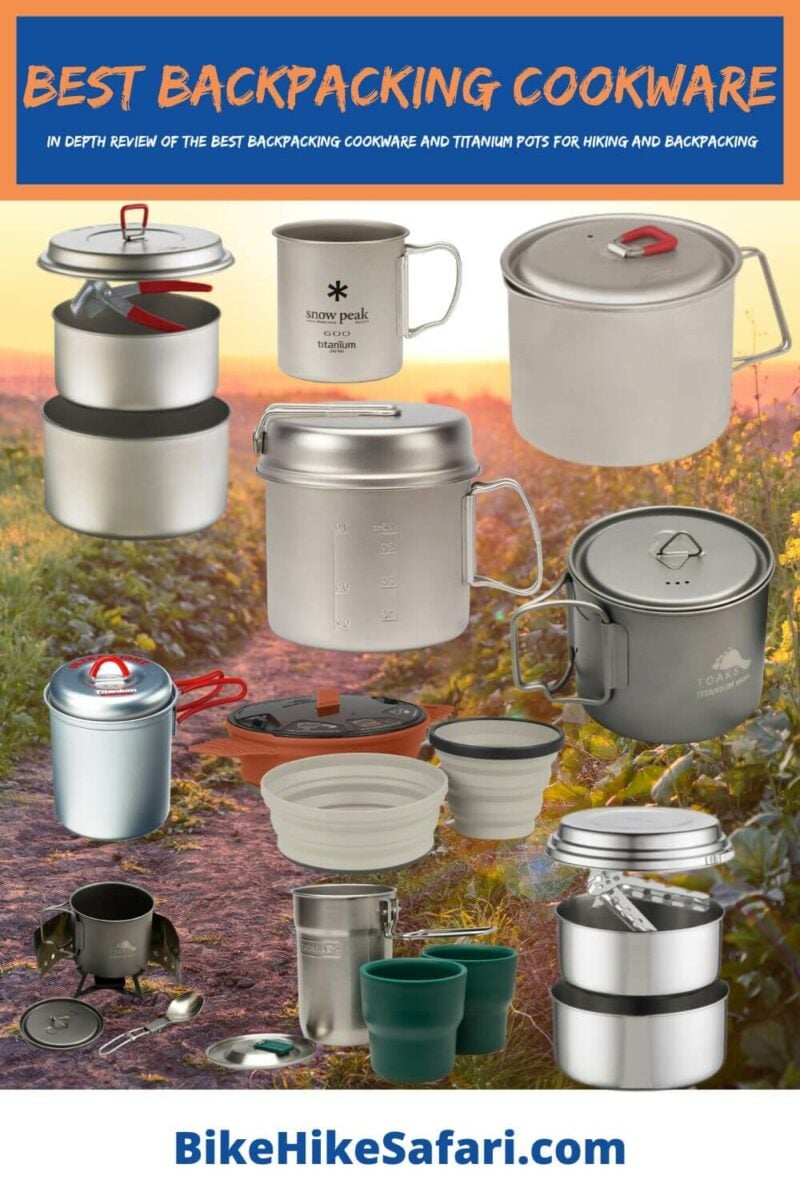
My current overall pick is the Snow Peak Trek 900, with the Fire Maple Petrel G2 as the best heat exchanger pot for fuel-efficient boiling in cold and wind, and the TOAKS Titanium 750ml Pot as the best lightweight solo pot. The core trade-off for this category is simple: heat exchanger aluminum boils faster and saves fuel, while titanium saves grams.
Quick Picks – Best Ultralight Backpacking Cookware 2026
- Best Overall: Snow Peak Trek 900 Titanium Cook Set – My personal go-to for over a decade of thru-hiking. Pot + skillet/lid combo, 6.2 oz, lifetime warranty.
- Best Ultralight Titanium Pot: TOAKS Titanium 750ml Pot – The most popular thru-hiker pot for a reason. 3.6 oz, fits a 110g canister and stove inside.
- Best Ultralight Solo Cup-Pot: Snow Peak Trek 700 Mug – Tiny, ultralight, perfect for boil-and-rehydrate solo hiking.
- Best Heat Exchanger Pot: Fire Maple Petrel G2 – Best fuel efficiency for cold and windy conditions, around 30% less fuel use than a flat-bottomed titanium pot.
- Best for Thru-Hiking: Vargo Bot 700ml – Doubles as a cold-soak jar and water container. A true thru-hike multi-tool.
- Best Compact Cookset: Sea to Summit Frontier Ultralight Collapsible Set – Packs flat. Great for bikepacking and short trips where bulk matters more than grams.
- Best Large Capacity Ultralight: Evernew Ti UL 1300 Pot – 4.6 oz with a wide base. The best titanium pot for two ultralight hikers.
- Best Stainless Steel: MSR Alpine Stainless Steel 2 Pot Set – Reasonably priced, almost indestructible, fire-safe, heavy.
Backpacking Cookware Comparison Table
| Brand | Material | Weight | Capacity |
|---|---|---|---|
| Snow Peak Trek 900 Titanium Cook Set | Titanium | 6.2 oz | 900 ml |
| TOAKS Titanium 750ml Pot | Titanium | 3.6 oz | 750 ml |
| Snow Peak Trek 700 Mug | Titanium | 4.8 oz | 700 ml |
| Fire Maple Petrel G2 | Aluminum | 6.5 oz | 750 ml |
| Vargo Bot 700ml | Titanium | 4.8 oz | 700 ml |
| Sea to Summit Frontier Ultralight Collapsible Set | Silicone / Aluminum | 11.2 oz | 1.1 L |
| Evernew Ti UL 1300 Pot | Titanium | 4.6 oz | 1.3 L |
| MSR Alpine Stainless Steel 2 Pot Set | Stainless Steel | 1 lb. 10 oz | 1.5L, 2L |
How We Tested
The backpacking cookware in this guide is researched and, where possible, field-tested by an experienced long-distance thru-hiker and former outdoor store manager. Across thousands of nights on the PCT, AT, CDT, Te Araroa and shorter backpacking and bikepacking expeditions, I judge backpacking cookware on weight-to-capacity, packability, boil time and fuel efficiency, lid and handle design, durability over years of use, and value for serious backpacking. Some of the items here were supplied by the manufacturer and some were purchased by the author for this review. For more on how I research and review gear, see the Review Policy for further details
Follow along on Social Media
Best Backpacking Cookware 2026 – Detailed Reviews
Best Backpacking Pot – Overall
Snow Peak Trek 900 Titanium Cook Set Pot and Skillet
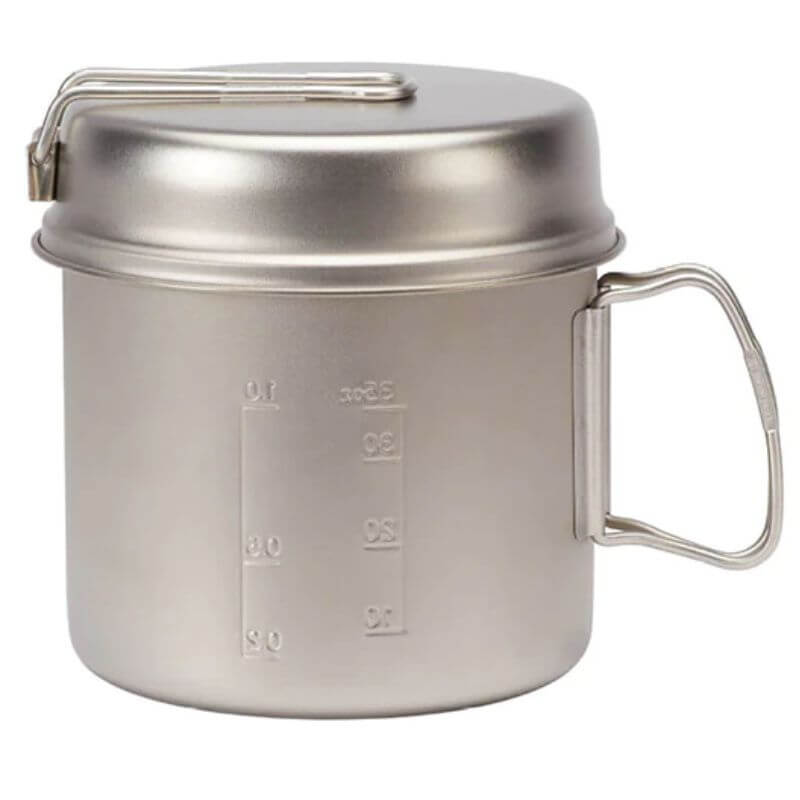
Weight: 6.2 oz / 175 grams
Material: Titanium
Capacity: 900 ml pot
Lid: Small skillet/lid
Pros:
> Made with titanium
> Includes pot & skillet
> Skillet doubles as a lid
> Lifetime guarantee
Cons:
> The Skillet isn’t a perfect fit as a lid
> The Skillet is not made of non-stick material
This has been my go-to backpacking cookset for more years than I can remember, and thousands of meals later it has not let me down. The pot/skillet combo gives me a 900 ml main pot plus a small skillet that doubles as a lid, which is enough flexibility for two-course solo meals or a main and a small side.
Both pieces are pure Grade A Japanese titanium with foldaway handles are slightly thicker and stronger than any of the other backpacking pots in this review. The pot is big enough to fit the medium sized 230 g gas canister inside. I ditched the supplied mesh sack years ago for a lightweight stuff sack but otherwise everything is original.
The honest trade off is the skillet/lid combo. It is a usable skillet but not non-stick, so pancakes or eggs are a not easy. As a lid it covers but does not seal. If you actually want to cook food rather than boil water, this is not the lightest or the easiest cookset, heat exchanger pots and the MSR Trail Mini Solo will outperform it for that. But for boil-water thru-hikers who want one titanium pot and a skillet for occasional real cooking, the Trek 900 still earns its place at the top.
Trade off: Versatility and lifetime warranty in exchange for slightly more weight than a single-pot titanium setup.
Best for: Solo and two-up backpackers and thru-hikers who want one titanium pot for life.
Compare Prices:
Best Titanium Backpacking Cookware
TOAKS Titanium 750ml Pot Review
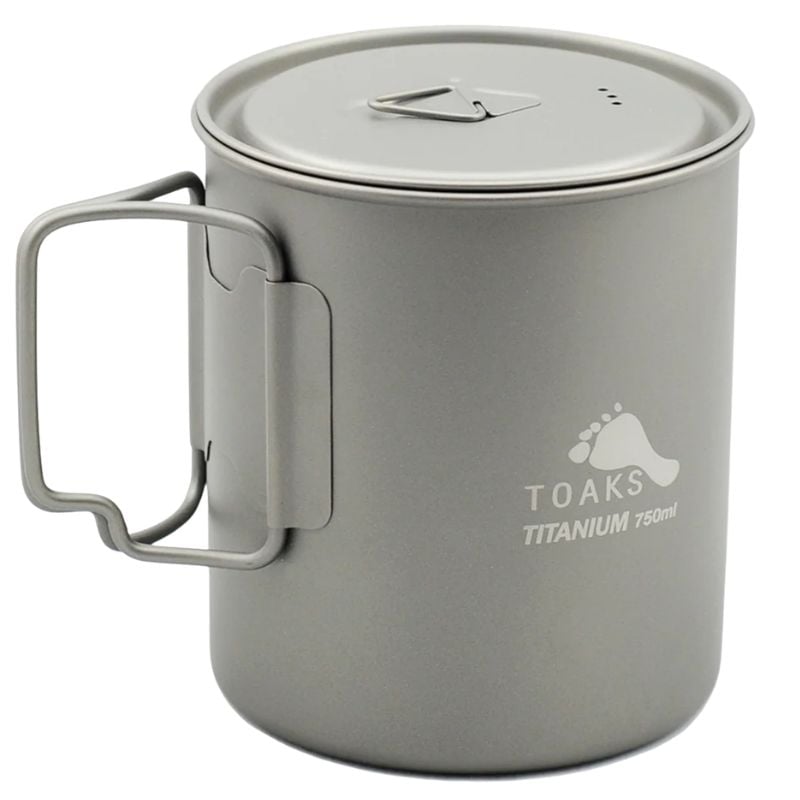
Weight: 3.6 oz / 103 grams
Material: Titanium
Capacity: 750 ml
Lid: Yes
Sizes available: 550, 650, 750, 900, 1100, 1600 ml
Pros:
> Made with titanium
> Ultralight
> 750 ml size is perfect size
> Comes with a lid
Cons:
> Not much, not big enough for more than 1 person.
The TOAKS 750 is the most popular titanium pot on long-distance trails for a reason. It is light, cheap, well featured, durable enough for thousands of miles, and just the right size for one hiker who wants a hot meal and a coffee.
The 750 ml is the sweet spot. I used to recommend the 550 ml version which is great if you only ever boil water for one freeze-dried meal, but the 750 gives you extra room for ramen, rice or oats plus a hot drink. It also nests the small size 110 g canister and a small backpacking stove like the Pocket Rocket 2 or Soto Windmaster.
Like all thin-wall titanium, the TOAKS heats fast but unevenly. Real cooking will scorch the base unless you stir constantly and run the stove low. For boil-water style thru-hiking it is hard to beat at this weight and price.
Trade off: Ultralight and cheap, in exchange for hot spots and a fairly loose lid.
Best for: Solo ultralight backpackers and thru-hikers who mostly boil water.
Compare Prices:
Best Ultralight Titanium Hiking Pot
Snow Peak Trek 700 Mug Review
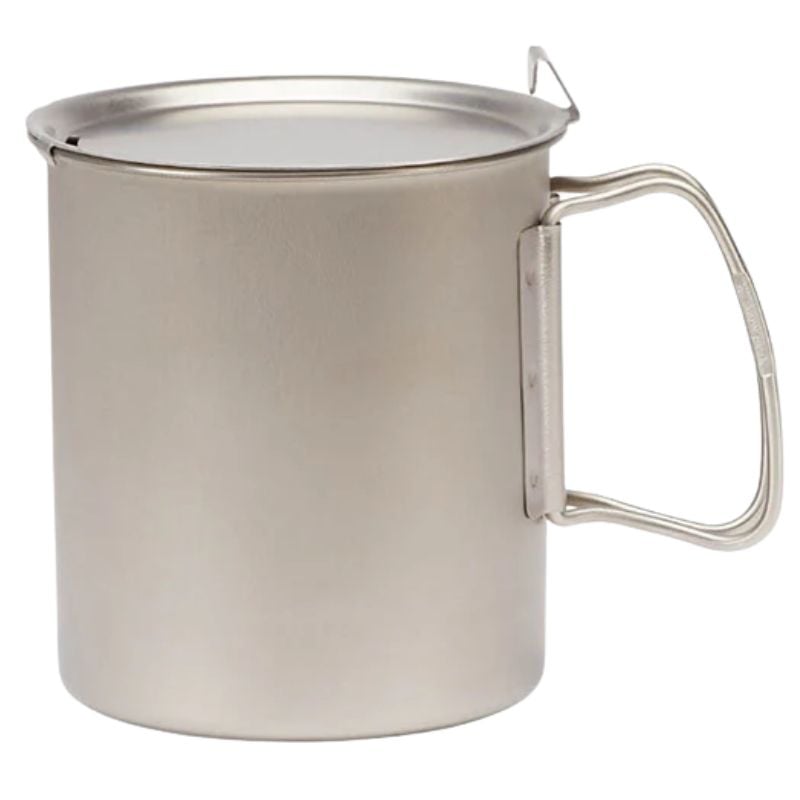
Weight: 4.8 oz / 88 grams
Material: Titanium
Capacity: 700 ml
Lid: Yes
Pros:
> Ultralight
> Made with titanium
> 700 ml size
> Handles fold down
Cons:
> Heavier than the Toaks pots
For minimalist thru-hikers who only need to boil water for freeze-dried meals and a hot drink, the Snow Peak Trek 700 Titanium Mug is the right size. It is light, durable, and just big enough to handle a solo ramen plus a coffee on the side.
The slightly bigger 700 ml is a preferred upgrade over my old Ti-Single 600 favourite. Like all narrow ti mugs it has hot spots, so it is for boiling water, not for cooking. It is big enough to fit the small 110 g gas canister inside the pot. It is also made from a heavier and stronger grade of titanium than the lighter Toaks range of cookpots.
Trade off: Tiny capacity in exchange for very low weight.
Best for: Boil-water-only solo thru-hikers, fastpacking, weight-obsessed setups.
Compare Prices:
Best Heat Exchanger Pot
Fire Maple Petrel G2 Review
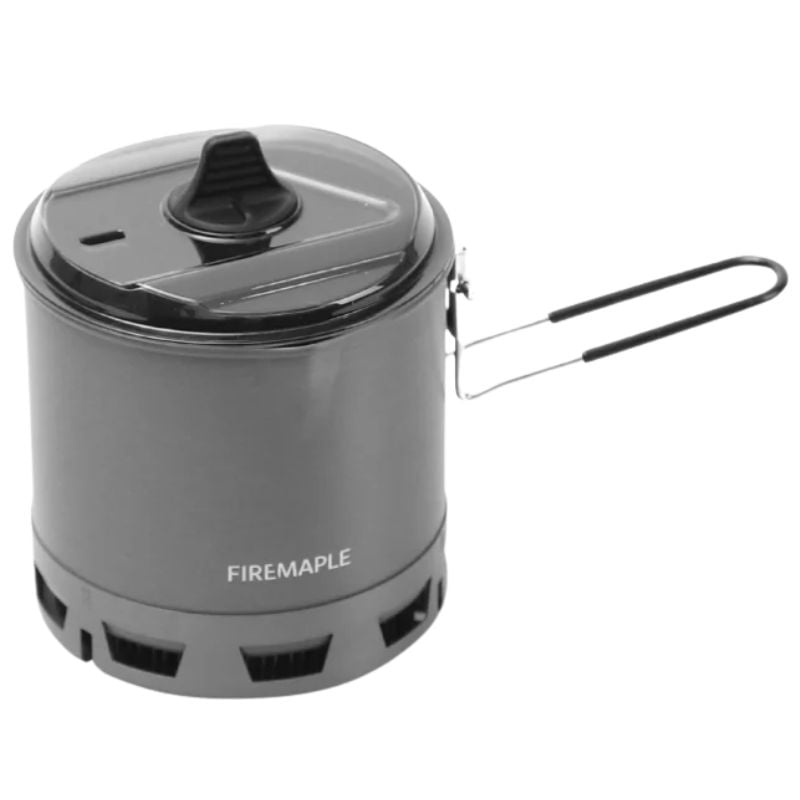
Weight: 6.5 oz / 184 grams
Material: Anodized aluminum pot, Tritan plastic lid, silicone grip
Capacity: 750 ml
Heat exchanger: Yes, slotted ring
Lid: Triton Plastic lid
Pros:
> Rapid boil time
> Lightweight
> Reasonably priced
Cons:
> Not as light as many titanium pots
Heat exchanger pots are the biggest shift in backpacking cookware in the last decade, and the Fire Maple Petrel G2 is one of the two best on the market alongside the wider Petrel 800 Ramen. The corrugated aluminum ring under the base concentrates heat and blocks wind, and in field testing it cuts fuel use by around 25 to 30% compared to a flat-bottomed titanium pot.
For thru-hiking that means real grams saved over a long trail in fuel weight, not just on the pot itself. The G2 also nests an 8 oz canister, which a lot of HX pots can’t do.
The trade off is bulk and weight on the pot itself — a Petrel G2 is heavier than my TOAKS — but in cold, wet, or windy conditions it earns back every gram. If you mostly hike fair-weather summer trails and only ever boil water for freeze-dried meals, a titanium pot is still fine. For shoulder season, alpine starts and cold mountain mornings, an HX pot is the more honest choice.
Trade off: A few extra ounces on the pot for noticeably less fuel carried.
Best for: Cold and windy conditions, longer thru-hikes where fuel weight adds up, hikers who want faster boils.
Compare Prices:
Best Thru-Hiking Pot
Vargo Bot 700ml Review
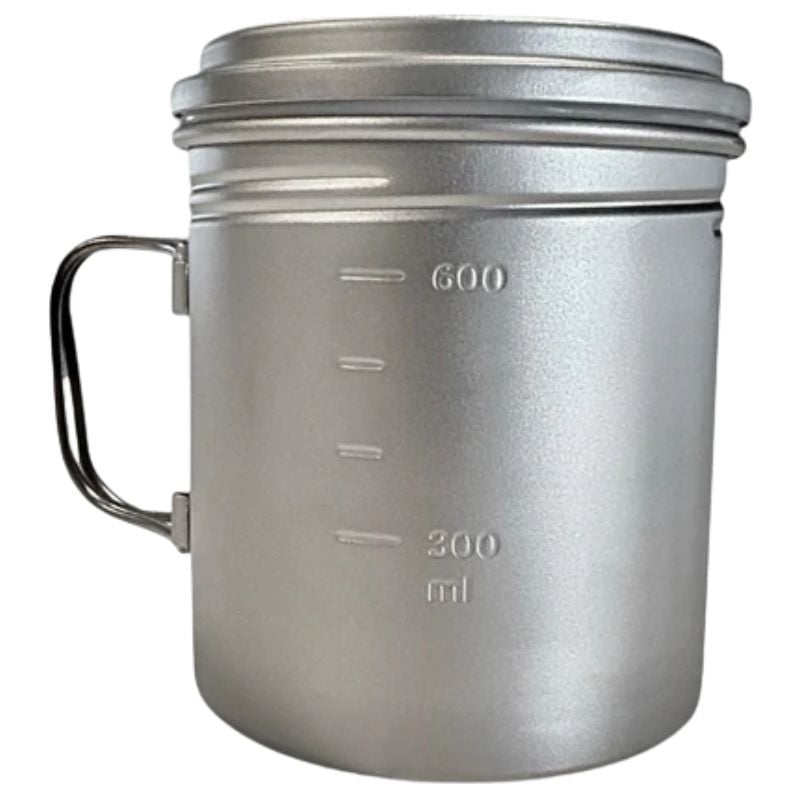
Weight: 4.8 oz / 138 grams
Material: Titanium
Capacity: 700 ml
Lid: Screw-on with silicone seal, fully watertight
Sizes available: 700 ml, 1 L, 1.1 L
Pros:
> Can be used for cold soaking meals
> Easy Installation
> Durable
Cons:
> Don’t heat food then put the lid on, almost impossible to open when it cools
> Lid can get damaged
> More care needed when cleaning, especially the lid
The Vargo Bot is the niche thru-hiker’s answer to redundancy in the kitchen. The screw-on titanium lid turns a regular cookpot into a sealable container, which means you can cold soak overnight, use it as a backup water bottle on a dry stretch, or pack it with food without anything leaking into your bag.
I’d recommend the 700 ml for most thru-hikers. It sits more stably on a canister stove than the taller 1L. The wider 1.1L is another worthy choice if you want a bigger and wider pot.
The trade offs are real. The screw lid can be a difficult at elevation when pressure changes and do not put hot water in the pot to soak your food, when it cools the pressure change will seal the lid in a way that makes it difficult to open, you have been warned! You pay a premium for the precision threads. But if cold soaking is part of your routine but still want the option to boil water or have a hot meal then this is the best option on the market.
Trade off: Premium price and a fiddly lid for true pot + bottle + cold-soak versatility. Cold soaking food is not for everyone, I’ve tried it and I know it is not for me.
Best for: Thru-hikers who cold soak, ultralight bikepackers, anyone trying to cut redundant items.
Compare Prices:
Best Compact Backpacking Cook Set
Sea to Summit Frontier Ultralight Collapsible Set

Weight: 11.2 oz / 317 grams
Material: Food grade silicone rubber and anodized aluminium base
Capacity: 1.1 L Kettle
Lid: Yes
Pros:
> Very compact size
> Includes large pot, cup, and bowl
> Perfect for one person (2 person version available)
> Stackable with all other Sea to Summit pots, bowls, or cups, can easily turn it into a 2-person cookset.
Cons:
> Heavy
> Cant be used on a campfire or stove at home
The Sea to Summit Frontier Ultralight Collapsible Kettle 3-Piece Cookset with Cup and Bowl is the newest updated cooking system for STS that replaced the popular X-Series. It is the most compact backpacking cookware set in this review and it is a modular system, so you can add more Sea to Summit bowls, cups, pots, or kettles to the system if you want to make it a 2-person cookset, or 3-person cookset.
The Sea to Summit Frontier Ultralight Collapsible cookware system is a little on the heavy side at 11.2 oz / 317 grams so ultralight hikers will not seriously look at this as something to consider. But for overnight or week-long backpacking trips or Bikepacking trips, it is certainly a worthy consideration. I have been using the collapsible mug and bowl for many years and can confirm they are durable for long-term use.
Trade off: Heavier than a comparable ti pot for genuinely better packability.
Best for: Bikepackers, weekend backpackers, hikers who care more about pack volume than grams.
Compare Prices:
Best Large Capacity Ultralight Pots
Evernew Ti UL 1300 Pot Review
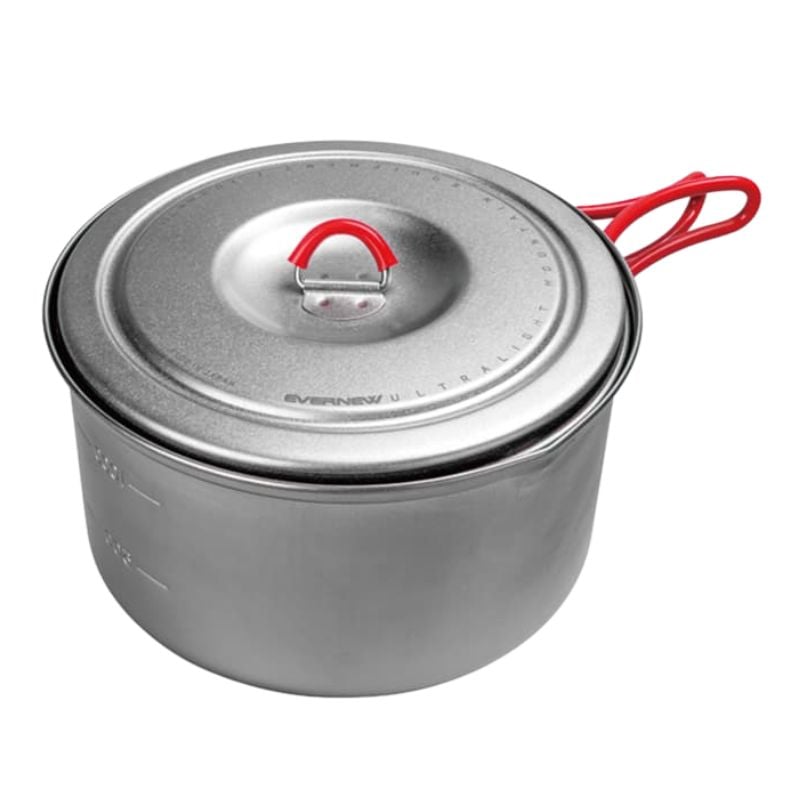
Weight: 4.6 oz / 130 grams
Material: Titanium
Capacity: 1.3 L
Lid: Yes
Insulated handles: Yes, on pot and lid
Pros:
> Made with titanium
> Can fit 2 small gas canisters inside
> Large 1300 ml size
> Safe red fold-away handles
Cons:
> Premium product at a premium price
The Evernew Ti UL 1300 is the answer for ultralight couples who want a real ti pot for two or who just want more headroom for cooking. At a bit over 4 oz for a full 1.3 L pot with a lid and insulated handles, the value-per-gram is excellent.
The wide base spreads heat more evenly than a tall narrow titanium pot like the TOAKS, which means actually cooking pasta or one-pot meals is more realistic. The lid is tight enough to seal for storage and fit cooking gear and a gas canister.
Trade off: Best-in-class titanium features and capacity, but harder to source than a TOAKS.
Best for: Couples thru-hiking, solo hikers who want to actually cook, ultralight hikers who hate drain spills.
Compare Prices:
Best Stainless Steel Backpacking Pots
MSR Alpine Stainless Steel 2 Pot Set

Weight: 26 oz / 730 grams
Material: Stainless steel
Capacity: 1.5 L and 2 L
Lid: Yes 1 lid fits both pots
Handles: Yes
Pros:
> Almost unbreakable
> Great to use on an open-fire
> You can use one pot or both depending on what trip you have planned
Cons:
> Heavy
If you cook on a fire, you guide, or you just want a pot that will never warp, the MSR Alpine Pots is the pick. While they are heavy I used these pots for many years when I hiked in areas that allowed me to cook on an open fire.
Stainless is heavy compared to titanium and ultralight hikers will not look at it twice. But it is almost indestructible, heats evenly, cleans easily, and handles direct fire without flinching. For shoulder-season trips where I want a fire-safe pot, this is what I take.
Trade off: Significant weight for true durability and fire safety.
Best for: Guides, fire cookers, base camp + day hike setups, ultralight hikers’ “rough trip” backup.
Compare Prices:

Other Backpacking Pots and Hiking Cooksets
The backpacking cookware list below might be a good option and may be added when they have been reviewed.
- MSR Trail Mini Solo – Anodized aluminum, drain holes, pot lifter, measuring cup, all-in-one beginner-to-thru-hiker friendly.
- Evernew Titanium Pasta Pot 1L – 4.4 oz with a wide base, strainer holes, and pour spout. The best titanium pot for two ultralight hikers.
- GSI Halulite Boiler 1.1L – Durable, even heat, insulated handles, great value.
- MSR Alpine Stowaway 1.1L – Cheap, almost indestructible stainless steel, fire-safe.
- MSR Ceramic Solo Pot 1.3L – PFAS-free non-stick.
Cookware Buyers Guide
Cookware Buyers Guide
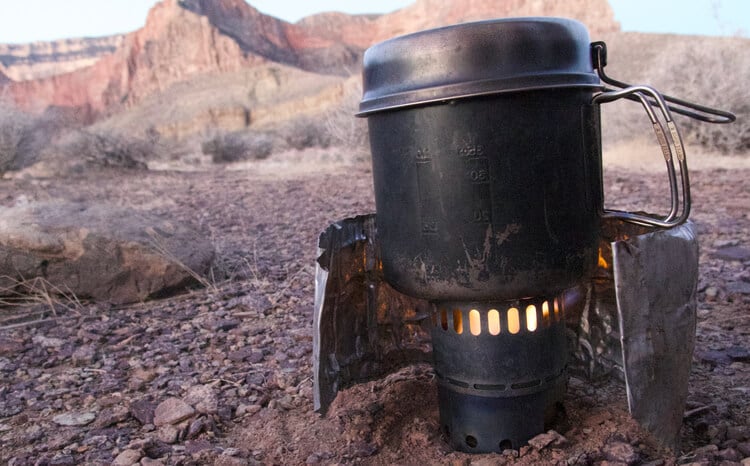
Material – Titanium, Aluminum, Stainless Steel, silicone
Titanium
Titanium is still the default for ultralight thru-hiking. It is roughly half the weight of stainless, doesn’t taste of metal, is corrosion resistant, and durable for what it weighs. The trade off is heat, thin titanium creates hot spots that will scorch food. For boiling water, it is hard to beat.
Hard-anodized aluminum
Hard-anodized aluminum is the right call if you actually cook. Heat spreads more evenly, the wall thickness is more forgiving, and modern non-stick coatings (especially MSR’s ceramic) hold up well. Aluminum is also the only material that supports a heat exchanger base, which is the biggest reason it has come back into ultralight conversations.
Stainless steel
Stainless steel is heavy but almost indestructible, fire-safe, and cheap. Worth it for fire cookers, guides, and hikers who want one pot for life.
Silicone
This is a new and interesting material that has recently made its way into backpacking cookware. Primarily it is used by Sea to Summit on the Frontier Collapsible Series Pots and all their other ‘Frontier’ products. Essentially the base of the pot is made with material such as Stainless steel and the sides are made with silicone and made in a way to be compressible and stackable. A brilliant idea that works very well, although they are quite a bit heavier than titanium
Heat Exchanger Pots – The Biggest Shift in Backpacking Cookware
A heat exchanger pot has a corrugated aluminum ring under the base that concentrates flame and blocks wind. In real testing the boost is significant, around 25 to 30% less fuel used to boil the same amount of water, with bigger gains in cold and wind. For shoulder season, alpine starts and cold mountain mornings, that fuel savings adds up over a long trail and can outweigh the extra 2 to 3 ounces on the pot itself.
The honest counter is that for short, warm-weather summer trips an ultralight titanium pot still wins on total weight. The right answer depends on your trail, season, and how much you cook.
Pot Size and Volume
As a rough rule, plan on 500–700 ml per hiker. A 700–750 ml pot is right for one. A 900 ml–1.1 L pot is right for two or for one hiker who likes a hot drink alongside their meal. A 1.3–1.5 L pot is the right call for two people who actually cook.
Lids, Spouts and Strainer Holes
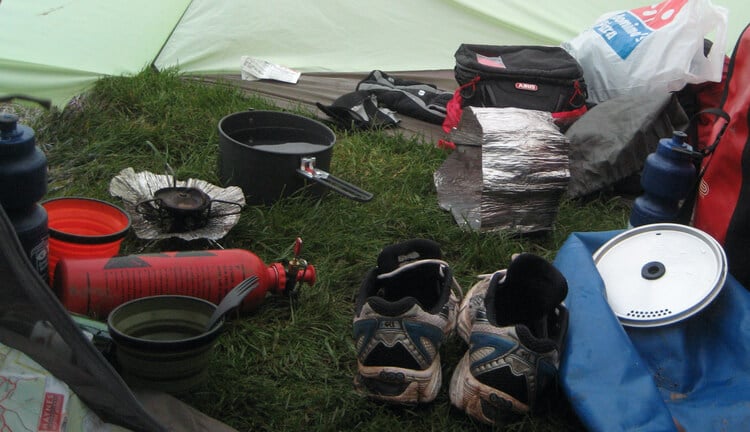
A good lid does three jobs – covers, drains, and pours. Most titanium lids fail at draining because they sit loose. Aluminum pots with snap-fit lids (Petrel G2) handle pasta water far better. Pour spouts matter every time you fill a freeze-dried meal bag.

Packability and Nesting a Fuel Canister
Inside the pot you should be able to fit, at minimum, a 110 g canister and a small stove. Bigger pots will nest an 8 oz canister too. Folding handles and a lid that snaps in place keep the whole thing quiet inside a pack.
Cooking vs Boiling Water
If your trail meals are 90% boil-and-rehydrate, a titanium pot is fine. If you actually cook eggs, pasta, real pan meals, go anodized aluminum, and look at ceramic non-stick (MSR Ceramic Solo) to avoid PFAS-based coatings.
Cold Soaking
If you cold soak meals, a sealable pot like the Vargo Bot does double duty as a cookpot, a cold-soak jar, and an emergency water container. That can remove a piece of plastic from your kit entirely. A word of warning about cold soaking, it is not for everyone, but everyone should try it at least once. I have tried it while thru-hiking and hated it as I love a warm meal at the end of the day.
Price and Value
Titanium costs more per gram. Anodized aluminum is the best value for cooking performance. Stainless is the best value for durability. Heat exchanger pots are surprisingly affordable for what they save you in fuel weight on a long trail. When you consider backpacking pots and cookware should last 20+ years the little extra you spend at the checkout is as much of a concern.

Conclusion
Here are the Best Backpacking Pots and Cookware Sets for Backpacking:
- Best Overall: Snow Peak Trek 900 Titanium Cook Set
- Best Ultralight Titanium Pot: TOAKS Titanium 750ml Pot
- Best Ultralight Solo Cup-Pot: Snow Peak Trek 700 Mug
- Best Heat Exchanger Pot: Fire Maple Petrel G2
- Best for Thru-Hiking: Vargo Bot 700ml
- Best Compact Cookset: Sea to Summit Frontier Ultralight Collapsible Set
- Best Large Capacity Ultralight: Evernew Ti UL 1300 Pot
- Best Stainless Steel: MSR Alpine Stainless Steel 2 Pot Set
Another one of the Best Backpacking Gear Reviews from BikeHikeSafari.
Frequently Asked Questions
What is the best backpacking cookware for thru-hiking?
For most thru-hikers, the Snowpeak 900ml titanium or TOAKS Titanium 750ml are still the best, they are light, cheap, durable enough for thousands of miles, and the right size for one hiker. If you cold soak, the Vargo Bot is a stronger choice. If fuel weight on a long trail matters more than pot weight, a Fire Maple Petrel G2 heat exchanger pot can save more fuel than it costs in grams.
Is titanium or aluminum better for backpacking cookware?
Titanium for ultralight and boil-water cooking. Aluminum for actual cooking, even heating, and any pot with a heat exchanger base. There is no single “best material”, match the material to how you cook.
What is a heat exchanger pot and is it worth it?
A heat exchanger pot has a corrugated aluminum ring under the base that concentrates flame and blocks wind. In real conditions it cuts fuel use by around 25-30% versus a flat-bottomed titanium pot. For cold, wet, windy or long trips it is worth the extra 2-3 oz on the pot. For short, warm summer trips, an ultralight titanium pot is still lighter overall.
What size pot do I need for backpacking?
Around 700-750 ml per hiker for boil-and-rehydrate meals. A 1 L pot covers one big eater or two minimalists. A 1.1-1.3 L pot is right for two hikers who actually cook.
Can you cook food in a titanium pot or only boil water?
You can cook in titanium, but you have to fight it. Thin titanium creates hot spots that burn food. Run the stove low, stir often, and use slightly more oil or water. For real cooking, anodized aluminum or ceramic-coated aluminum is much easier.
Are non-stick backpacking pots safe?
Traditional Teflon coatings can flake and contain PFAS chemicals that some US states are phasing out. Ceramic non-stick (like MSR’s Fusion / Ceramic Solo) is PFAS-free and the safer non-stick option for backpacking cookware.
Follow along on Social Media
BikeHikeSafari Gear Review Process
The author, Brad McCartney from BikeHikeSafari is a small independent adventurer and outdoor gear tester who owns and runs BikeHikeSafari.com.
BikeHikeSafari is not part of a large blog network and is proudly independent. All reviews on this site are independent and honest gear reviews of outdoor products by the author.
The author, Brad McCartney is a very experienced triple crown thru-hiker, adventurer, and bike tourer having spent 1000s of nights sleeping in a tent and sleeping bag (Read more). He was a manager of an outdoor retail store and is very experienced in what is important when using and testing gear for reviews like this.
BikeHikeSafari will never receive any money for reviews and they do not accept sponsored reviews on this website. All the comments about the gear reviews are from the author based on his years of experience. Hope this independent review was helpful for you.

