

On the desert sections of the PCT or AZT you are likely to see ultralight thru-hikers cutting more than a pound from their pack by ditching the backpacking tent for an ultralight tarp. If you are a thru-hiker, ultralight backpacker, or bikepacker looking for the lightest reliable shelter you can carry, a well-pitched ultralight tarp will do more for your weight savings than almost any other piece of gear. I am a long-distance hiker and former outdoor store manager, and the backpacking tarps in this guide represent the best available for backcountry conditions across thru-hikes and shoulder-season trips.
My current top pick is the Hyperlite Mountain Gear Flat Tarp, with the Zpacks Flat Tarp as the lightest serious option on the planet, and the Gossamer Gear Twinn Tarp as the best value catenary cut. For most of these tarps, all you need to pitch them are some Lightweight Trekking Poles and Lightweight Tent Stakes. The core trade-off you will be navigating: weight and packability versus weather coverage and pitching versatility. For how I research and field-test gear, see the Review Policy for further details.
Backpacking Tarp 2026 – Quick Picks
- Best overall: Hyperlite Mountain Gear Flat Tarp – full-size DCF tarp with lots of tie-outs, the workhorse I keep coming back to for thru-hiking.
- Best ultralight DCF: Zpacks 7′ x 9′ Flat Tarp – the lightest backpacking tarp on the planet, the obvious choice if you are counting every gram.
- Best catenary cut: Mountain Laurel Designs Grace Tarp – drum-tight A-frame pitch in an ultralight package, hard to beat as a solo thru-hiking shelter.
- Best group shelter: Zpacks Big Ass Camp Tarp – 130 ft² of DCF coverage at under 11 oz for ultralight group trips.
- Best poncho-tarp hybrid: Six Moon Designs Gatewood Cape – rain poncho and shelter in one, a classic thru-hiker setup.
- Best 1P shaped tarp: Zpacks Hexamid – floorless DCF tarp tent shelter with bug mesh skirt for solo thru-hikers.
- Best hammock-friendly tarp: Kammok Kuhli Ultralight – quick A-frame pitch with eight guy points, works on the ground or over a hammock.
- Best catenary value: Gossamer Gear Twinn Tarp – sub-10 oz catenary cut for around $130, the best entry point into UL tarp camping.
How We Tested
The ultralight backpacking tarps in this guide are researched and, where possible, field-tested by an experienced long-distance hiker and former outdoor store manager. Across thru-hikes, shoulder-season trips, and bikepacking expeditions, I judge tarps on weight-to-coverage, packed size, weather resistance, pitch versatility, durability, and value for serious backpacking.
Some of the items were supplied by the manufacturer and some items were purchased by the author for this review. For more on how we research and review gear, see the Review Policy for further details.
Backpacking Tarp Comparison Table
| Brand | Weight | Material | Type | Sizes (feet) |
|---|---|---|---|---|
| Hyperlite Mountain Gear Flat Tarp | 9 oz | DCF | Flat Tarp | 8×6, 8×10 |
| Zpacks Flat Tarp | 4.9 oz | DCF | Flat Tarp | 7×9, 8.5×10 |
| Mountain Laurel Designs Grace Tarp | 5.3 oz | DCF | Catenary tarp | 7x5x9 or 8.5x 7x 9.25 |
| Zpacks Big Ass Camp Tarp | 9.1 oz | DCF | Flat Tarp | 10×13 |
| Six Moon Designs Gatewood Cape | 11 oz | Sil Nylon | Pocho Tarp | 7×4.1 |
| Zpacks Hexamid | 9.7 oz | DCF | Tarp Tent | 8.3×4 |
| Kammok Kuhli Ultralight | 14 oz | Sil Nylon | Catenary Tarp | 11×7.4 |
| Gossamer Gear Twinn Tarp | 9.7 oz | Sil Nylon | Catenary Tarp | 8.6×7 |
Follow along on Social Media
Best Ultralight Backpacking Tarps – Detailed Reviews
Best Backpacking Tarp 2026
Hyperlite Mountain Gear Flat Tarp

Weight: 9 oz / 255 grams
Type: Flat Tarp
Sizes: 8.6′ x 8.6′ and 8′ x 10′
Material: DCF, .75 oz/sqyd
Pros:
> Comes with unlimited pitching options
> Has flat edges and square corners
> Made from Dyneema Composite Fabric
> Extremely durable
> Ultralight
Cons:
> Doesn’t come with stakes
The HMG Flat Tarp is my benchmark pick when someone asks what to buy first. The flat-edged, square-cornered design has no catenary curve to lock you into one pitch, so I can run it as a low-storm A-frame in wind, a high lean-to for views, or a tight wedge against a wet shoulder-season night. You can use adjustable trekking poles to set it up depending on your size and height and you will need to buy ultralight tent stakes separately.
It suits thru-hikers, shoulder-season backpackers, and anyone who wants one tarp that can adapt to anything. The DCF does not stretch when wet, which means I can pitch it once and not get up at 2 AM to re-tension it after rain.
The trade-off is the price and the 8′ width on the larger size, which is a touch narrow if you sleep diagonally or share with a partner. I would still rather have the HMG than anything wider in a heavier fabric.
Trade-off: pay more for DCF that does not sag, or save money with silnylon and re-tension in wet weather.
Best for: thru-hiking, bikepacking, and any backpacker who wants one durable tarp for years of use.
Compare Prices:
Best Ultralight Backpacking Tarp 2026
Zpacks 7′ x 9′ Flat Tarp

Weight: 4.9 oz / 139 grams
Size: 7′ x 9′ or 10′ x 8.5′
Type: Flat Tarp
Material: DCF .55 oz/sqyd
Pros:
> Ultralight
> Made from .55 oz/sqyd Dyneema Composite Fabric
> Two-year limited warranty
Cons:
> High price point
If you want the lightest reliable tarp on the market, the Zpacks Flat Tarp is the obvious answer. There are two sizes, 10′ x 8.5′ and 7′ x 9′. The smaller size is the best option in my opinion and best suited to weight-counting thru-hikers, fast packers, and anyone running a true sub-10 lb base weight. The thinner .55 oz/sqyd DCF is less abrasion-resistant than the heavier .75 builds, so it rewards careful site selection.
The catch is the price, and the slightly fewer tie-outs than the HMG. For a tarp purist who has used a few previous models, that is a fair trade.
Trade-off: lightest serious tarp on the market, but the thinnest DCF means you need to be careful pitching it over rough terrain.
Best for: ultralight thru-hikers and anyone whose pack budget is measured in grams.
Compare Prices:
Best Catenary Shaped Tarp
Mountain Laurel Designs Grace Tarp Review
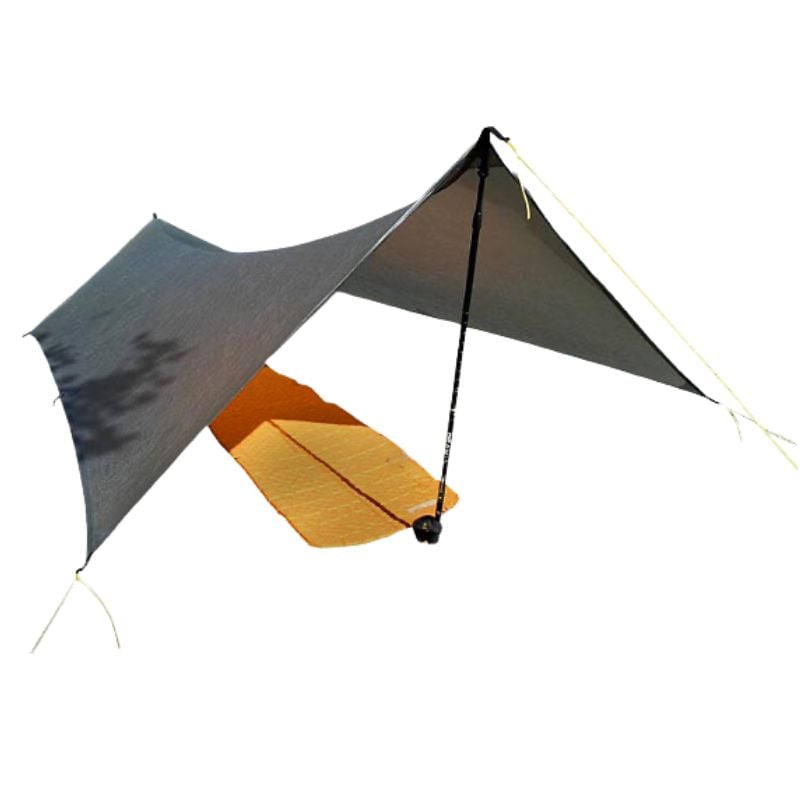
Weight: 5.3 oz / 150 grams
Type: Catenary tarp, tapered
Size: 7′ x 5′ x 9′ or 8.5′ x 7′ x 9.25′
Material: Dyneema .75 oz/sqyd
Pros:
> Ultralight
> Tent pegs and guy lines extra cost and weight
> DCF 0.5 is ultralight, also available in 0.75 and sil-nylon
Cons:
> Not cheap
The MLD Grace Tarp in DCF is the catenary tarp for a long thru-hike. The curved ridgeline and tapered cut give you a nice tight pitch every time, which matters when you are setting up tired and wet.
It suits thru-hikers and ultralight backpackers running a trekking-pole-supported A-frame as a primary shelter. The widened head end gives you room to sit up, which a square flat tarp does not.
The trade-off is the fixed A-frame format. You give up the versatility of a flat tarp in exchange for a faster, tauter, lighter pitch.
Trade-off: best-in-class A-frame pitch versus the versatility of a flat tarp.
Best for: solo thru-hikers who want a UL tarp shelter and will pitch A-frame almost every night.
Compare Prices:
Best Group Shelter Tarp
Zpacks Big Ass Camp Tarp Review
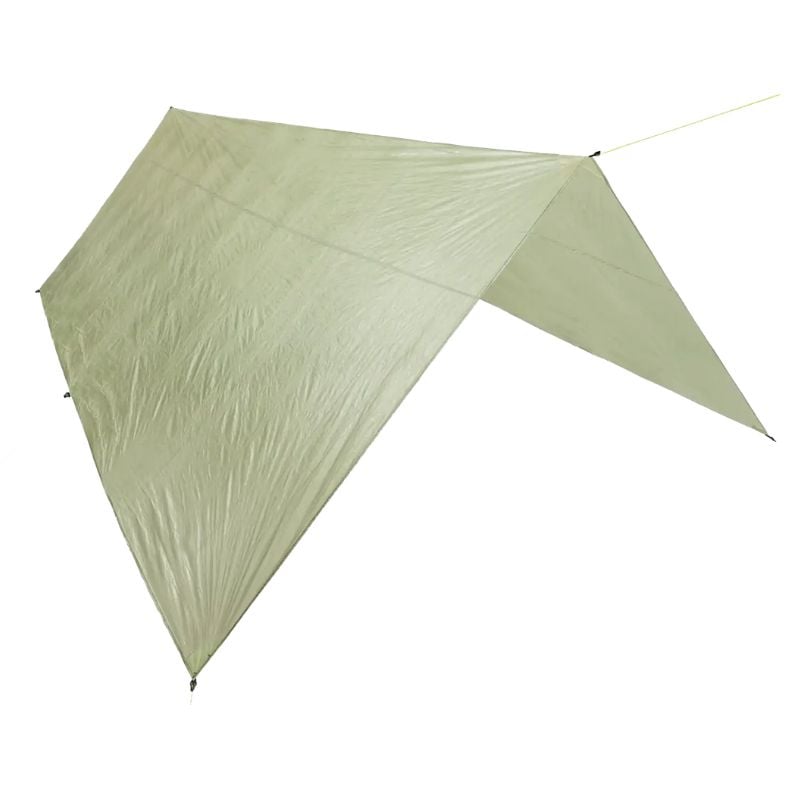
Weight: 9.1 oz / 258 grams
Type: Flat Tarp
Size: 13′ x 10′
Material: DCF .5 oz/sqyd
Pros:
> Made from .55 oz/sqyd Dyneema Composite Fabric
> Large 13′ x 10′ size
> Perfect lightweight group shelter
Cons:
> Not cheap
> Guylines, pegs and stuff sac not included
The Zpacks Big Ass Camp Tarp is the only ultralight DCF group shelter on the market for a small group wanted communal coverage for cooking and hanging out in rain. At 130 ft² and under 11 oz, the area-to-weight ratio is in a class of its own.
It suits guided UL groups, shoulder-season trips with 4 hikers, and anyone splitting weight across a small party.
The trade-off is the price and the fact that with only eight tie-outs there are no mid-panel options to deal with wind on a tarp this large.
Trade-off: best group-shelter weight on the market versus a high price and a need for very good site selection.
Best for: small UL groups wanting a DCF communal shelter.
Compare Prices:
Best Ponch Tarp 2026
Six Moon Designs Gatewood Cape

Weight: 11 oz / 310 grams
Type: Ponch Tarp
Size: 35 square feet of coverage
Material: Silnylon
Pros:
> Features micro buckles that help to connect the harness to the cape
> Full zippered entrance
> Comes with a lifetime warranty
> Works as a Waterproof poncho and waterproof tarp
Cons:
> Not suitable for taller people
The Six Moon Designs Gatewood Cape is one of the few pieces of gear that does two jobs well. It is a rain poncho that covers you and your pack while hiking, and a single-person shelter when you stop for the night. For thru-hikers who weigh every duplicated function in their pack, that is hard to argue with.
It suits solo thru-hikers in moderate climates, fast packers, and anyone running an aggressively ultralight kit. Pair it with the Serenity Ultralight NetTent to provide complete bug protection.
The trade-off is the size. Taller hikers will find it tight as a shelter, and the poncho function works best when you are not also wearing a tall pack.
Trade-off: doubles as rain gear and shelter, but compromises slightly on both compared to dedicated pieces.
Best for: ultralight solo thru-hikers in moderate, lower-bug climates.
Compare Prices:
Zpacks Hexamid Review
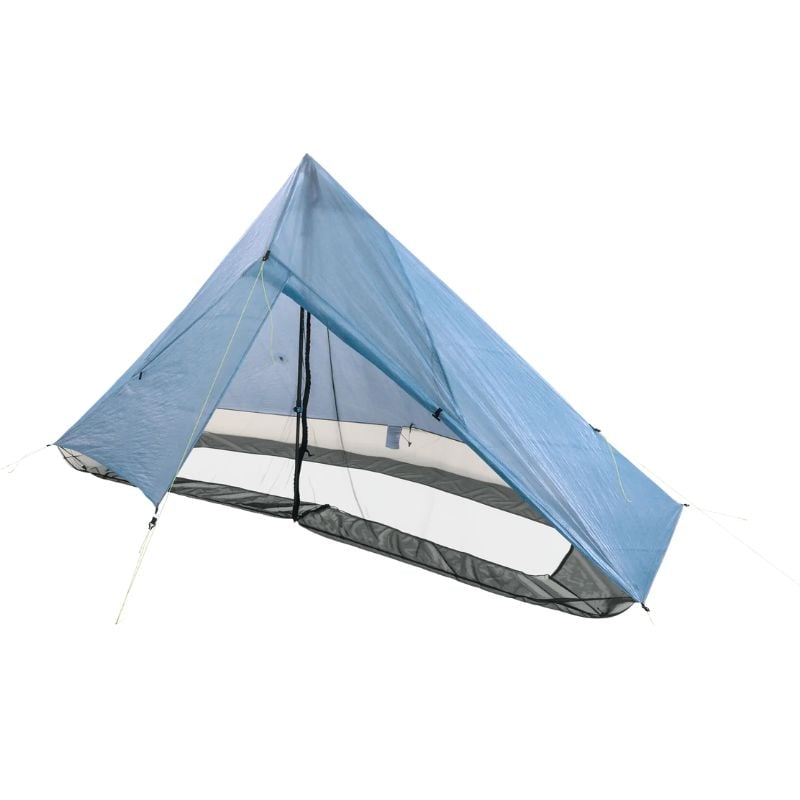
Weight: 9.7 oz / 275 grams
Type: Tarp Tent with bug mesh
Size: 8.3′ x 4′
Material: DCF .51 oz/sqyd
Pros:
> Ultralight and compact design
> .51 oz Dyneema
> Best for buggy areas
Cons:
> Not cheap
The Zpacks Hexamid is the shaped tarp I would carry for a solo bug-season thru-hike when I still want the open feel of a tarp setup. The bug mesh skirt and zippered door give you real insect protection without going to a full tent, and the modular floor adds about 3 oz if you want it.
It suits solo thru-hikers, especially in mosquito-heavy seasons, and anyone who wants a single trekking-pole tarp that pitches faster than a flat tarp.
The trade-off is the 1P footprint and the price. The floor is sold separately.
Trade-off: faster pitching and built-in bug protection versus the configurability of a true flat tarp. Not as good as a fully enclosed ultralight thru hiking tent.
Best for: solo thru-hikers running a UL bug-season setup.
Compare Prices:
Best Hammock Friendly Tarp
Kammok Kuhli Ultralight

Weight: 14 oz / 397 grams
Type: Catenary Tarp
Size: 11′ x 7.3′
Material: Coated ripstop nylon
Pros:
> Includes stakes, guy lines & stuff sac
> Durable
> Reasonably priced
Cons:
> One compromise made between the Kuhli Ultralight and its bigger sibling the Kuhli Shelter is the smaller coverage area
The Kammok Kuhli Ultralight is the tarp I would recommend to someone who switches between backpacking hammock and ground camping and wants one tarp that does both. The 11′ length covers a hammock properly, and on the ground it pitches as a knot-free A-frame with four included stakes.
It suits hybrid use as a Hammock Tarp and ground tarp users, weekend backpackers, and anyone who wants a quick, intuitive setup.
The trade-off is the smaller coverage area than the full Kuhli Shelter, and the catenary cut limits storm-mode pitching options.
Trade-off: a versatile hammock-and-ground tarp at the cost of some storm-mode flexibility.
Best for: hybrid hammock and ground backpackers who want one tarp for both.
Compare Prices:
Best Budget Catenary Tarp
Gossamer Gear Twinn Tarp

Weight: 9.7 oz / 275 grams
Type: Catenary Tarp
Size: 8.6′ x 7′
Pros:
> Lightweight
> Made with compact 10D Nylon
> Good price
Cons:
> Not much, need your own stakes and poles
The Gossamer Gear Twinn Tarp is the catenary tarp I would buy if I wanted to try cat-tarp camping without spending DCF money. At around $130 and sub-10 oz, it is the cheapest serious catenary cut on the market and the easiest entry point into ultralight tarp camping.
It suits thru-hikers on a budget, weekend backpackers, and anyone testing the cat-tarp format before committing to a DCF Grace Tarp.
The trade-off is the A-frame-only pitch and the lack of mid-panel tie-outs.
Trade-off: limited to A-frame pitching but at a price that lets you experiment without regret.
Best for: budget-conscious thru-hikers and anyone trying a catenary tarp for the first time.
Compare Prices:
Ultralight Backpacking Tarp Buyers Guide
Ultralight Backpacking Tarp Buyers Guide
Dyneema vs Silnylon vs Silpoly
Dyneema Composite Fabric is the lightest, strongest, and most expensive tarp material. It does not absorb water, does not sag when wet, and is almost always factory seam-sealed. The downsides are price and pack bulk. Silnylon and silpoly are nylon and polyester treated with silicone. Silpoly stretches less than silnylon, sags less in rain, and resists UV better. Silnylon is slightly stretchier, which helps achieve a taut pitch but means you may need to re-tension overnight in rain. For a thru-hike, I prefer DCF if the budget allows and silpoly as the next-best option. Silnylon is fine for weekenders.
Size – 1P, 2P, Group
For most solo backpackers, a 10′ x 8.5′ flat tarp is the sweet spot. It is large enough to sleep two, shelter a communal cook on a group trip, and pitch in low storm mode without leaving your feet exposed. A 1P tarp at 7′ x 9′ will save you a couple of ounces but compromises versatility. For a catenary tarp, size up to the 2P version. The weight penalty is minimal and the extra headroom matters every night you are in it.
Flat Tarp vs Catenary Cut
A flat tarp is a square, rectangle, or hexagon of fabric with 90-degree corners that can be pitched in almost any configuration. A catenary cut tarp has curved ridgelines and edges that pull the fabric tight in an A-frame and shave a few ounces of fabric. The trade-off is simple. A flat tarp gives you maximum configurability, including low storm-mode pitches in wind. A catenary tarp gives you a faster, tauter, lighter A-frame pitch but locks you into that one configuration. If you can only own one ultralight tarp, I would choose a flat tarp.
Tie-Out Points and Setup
More tie-out points means more pitching options and more reinforcement in wind. Look for at least eight on a catenary tarp and ideally 12 or more on a flat tarp. Mid-panel tie-outs let you tension the centre of the tarp in wind so it does not balloon. Reinforced corners and centre points matter more than total count.
Packed Size
There are generally a couple of reasons that you might consider using tarp shelters. One of the main reasons is the smaller pack size than a tent. All the ultralight tarps in this review pack up to a small storage size.
Bivy Sacks, Ground Cloths, and Stakes
A tarp is not a complete shelter system on its own. You need a bivy sack or bug bivy for insect protection and splashback, a ground cloth so you can spread gear out around your sleeping pad, and good stakes. I run a polycryo ground sheet, an ultralight bivy or bug bivy in mosquito season, and Y-stakes for tension. Cheap shepherd stakes will not hold a serious tarp pitch in wind.
When Not to Choose a Tarp
A tarp is not the right shelter for heavy bug season unless you carry a bug bivy or net tent, for very cold and windy nights where wind penetration will dampen your quilt, for very damp shoulder-season conditions where moist air blowing under the perimeter will soak your insulation, or for snow loading that exceeds the tension your guy-outs can carry. In those scenarios I carry a UL trekking-pole tent instead.
Budget
Lastly, always consider your budget.
As you can see from the recommendations in this article, there are options available at varying price points which means that whether you have the money to spend or are working with a stricter budget, you’ll be able to find an option that is perfect for you that doesn’t break the bank.
Conclusion
The Best Ultralight Backpacking Tarps for 2026 are:
- Best overall: Hyperlite Mountain Gear Flat Tarp
- Best ultralight DCF: Zpacks 7′ x 9′ Flat Tarp
- Best catenary cut: Mountain Laurel Designs Grace Tarp
- Best group shelter: Zpacks Big Ass Camp Tarp
- Best poncho-tarp hybrid: Six Moon Designs Gatewood Cape
- Best 1P shaped tarp: Zpacks Hexamid
- Best hammock-friendly tarp: Kammok Kuhli Ultralight
- Best catenary value: Gossamer Gear Twinn Tarp
Follow along on Social Media
Frequently Asked Questions
What is the best ultralight backpacking tarp?
For most thru-hikers and ultralight backpackers, the Hyperlite Mountain Gear Flat Tarp is the best overall choice — full-size DCF, 21 tie-outs, and a flat-edged cut that pitches in any configuration. If grams matter more than budget, the Zpacks Flat Tarp is the lightest serious option.
Flat tarp or catenary tarp — which should I buy first?
Buy a flat tarp first. A flat tarp can do everything a catenary tarp can do plus low storm-mode pitches, wind walls, and lean-tos. A catenary tarp gives a faster A-frame pitch but locks you into one configuration. Most experienced tarp users own both eventually; start with the flat.
Is Dyneema (DCF) worth the price for a tarp?
For thru-hiking and serious ultralight kits, yes. DCF does not absorb water, does not sag when wet, packs small, and lasts. The price stings up front but a well-cared-for DCF tarp will outlive several silnylon tarps. For weekend use, a silpoly tarp at half the price is a perfectly reasonable choice.
What size tarp do I need for a thru-hike?
For solo and pair use, 10′ x 8.5′ flat tarps are the sweet spot. They cover one or two hikers with margin for gear, work as group cook shelters in rain, and pitch in storm mode without leaving feet exposed. 7′ x 9′ tarps save weight but reduce versatility.
Do I need a bivy sack with my tarp?
For bug season and very cold or windy nights, yes. A bivy sack solves the three failure modes of a tarp: bug exposure, wet ground, and wind penetration. For dry, mild, low-bug conditions, a polycryo ground sheet alone is enough.
Are silpoly tarps better than silnylon?
Silpoly stretches less than silnylon, sags less in rain, resists UV better, and dries faster. The downside is a slightly less taut feel at pitch. For modern ultralight tarp design, silpoly is generally the better choice over silnylon at the same weight class.
How do I pitch a tarp in rain and wind?
Pitch low to the ground in a storm-mode A-frame with the windward edge pegged tight to the dirt. Use good Y-stakes, not gram-saving shepherd stakes. Add mid-panel tie-outs in heavy gusts so the fabric does not balloon. Site selection matters as much as pitch — find natural windbreaks and avoid open ridgelines if you can.


BikeHikeSafari Gear Review Process
The author, Brad McCartney from BikeHikeSafari is a small independent adventurer and outdoor gear tester who owns and runs BikeHikeSafari.com.
BikeHikeSafari is not part of a large blog network and is proudly independent. All reviews on this site are independent and honest gear reviews of outdoor products by the author.
The author, Brad McCartney is a very experienced triple crown thru-hiker, adventurer, and bike tourer having spent 1000s of nights sleeping in a tent and sleeping bag (Read more). He was a manager of an outdoor retail store and is very experienced in what is important when using and testing gear for reviews like this.
BikeHikeSafari will never receive any money for reviews and they do not accept sponsored reviews on this website. All the comments about the gear reviews are from the author based on his years of experience. Hope this independent review was helpful for you.

